
The Skill Being Assessed
Every major infrastructure project, from a new bridge to a power grid upgrade, affects a wide range of people and organizations. The success of these projects often depends not just on technical execution, but on effectively managing the complex web of relationships with these stakeholders. The ability to identify who has a stake in your project, understand their motivations and influence, and engage with them strategically is a critical competency in physical and infrastructure asset management.
This assessment places you in the role of an asset management professional tasked with laying the groundwork for a successful project. You will apply a structured approach to stakeholder analysis and develop a foundational plan to guide the project's communication and engagement efforts. This skill ensures that projects not only meet technical specifications but also gain the social license and support needed to succeed.
Your Task
You are a Junior Asset Manager for the City of Veridia's Department of Public Works. The city is planning a major infrastructure project: the replacement of the aging Westwood Bridge, a key commuter artery. This project is vital for public safety and traffic flow but will cause significant disruption during its two-year construction phase. Your director has asked you to prepare an initial Stakeholder Analysis and Engagement Plan to ensure the project proceeds smoothly.
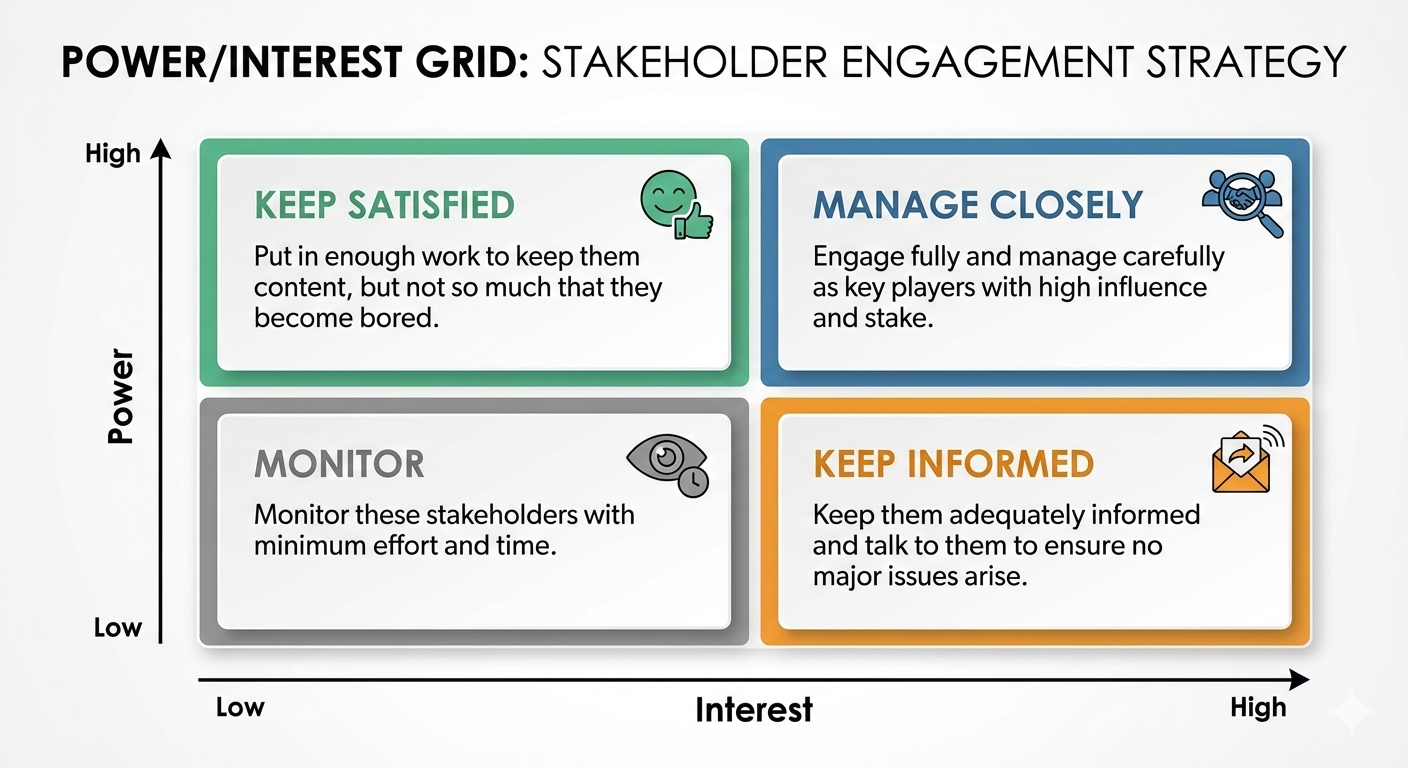
Your task is to create a report that includes the following three components: 1. Stakeholder Register: Identify all potential stakeholders from the provided resources and your own analysis. Categorize them into logical groups (e.g., Internal, External, Regulatory). 2. Stakeholder Analysis Matrix: For each stakeholder or group, analyze their level of interest in the project and their level of influence or power over its success. Place them within the four quadrants of the Power/Interest Grid and provide a brief justification for your analysis and their potential impact (positive or negative) on the project. 3. Engagement & Communication Plan: Based on your analysis, outline a basic engagement plan. For each of the four Power/Interest quadrants, define a clear engagement objective (e.g., "Ensure their concerns are addressed to prevent opposition") and list at least two specific communication tactics you would use for the stakeholders in that quadrant (e.g., "Monthly project update emails," "One-on-one briefings," "Public town hall meetings").
Resources and Data
Use the following documents and data to complete your analysis. These resources provide the initial context for the project and a starting point for your stakeholder identification.
Project Brief: Westwood Bridge Replacement This internal memo from the Director of Public Works officially kicks off the project and outlines its primary goals and challenges.
Key Document: Project Brief: Westwood Bridge Replacement
Preliminary List of Involved Parties This is a starting list of individuals and groups compiled by an administrative assistant. It is not exhaustive, and you will need to expand on it.
Preliminary List of Involved Parties
| Entity/Group | Initial Notes |
|---|---|
| Westwood City Mayor's Office | Primary political sponsor. Concerned with project timeline, budget, and public perception. Final approval authority. |
| Westwood City Department of Transportation | Project owner and lead agency. Responsible for technical oversight, traffic management during construction, and long-term maintenance. |
| Westwood River Keepers | Environmental advocacy group focused on the ecological impact on the Westwood River. Concerned with water quality, habitat disruption, and sustainable construction practices. |
| Downtown Westwood Business Association | Represents businesses impacted by construction detours and access changes. Interested in minimizing economic disruption and improving post-project commercial access. |
| Bridgeview Neighborhood Association | Represents residents in the immediate vicinity of the bridge. Concerns include construction noise, traffic detours through residential streets, property values, and post-project pedestrian/cyclist access. |
| State Department of Transportation (State DOT) | Key funding partner and regulatory body. Provides state-level grants and ensures compliance with federal and state highway standards for any connecting state routes. |
| Apex Engineering & Infrastructure | A potential lead engineering firm bidding for the project contract. Interested in the design specifications, procurement process, and technical requirements. |
| Westwood Transit Authority (WTA) | Operates public bus routes that utilize the bridge. Needs to coordinate route diversions during construction and has an interest in incorporating new bus lanes or transit-friendly features. |
Stakeholder Analysis Tool: The Power/Interest Grid This is a standard tool for categorizing stakeholders to help prioritize engagement efforts. Use it to structure your analysis matrix.
Submit Your Work
Insert DropBox here
Next Steps
Excellent work applying your analytical skills to this real-world scenario. Developing a robust stakeholder strategy is a foundational step in successful asset management.
When you are ready, please navigate back to the course to continue your learning journey.