Introduction
Have you ever been in a public meeting where residents are demanding better services—smoother roads, more reliable power, cleaner parks—while the finance director is presenting a budget with no room for new spending? It’s a classic scenario, and it highlights a central challenge in asset management. How do you bridge the gap between what people want and what an organization can realistically deliver?
This is where the discipline of translating stakeholder expectations into defined Levels of Service comes in. It’s a foundational process in modern physical and infrastructure asset management. It moves us away from reactive, complaint-driven work and toward a proactive, strategic approach. This isn't about just managing assets; it's about managing the outcomes those assets deliver. In this reading, we will explore the systematic process of listening to stakeholders, defining what "good" looks like in measurable terms, and using that framework to guide every decision you make as an asset manager.
The Problem with Vague Expectations
For decades, many organizations that manage public infrastructure operated on an implicit understanding of service. The lights should stay on, water should be clean, and roads should be drivable. But what does "drivable" actually mean? To a commuter in a sedan, it might mean no potholes. To a logistics company, it might mean a road surface that doesn't cause excessive wear on their truck tires. Without a clear, shared definition, you are constantly aiming at a moving target. This ambiguity leads to inefficient resource allocation, stakeholder frustration, and an inability to justify budgets effectively.
This is why formalizing expectations is so critical. The process begins by defining Levels of Service (LoS). These are the commitments an organization makes to its customers and stakeholders. They are the direct link between the strategic goals of the organization and the day-to-day operations of the asset management team.
LoS as a Promise
Think of Levels of Service as a promise to your stakeholders. It's a public declaration of the value you intend to provide. This promise creates accountability and builds trust, but it also requires a robust framework to ensure you can measure, manage, and report on your ability to keep it.
From Abstract Goals to Concrete Metrics
A Level of Service like "provide safe and reliable bridges" is a great starting point, but it's not actionable on its own. How do you measure "safe" or "reliable"? To make LoS meaningful, you must connect them to specific, measurable Performance Metrics.
This is the translation step. You take the qualitative desire and break it down into quantitative indicators.
Let's look at our "safe and reliable bridges" example. This single LoS could be supported by several performance metrics:
- Safety:
- Structural Integrity Rating (e.g., Bridge Condition Index score above 80).
- Number of high-priority maintenance work orders outstanding (target: < 5).
- Reliability/Availability:
- Percentage of time the bridge is fully open to traffic (target: 99.8%).
- Number of unplanned load-limit restrictions per year (target: 0).
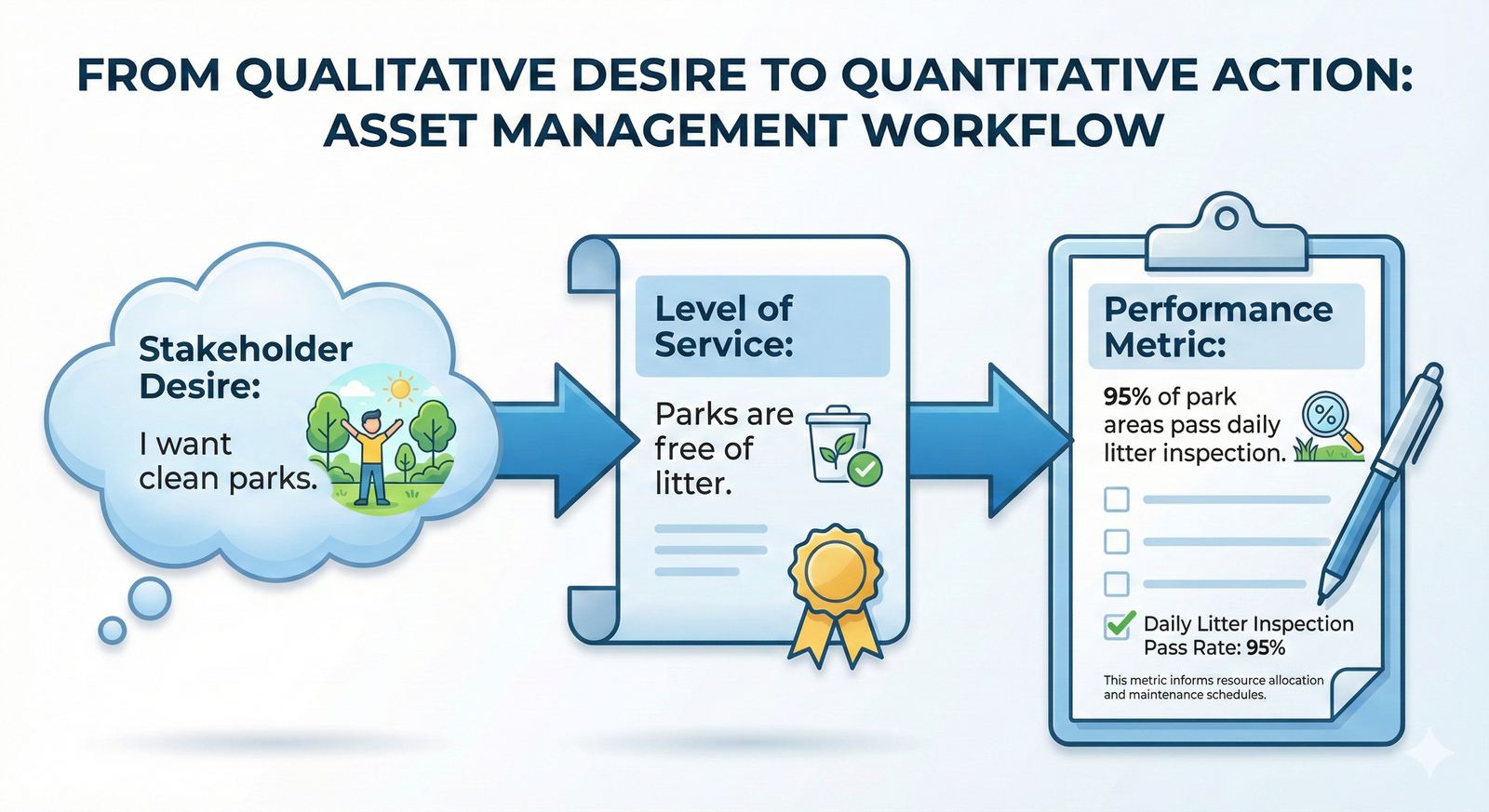
This data-driven approach transforms the conversation. Instead of debating feelings, you are discussing facts. It allows you to say, "To maintain a Bridge Condition Index of 80, we need a capital renewal budget of $1.2 million over the next three years. If the budget is cut to $800,000, the projected index will fall to 75, which increases the risk of unplanned closures."
The Art of Listening: Effective Stakeholder Consultation
You cannot define what stakeholders value without asking them. This is where Stakeholder Consultation becomes a cornerstone of the entire process. Stakeholders are not a uniform group; they include:
- Customers/Users: The public, residents, commercial users.
- Owners: The governing body, shareholders, taxpayers.
- Regulators: Environmental agencies, safety authorities.
- Internal Staff: Operations, maintenance, and finance departments.
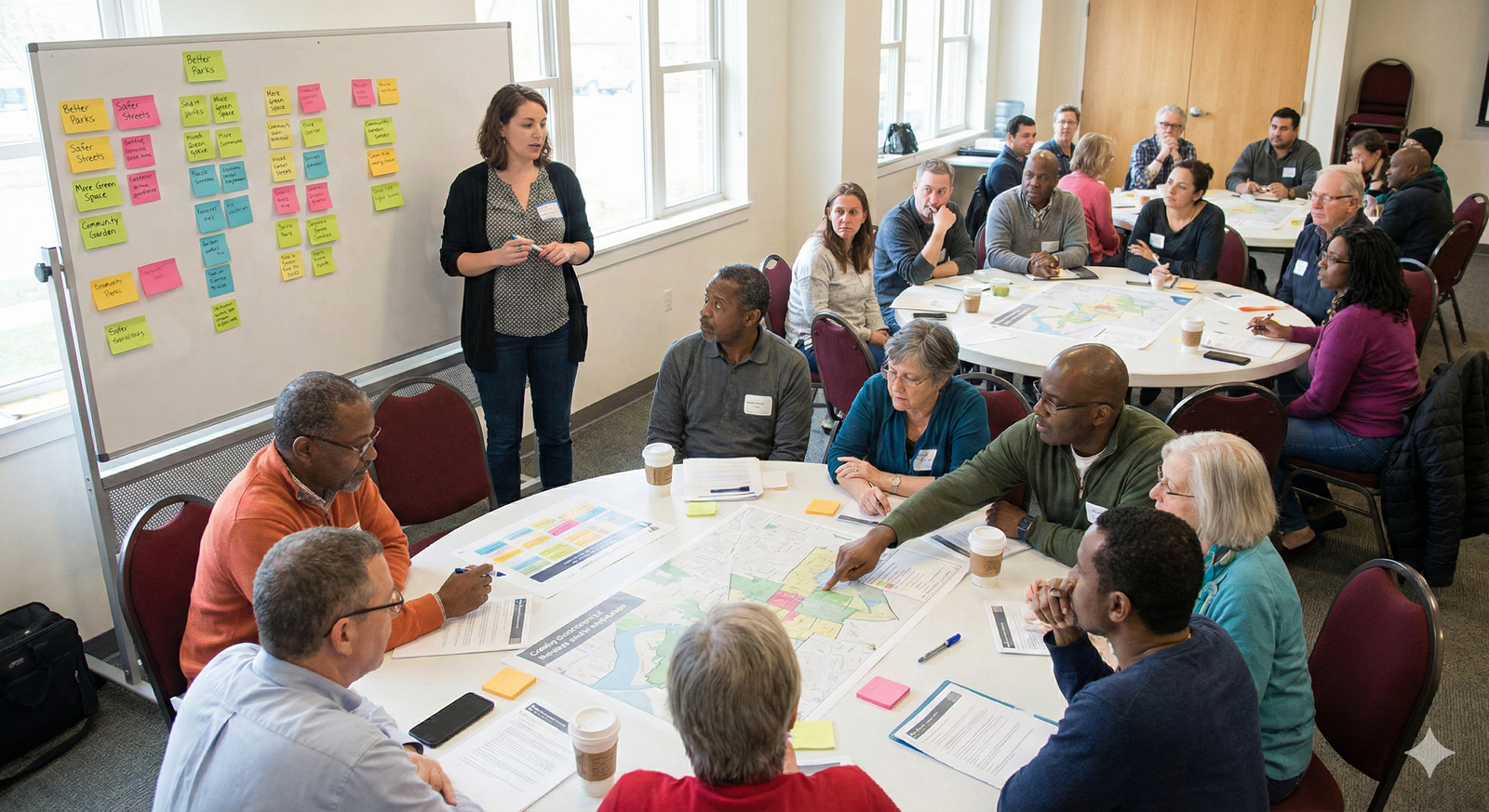
Each group has different priorities, and a robust consultation process seeks to understand and balance these often-competing interests. This isn't just about holding a single town hall meeting. It's a multi-faceted effort that can include surveys, focus groups, workshops, and analyzing customer complaint data.
📊 View Diagram: Stakeholder Consultation to LoS Definition Process
The key is to frame the conversation around trade-offs. It's easy for someone to say they want perfectly smooth roads everywhere. The conversation changes when you ask, "Would you prefer we resurface 10km of residential streets to a 'good' standard or 5km of main arterial roads to an 'excellent' standard for the same budget?" This forces a discussion about priorities and affordability, which is essential for setting realistic LoS.
Making it Official: The Power of Service Level Agreements
Once LoS and their corresponding metrics are agreed upon, they need to be formally documented. This is often done through a Service Level Agreement (SLA). While the term SLA is common in IT, its principles are perfectly suited for physical asset management. It serves as the formal "contract" that holds the organization accountable.
An SLA for a municipal water service, for example, would not just say "provide clean water." It would specify: * Service: Potable Water Supply * Level of Service Statement: Water will be safe to drink and aesthetically pleasing, with minimal service interruptions. * Performance Metrics & Targets: * Compliance with all national drinking water quality standards: 100% * Average duration of unplanned water outages: < 4 hours * Customer satisfaction rating for water taste and odor: > 90% * Reporting: Performance against these targets will be reported to the public quarterly on the city's website.
This document is not meant to be filed away and forgotten. It is a living management tool. It's the basis for your operational plans, your maintenance budgets, your capital investment strategies, and, most importantly, your communication with stakeholders. When you present your annual budget, you are no longer just asking for money; you are asking for the resources needed to deliver on the promises made in the SLA.
The Future: Dynamic LoS and Digital Twins
The field is not standing still. Historically, LoS were reviewed every few years. Today, technology is enabling a more dynamic approach. Smart sensors on bridges can provide real-time structural health data, allowing for a much more nuanced understanding of performance against safety targets. Advanced metering for utilities can pinpoint the exact location and duration of outages, feeding directly into reliability metrics.
Looking ahead, the integration of LoS with digital twins will be transformative. A digital twin is a virtual model of a physical asset or system. With it, you can simulate future scenarios. * "What happens to our road network's average Pavement Condition Index over the next 10 years if we only invest 75% of the recommended budget?" * "If a major storm hits, which parts of our electrical grid are most likely to fail, and how would that impact our service reliability LoS for different customer groups?"
This allows you to have proactive, evidence-based conversations with stakeholders about risk, investment, and future service levels before a crisis ever occurs. It moves asset management from a historical reporting function to a predictive, strategic one.
Closing
We've journeyed from the chaotic world of vague demands to the structured framework of professional asset management. The process of defining Levels of Service is the very heart of this transformation. It is a deliberate methodology for listening to stakeholders, understanding what they truly value, and translating those desires into measurable, actionable commitments.
By establishing clear LoS, defining the performance metrics that track them, and formalizing them in agreements, you create a powerful cycle of accountability and continuous improvement. This framework allows you to justify budgets, prioritize work, and communicate performance with clarity and confidence. It changes your role from a simple custodian of physical assets to a strategic manager of essential services, building trust and delivering demonstrable value to the communities and organizations you serve.
Learning Outcomes
In this reading, you have explored the critical link between stakeholder needs and asset management strategy. You can now: * Explain how systematic stakeholder engagement and consultation are used to gather the priorities and expectations that form the basis for meaningful Levels of Service. * Describe how well-defined Levels of Service, supported by specific performance metrics and formalized in Service Level Agreements, are used to guide operational decisions, justify budgets, and report on asset performance to all stakeholders.
You have also been introduced to the core vocabulary of service-level planning, including Levels of Service (LoS), Performance Metrics, Stakeholder Consultation, and Service Level Agreements (SLA).
Assess Yourself
Check your understanding of the key concepts from this reading.
❓ Knowledge Check
Test your understanding of the key concepts from this section.
Next Steps
Excellent work. You have just covered one of the most fundamental strategic processes in modern asset management. When you are ready, please navigate back to the course to continue your learning journey.
