
Introduction
If you've been in this field for any length of time, you've seen it: the asset management policy that’s treated more like a dusty artifact than a guiding document. It gets written, approved, and then filed away, only to be pulled out for an audit. But what if your policy could be more? What if it could be the central pillar that aligns your entire organization, from the boardroom to the boiler room, toward a common goal of creating and sustaining value from your assets?
A truly effective asset management policy is not boilerplate text. It is a carefully crafted declaration of intent, a commitment that translates high-level business objectives into tangible asset-related decisions. It answers the fundamental question: "How will we manage our physical assets to achieve our organization's strategic goals?" This article will guide you through the process of moving beyond a check-the-box document to create a living policy that provides clarity, drives performance, and builds a strong foundation for your entire asset management system.
From the Top Down: Linking Strategy to Policy
The single biggest mistake an organization can make is to develop its asset management policy in a vacuum. Without a clear connection to the overarching business strategy, your policy will lack purpose and authority. It becomes a list of well-intentioned but disconnected statements. To build a policy with teeth, you must first look up to the organization's highest-level ambitions.
This starts with the Organizational Strategic Plan. Think of this as the destination you've plugged into your GPS. It tells you where you're going. The Asset Management Policy, then, is your choice of transportation and the rules of the road you'll follow to get there. It defines how you will use and manage your assets to reach that destination.
📊 View Diagram: The Hierarchy of Strategic Alignment
This clear "line of sight" is critical. A maintenance technician replacing a pump bearing isn't just fixing a piece of equipment; they are executing a tactic that supports a maintenance plan, which in turn delivers the reliability required by the asset management policy to ultimately help the company achieve its strategic objective of, for example, being the most reliable provider in the market. When everyone in the organization can see this connection, their work has context and purpose.
Establishing a Clear Line of Sight
A powerful asset management policy enables any employee, from a senior executive to a frontline operator, to trace a direct line from their daily tasks to the organization's highest strategic goals. This alignment ensures that decisions at all levels are consistent and contribute to the overall mission. If you can't explain how a specific asset management activity supports the strategic plan, you should question why you're doing it.
Building the Foundation: Who Gets a Say?
A policy written by one person or a single department is destined to fail. It won't have the buy-in necessary for successful implementation, and it will inevitably miss critical perspectives. Asset management is a team sport, involving nearly every part of the organization. Your policy development process must reflect this reality.
The first step is to identify your stakeholders and understand their needs. These are the groups and individuals who are affected by, or can affect, your asset management decisions. This goes far beyond just the engineering and maintenance teams.
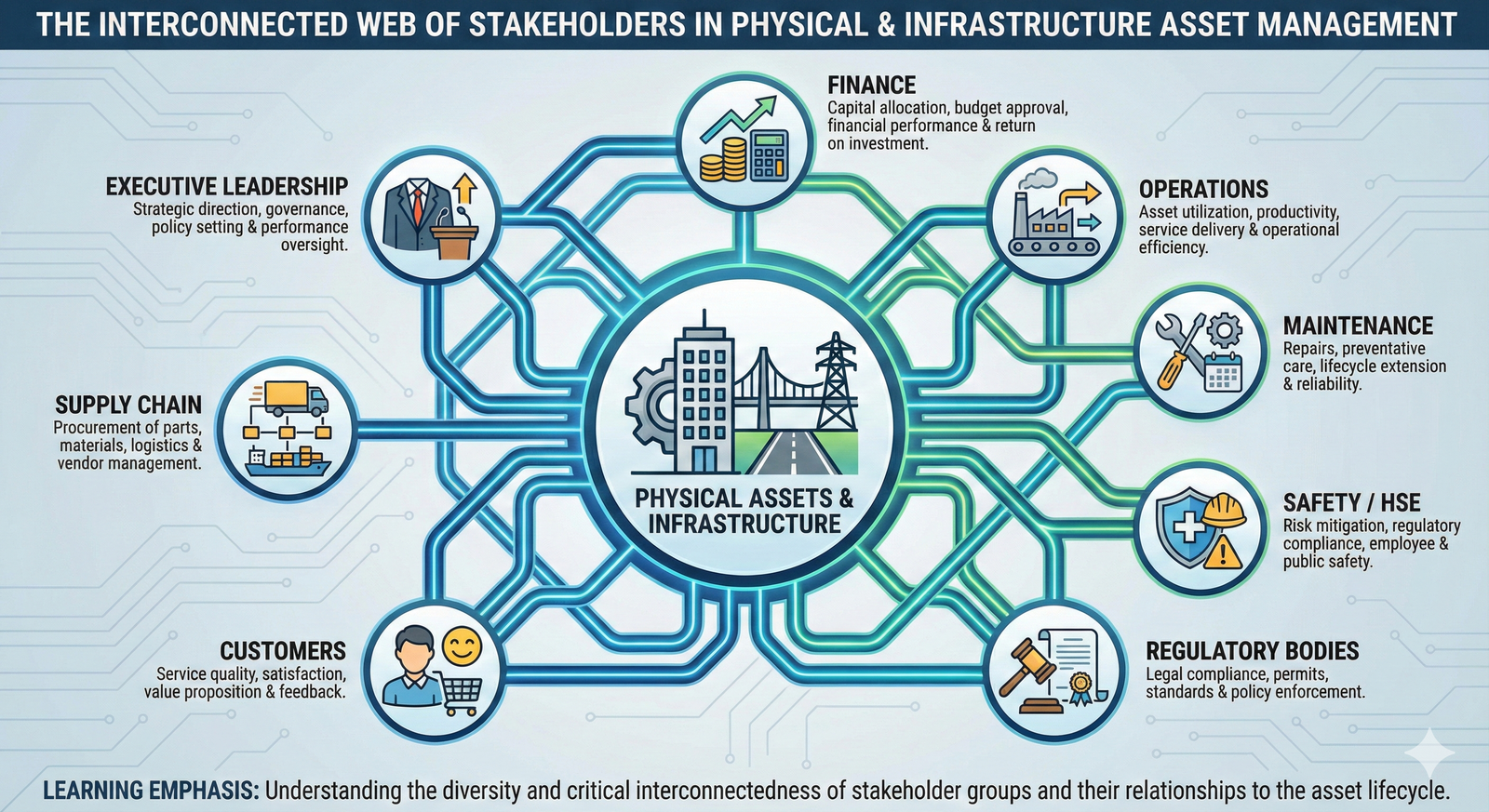
Once you know who your stakeholders are, you must systematically gather their Stakeholder Requirements. Effective methods for this include: * Workshops: Facilitated sessions are excellent for brainstorming and identifying shared goals and points of conflict between different departments. * Interviews: One-on-one conversations with key leaders (like the CFO, COO, or Head of Safety) can provide deep insights into their specific pressures and objectives. * Surveys: Useful for gathering input from larger groups of people, like operators or technicians. * Document Review: Analyzing the strategic plan, financial reports, risk registers, and regulatory permits will reveal many implicit and explicit requirements.
You will inevitably encounter conflicting requirements. Finance may want to minimize capital spending, while Operations needs new equipment to meet production targets. This is not a problem; it is the central challenge of asset management. Your role is to make these trade-offs visible and facilitate a decision-making process based on risk and value.
Mentor's Corner: Navigating Conflicting Requirements
Don't try to solve every conflict yourself. Your job is to facilitate a transparent discussion. Use a simple matrix to map out the requirements, who they came from, and the implications of meeting or not meeting them. Frame the conversation around the organization's strategic objectives. Ask the group: 'Given our strategic goal to increase market share, which of these requirements—extending asset life or minimizing short-term cost—presents the greater risk to that goal?' This elevates the decision from a departmental dispute to a strategic choice.
The Anatomy of a Powerful Policy
With your strategic direction set and stakeholder requirements gathered, you are ready to draft the document itself. While the exact format can vary, a comprehensive asset management Policy should contain several key components.
1. Purpose and Scope: This section provides a clear, concise statement of why the policy exists and what it covers. The purpose might be "to direct how [Our Organization] manages its physical assets to achieve its strategic objectives in a sustainable and value-driven manner." The scope should clearly define the asset types, facilities, and business units covered by the policy. Be explicit about what is not covered (e.g., IT software, financial assets).
2. Principles and Commitments: This is the heart of the policy. It's a series of high-level "we will" statements that articulate the organization's core asset management values. These are not detailed instructions; they are guiding principles. Examples include: * "We will make asset management decisions based on a balanced consideration of performance, cost, and risk over the entire asset lifecycle." * "We will comply with all applicable legal and regulatory requirements." * "We will ensure the safety of our employees and the public in all asset-related activities." * "We will foster a culture of continuous improvement in our asset management practices."
3. Roles, Responsibilities, and Authorities: A policy without clear accountability is just words on a page. This section must define the Governance structure for asset management. It should answer: * Who is ultimately accountable for asset management performance (e.g., a specific C-suite executive)? * Who is responsible for developing and maintaining the asset management strategy and plans (e.g., an Asset Manager or a steering committee)? * What are the asset management responsibilities of other key roles (e.g., finance, operations, project managers)?

4. Linkages to Other Documents: The policy does not exist in isolation. It is the parent document for other critical components of the asset management system. This section should explicitly reference its relationship to: * The Strategic Asset Management Plan (SAMP): The SAMP details how the policy's principles will be put into action and the objectives achieved. * Asset Management Plans (AMPs): Tactical plans for specific asset classes or systems. * Other key corporate processes like capital planning, risk management, and maintenance management.
5. Review and Improvement: A policy must be a living document. Markets change, technology evolves, and strategic goals shift. This section should mandate a periodic review of the policy (e.g., annually or every two years) to ensure it remains relevant and effective. It should specify who is responsible for initiating and leading this review process. This commitment to review is what saves the policy from the dusty shelf.
Closing
Crafting a robust asset management policy is a strategic act. It's an investment of time and collaborative effort that pays dividends in clarity, alignment, and value. By directly linking your policy to the organization's strategic plan, you give it purpose and authority. By systematically engaging your stakeholders, you build the consensus and buy-in essential for success. And by structuring the document with all the key components—from principles to governance—you create a practical tool, not a theoretical treatise.
The result is a policy that moves beyond the boilerplate. It becomes the definitive guide for making risk-based, value-focused decisions about your physical assets. It empowers your teams, clarifies accountability, and sets a clear course for your entire asset management system. This is the foundation upon which a culture of excellence in asset management is built.
Learning Outcomes
In this reading, you have explored the critical elements of creating a value-driven asset management policy. You are now equipped to:
- Analyze the relationship between an organization's strategic plan and its asset management policy, ensuring that asset-related decisions directly support top-level business goals.
- Identify methods for gathering and integrating stakeholder requirements, building a policy that reflects the needs of the entire organization.
- Describe the key components of a comprehensive asset management policy document, understanding the anatomy of a policy that is clear, actionable, and complete.
You have also become familiar with the foundational concepts of an Asset Management Policy, the Organizational Strategic Plan, Stakeholder Requirements, and the principles of Governance that hold the system together.
Assess Yourself
❓ Knowledge Check
Test your understanding of the key concepts from this section.
Next Steps
Well done on completing this reading. You have taken a significant step in understanding how to build the strategic foundation for any successful asset management program.
Please navigate back to the course page to continue to the next activity.
