
Introduction
If you've ever been in a meeting where a senior leader declares a bold new vision—like "We will become the most resilient city in the region"—you know there's a moment of silence that follows. It's the moment when the operational teams, the engineers, the planners, and the maintenance crews all think the same thing: "That's great. But what do you want me to do on Monday morning?"
This is one of the most common and critical challenges in our profession. How do we bridge the vast gap between a high-level policy statement and the tangible, daily actions required to make it a reality? A vision without a plan is just a good intention. In asset management, good intentions don't keep the lights on, the water flowing, or the bridges standing.
This is where the disciplined process of creating Strategic Asset Management Objectives (SAMOs) and Key Performance Indicators (KPIs) comes in. It’s the framework that translates abstract goals into a concrete roadmap for your assets. It’s how you ensure that every decision, from a capital investment to a maintenance schedule, is pulling in the same direction, moving your organization from its current state to its desired future. This reading will guide you through that process, showing you how to build the connective tissue between your organization's strategy and its real-world outcomes.
The Foundation: Your Asset Management Strategy
Before you can set objectives or measure performance, you need a North Star. In our world, that's the Asset Management Strategy. Think of it as the documented rationale for your entire asset management program. It answers the fundamental question: "How will we use our assets to achieve the overall goals of our organization?"
This isn't just a document that sits on a shelf. It’s a live guide, informed by your organization's mission, financial constraints, risk appetite, and stakeholder expectations. A municipal water authority's strategy might focus on public health and regulatory compliance, while a private manufacturing plant's strategy might prioritize production uptime and cost efficiency. The strategy provides the "why" behind every decision you make.
From Broad Strokes to Specific Goals: Translating Policy into SAMOs
With a clear strategy in place, the next step is to break it down into something more concrete. This is where we develop Strategic Asset Management Objectives (SAMOs). A SAMO is a direct response to a strategic goal, but it's framed in the language of asset management.
Let's take that vague policy statement from our introduction: "We will become the most resilient city in the region." What could that mean for the public works department?
- It could mean minimizing service disruptions from extreme weather.
- It could mean ensuring critical infrastructure can recover quickly after an earthquake.
- It could mean reducing the financial impact of asset failures.
The process of creating a SAMO is about making these implications specific and measurable. To do this effectively, we use a time-tested framework.
The SMART Framework for Objectives
To ensure your SAMOs are clear and actionable, they should be SMART:
- Specific: Clearly state what you want to achieve. (e.g., 'Reduce failures' instead of 'Improve reliability').
- Measurable: Define how you will quantify success. (e.g., 'Reduce failures by 15%').
- Achievable: Is the objective realistic given your resources and constraints?
- Relevant: Does this objective directly support the broader asset management strategy and organizational goals?
- Time-bound: Set a clear deadline for achieving the objective. (e.g., '...within the next 5 years').
Applying the SMART framework, we can translate "become more resilient" into a powerful SAMO:
"Reduce the number of critical asset failures during extreme weather events by 30% over the next five years, with a focus on the primary power grid and water pumping stations."
Notice the difference. This statement is no longer a vague aspiration. It's a clear, measurable, and time-bound Objective that a team can build a plan around. It gives them a defined Target (a 30% reduction) and a deadline (five years). This is the first crucial step in connecting Strategy to execution.
Measuring What Matters: An Introduction to Performance Measurement
Once you have your SAMOs, the next question is: "How will we know if we are on track?" This brings us to the world of Performance Measurement and its most famous tool, the Key Performance Indicators (KPIs).
KPIs are not just numbers; they are signals. They tell you whether your actions are producing the desired results. A well-chosen set of KPIs provides a clear, concise picture of your performance against your SAMOs. The challenge is to measure what truly matters, not just what is easy to count.
A common mistake is to drown the organization in metrics. You might be able to measure hundreds of things, but only a few are "key" to your success. The art is in selecting the vital few that give you the most insight with the least noise.
Looking Back or Looking Ahead? The Crucial Difference Between Lagging and Leading KPIs
This is perhaps the most important distinction to grasp when developing your measurement framework. Not all KPIs are created equal. They serve two very different, but equally important, functions.
📊 View Diagram: The Relationship Between Leading and Lagging KPIs
Lagging Indicators: The Rear-View Mirror
A lagging indicator measures past performance. It tells you the final score, the outcome of your efforts. They are "lagging" because they report on results after the fact.
For our SAMO of reducing asset failures, a classic lagging KPI would be: * KPI: Number of critical asset failures per year.
Other examples include: * Total maintenance cost for the previous quarter. * Number of workplace safety incidents last year. * Average customer satisfaction score.
Lagging indicators are essential. They tell you if you actually achieved your objective. They are what you report to executives and stakeholders. However, they have a major limitation: you can't change them. By the time you measure a lagging indicator, the performance period is over. They tell you that you have a problem, but they don't tell you why, or what to do about it.
Leading Indicators: The Windshield
A leading indicator measures the activities and inputs that are expected to drive future results. They are predictive and give you a glimpse of where you are heading. They are your early warning system, allowing you to make course corrections before it's too late.
For the same SAMO, what activities would lead to fewer failures? * KPI: Percentage of critical assets with a completed preventive maintenance plan. * KPI: Percentage of high-risk components replaced on schedule. * KPI: Number of hours spent on predictive maintenance analysis (like vibration analysis or thermography).
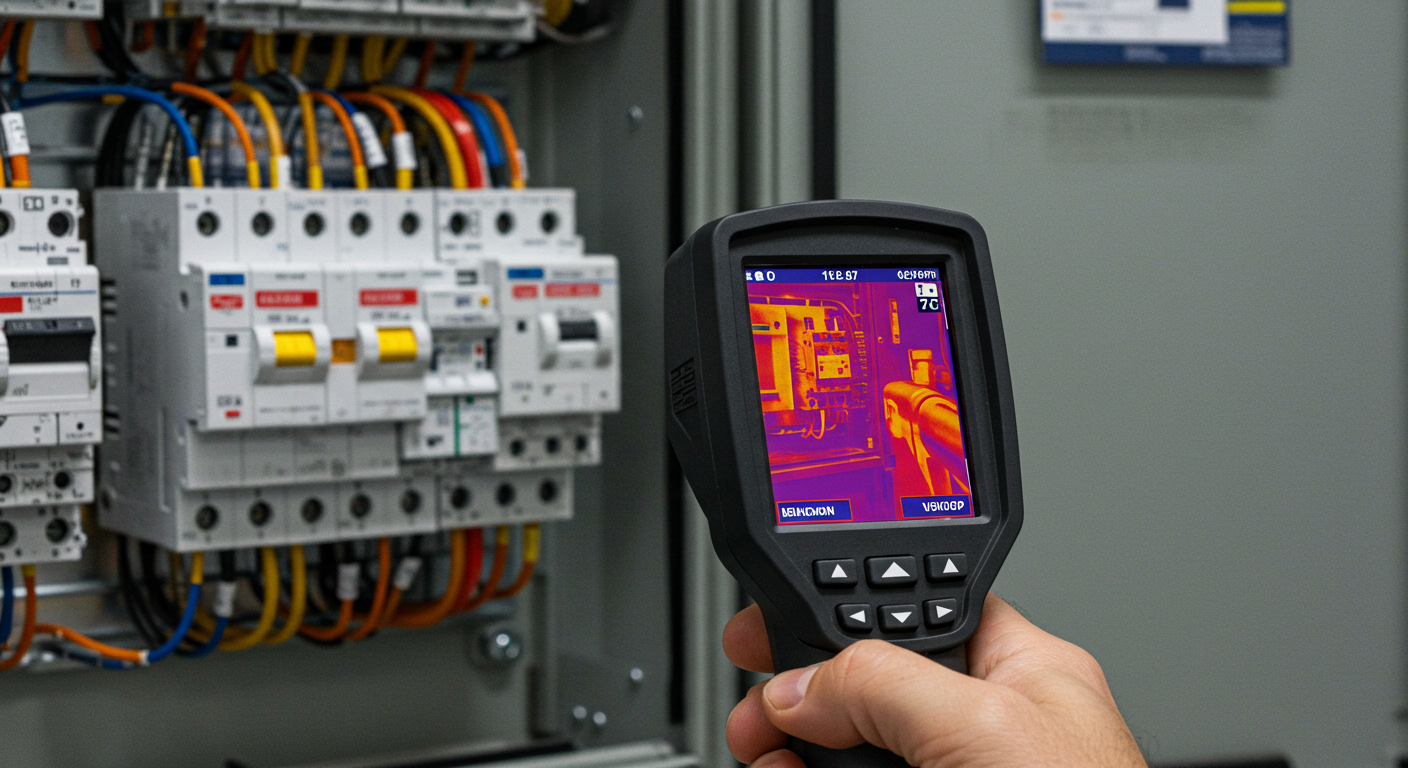
These are things you can actively manage. If your team is falling behind on preventive maintenance (a leading KPI), you can intervene by reallocating resources or addressing the root cause. You don't have to wait until the end of the year to see the failure rate (the lagging KPI) go up.
A balanced approach is the key. You need lagging indicators to confirm you've reached your destination, and you need leading indicators to make sure you're on the right road to get there.
The Danger of an Unbalanced View
Organizations that focus only on lagging indicators are always looking in the rear-view mirror. They are reactive, constantly fighting fires. Organizations that focus only on leading indicators can get lost in activity that doesn't actually produce results. You might be 100% compliant with your maintenance schedule, but if the failure rate isn't dropping, your plan is wrong. You need both to navigate effectively.
Developing Your KPIs: A Step-by-Step Guide
Let's walk through the process of creating a robust set of KPIs for a SAMO.
SAMO: "Reduce unplanned downtime on the main production line by 20% within 24 months."
Step 1: Identify the Lagging Indicator. This is usually straightforward. The lagging KPI is a direct measure of the SAMO itself. * Lagging KPI: Percentage of unplanned downtime hours vs. total operating hours. * Target: A 20% reduction from the current baseline.
Step 2: Brainstorm the Drivers (Potential Leading Indicators). Ask your team: "What actions, if performed consistently and well, will lead to less unplanned downtime?" You might get a list like this: * Doing our preventive maintenance (PM) on time. * Inspecting equipment for wear and tear. * Training operators to spot problems early. * Having the right spare parts on hand. * Analyzing the root cause of past failures. * Replacing old equipment before it fails.
Step 3: Select and Refine the Leading KPIs. You can't track everything. Choose a few high-impact, measurable activities from your brainstormed list.
- Leading KPI 1 (Maintenance): PM schedule attainment.
- Definition: (Number of PM tasks completed on time / Total number of PM tasks scheduled) x 100%.
- Target: > 95% monthly.
- Leading KPI 2 (Reliability): Percentage of critical component failures with a completed Root Cause Analysis (RCA).
- Definition: (Number of RCAs completed / Number of critical component failures) x 100%.
- Target: 100% within 14 days of failure.
- Leading KPI 3 (Supply Chain): Critical spare part availability.
- Definition: (Number of critical spare parts in stock / Total number of required critical spares) x 100%.
- Target: > 98%.
Step 4: Create a Performance Dashboard. Visualize your KPIs. A simple dashboard can show the relationship between your efforts and your results. When your team sees the PM attainment (leading) go up, and a month later they see the downtime (lagging) start to trend down, it creates a powerful feedback loop that reinforces the right behaviors.
Here is some sample data that could be used to track these KPIs.
Table 1: Production Line Performance Data
| Month | Unplanned Downtime Percent | PM Attainment Percent | RCA Completion Percent | Critical Spare Availability Percent |
|---|---|---|---|---|
| Jan-24 | 5.2 | 81.5 | 79.0 | 85.1 |
| Feb-24 | 5.3 | 84.0 | 82.5 | 86.3 |
| Mar-24 | 5.0 | 87.2 | 85.0 | 88.9 |
| Apr-24 | 4.8 | 90.1 | 88.4 | 91.2 |
| May-24 | 4.9 | 88.5 | 86.0 | 92.5 |
| Jun-24 | 4.6 | 92.3 | 91.0 | 94.0 |
| Jul-24 | 4.4 | 94.6 | 93.5 | 95.8 |
| Aug-24 | 4.2 | 96.1 | 95.2 | 96.4 |
| Sep-24 | 4.1 | 97.5 | 96.8 | 97.1 |
| Oct-24 | 4.0 | 98.0 | 98.5 | 97.5 |
| Nov-24 | 4.1 | 98.2 | 97.9 | 98.0 |
| Dec-24 | 4.0 | 98.8 | 99.1 | 98.3 |
This structured approach ensures that your KPIs are not just arbitrary numbers but are directly linked to your strategy and provide a balanced view of both your actions and your outcomes.
Closing
We began with a simple question: how do you turn a lofty vision into Monday morning's work plan? The answer lies in the disciplined path from policy to performance. It’s about translating broad strategic goals into the sharp focus of SMART objectives. It’s about understanding that you cannot manage what you do not measure.
The true power of this process comes from creating a balanced perspective. By using lagging KPIs, you hold yourself accountable for the final outcome—did you actually reduce downtime or improve resilience? But by actively managing a handful of well-chosen leading KPIs, you give your teams the tools to influence that outcome. You empower them to look through the windshield, not just in the rear-view mirror, allowing for proactive adjustments that prevent problems before they occur.
This framework isn't just a theoretical exercise; it is the engine of continuous improvement in asset management. It connects the boardroom to the boiler room, ensuring that everyone understands their role in achieving the organization's most important goals.
Learning Outcomes
In this reading, you have explored the critical process of linking strategy to results. You now have the foundational knowledge to:
- Translate Policy into Action: You can take a high-level policy or strategic goal and break it down into a specific, measurable, achievable, relevant, and time-bound Strategic Asset Management Objective (SAMO).
- Distinguish Between Key Measurement Types: You can clearly differentiate between leading KPIs, which are predictive measures of activity, and lagging KPIs, which are measures of past outcomes. You understand why a balance of both is essential for effective performance management.
- Develop Meaningful Metrics: You can create relevant KPIs and set appropriate targets that directly measure the progress and achievement of your SAMOs.
- Understand Core Concepts: You are now familiar with the definitions and applications of key terms including Asset Management Strategy, Strategic Asset Management Objectives (SAMOs), Key Performance Indicators (KPIs), Strategy, Objective, Target, and Performance Measurement.
Next Steps
Excellent work completing this reading. You've built a solid foundation for understanding how to measure what matters in asset management.
Please navigate back to the main course page to continue with your next activity.
