
The Skill
An asset management policy is the foundational document that guides an organization's approach to managing its physical and infrastructure assets. It is a formal, high-level statement that establishes the principles, commitments, and objectives for asset management across the entire organization.
Developing this policy involves translating broad organizational goals into specific, actionable commitments for how assets will be managed throughout their lifecycle—from planning and acquisition to operation, maintenance, and disposal. This skill requires strategic thinking, clear communication, and an understanding of how physical assets deliver value.
Why Is This Skill Important?
A well-drafted asset management policy is the cornerstone of any effective asset management system. Without it, efforts can be disjointed, reactive, and misaligned with strategic goals. This policy provides the "why" behind your organization's asset management activities.
It ensures everyone, from executive leadership to frontline technicians, understands the organization's commitments to sustainable service delivery, risk management, and long-term value optimization. It provides a framework for consistent decision-making, supports regulatory compliance, and justifies resource allocation for maintenance and renewal projects. Mastering this skill allows you to establish the strategic direction that transforms asset management from a purely technical function into a key driver of organizational success.
Your Task
Your task is to draft a foundational Asset Management Policy for the Public Works department of a mid-sized city. You will be provided with a memo from the City Manager that outlines the context and strategic drivers for this initiative.
Using the information in the memo and the guidance that follows, you will construct a complete policy document. Your draft should be clear, professional, and contain all the essential components of a robust asset management policy.
Your Process
- Review the Scenario: Carefully read the provided memo to understand the city's goals and context.
- Outline the Policy: Structure your document using the standard sections of an asset management policy.
- Draft Policy Statements: Write clear, actionable statements for each section.
- Assemble the Document: Compile your sections into a single, coherent draft policy.
Resources and Data
To complete this task, you will use the following simulated document. This memo provides the necessary background and strategic direction from the city's leadership.
Key Document: Memo: Asset Management Policy Initiative
Detailed Steps
Follow these steps to build your asset management policy. Each step corresponds to a critical section of the final document.
Step 1: Establish the Structure
A standard asset management policy is not complex, but it must be logical. It connects high-level goals to specific commitments. Use the following structure for your draft.
📊 View Diagram: Core Sections of an Asset Management Policy
Step 2: Draft the "Purpose and Scope"
This section sets the stage. It should state why the policy exists and what it covers.
- Purpose: Start with a clear statement. Example: "The purpose of this policy is to establish the framework for the systematic and coordinated management of all public works assets..."
- Scope: Clearly define which assets are covered by the policy. Use the list from the City Manager's memo (transportation, water systems, public buildings). Also, state that the policy applies to all phases of the asset lifecycle.
Asset Management
Step 3: Articulate "Principles and Commitments"
This is the heart of the policy. Here, you translate the city's strategic objectives (from the memo) into high-level commitments. For each strategic objective, write a corresponding policy principle.
- For "Enhance Service Reliability": Your principle could be about maintaining a defined Level of Service.
- For "Promote Fiscal Sustainability": Your principle could focus on using lifecycle cost analysis for decision-making.
- For "Strengthen Community Resilience": Your principle could commit to incorporating risk and resilience assessments in asset planning.
Writing Effective Policy Statements
Use strong, active verbs. Instead of 'An effort will be made to...', write 'The City will...'. Be clear and unambiguous. The goal is to state a commitment, not to describe a process.
Step 4: Define "Roles and Responsibilities"
A policy is ineffective if no one is accountable. This section assigns high-level responsibilities for implementing the policy. It does not need to list every person, but it should clarify accountability at different levels of the organization.
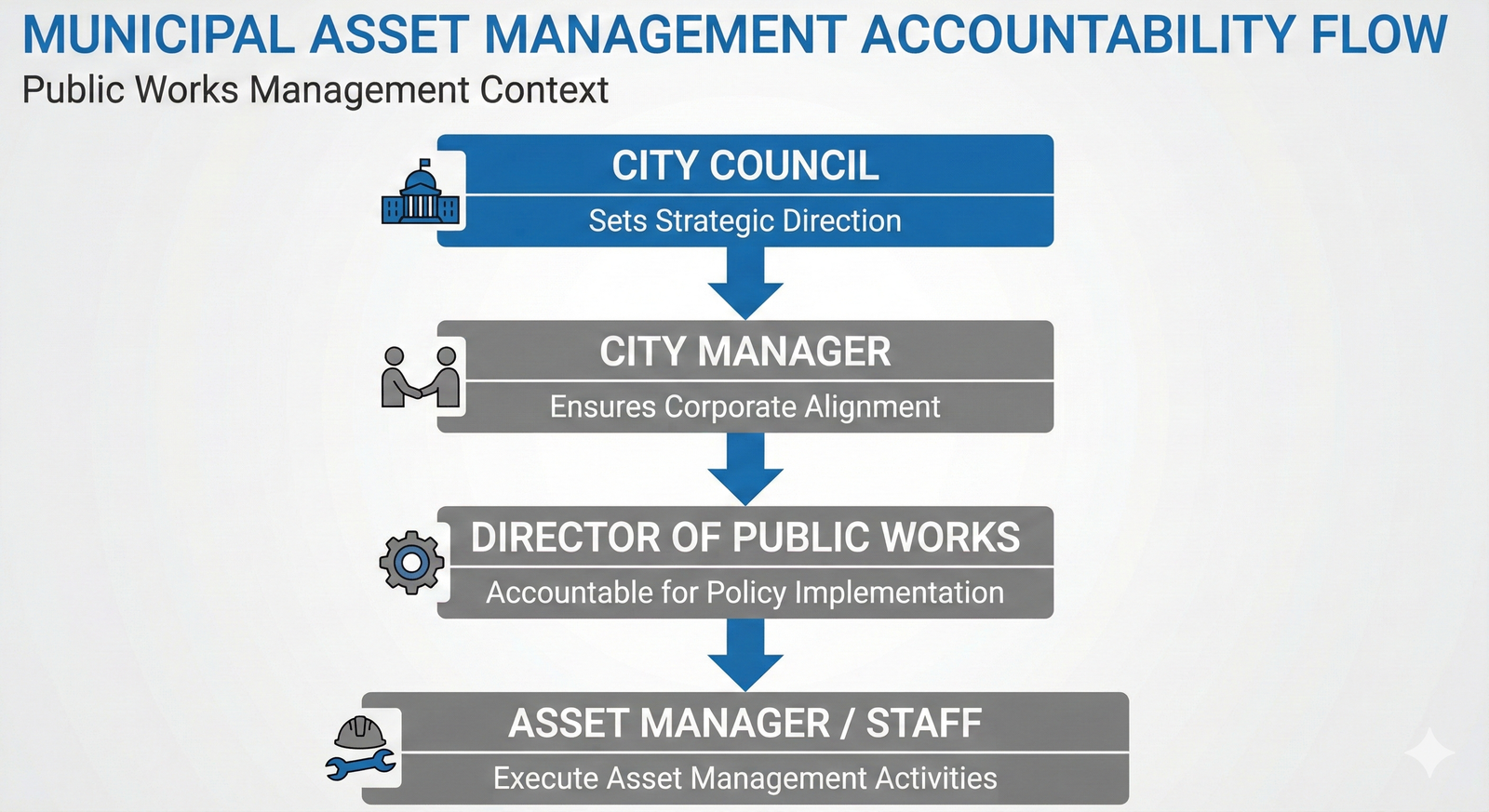
Your text should briefly describe the primary asset management responsibility of each role shown in the diagram. For example: "The Director of Public Works is accountable for the implementation, monitoring, and continual improvement of this policy and the associated asset management system."
Step 5: Document "Alignment with Strategic Objectives"
This section explicitly links the asset management policy to the organization's overarching strategic plan. It demonstrates that asset management is not an isolated activity.
Simply state that this policy directly supports the City of Northwood's Strategic Plan for 2024-2028. You can list the three specific objectives from the City Manager's memo to make the connection explicit. This reinforces the policy's importance and relevance.
Step 6: Establish "Policy Review and Improvement"
A policy should be a living document. This final section establishes a process for keeping it current and effective. Specify a review cycle. A typical timeframe is every 2-3 years, or sooner if there are significant changes to the organization's strategic direction or operating context. State who is responsible for initiating the review (e.g., the Director of Public Works).
An Expert Response
About This Response
This is a sample of a high-quality response. Your own draft may have different wording or structure while still being an excellent response. Use this as a guide for comparison and refinement, not as the only correct answer.
City of Northwood - Department of Public Works
Asset Management Policy
1.0 Purpose and Scope
1.1 Purpose: The purpose of this policy is to establish a consistent and systematic framework for the management of all physical assets owned and operated by the City of Northwood's Department of Public Works. This policy defines the principles and commitments that will guide the development of a comprehensive asset management system to support the delivery of sustainable public services.
1.2 Scope: This policy applies to all physical infrastructure assets under the purview of the Department of Public Works, including transportation networks, water and wastewater systems, and public buildings and facilities. It encompasses all phases of the asset lifecycle, from initial planning and acquisition through operation, maintenance, renewal, and disposal.
2.0 Principles and Commitments
The City of Northwood is committed to the following principles in the management of its public assets:
- Service-Focused: The City will manage its assets to achieve defined levels of service that meet the present and future needs of the community.
- Value Optimization: The City will make asset decisions based on a balanced consideration of performance, cost, and risk over the entire asset lifecycle.
- Risk-Based: The City will identify and manage risks to asset performance and service delivery to strengthen the resilience of our community and infrastructure.
- Data-Driven: The City will maintain accurate and reliable asset information to support transparent, evidence-based decision-making.
- Continual Improvement: The City will regularly review and improve its asset management practices, processes, and systems.
3.0 Roles and Responsibilities
- City Council: Sets the overall strategic direction and approves the necessary budget for asset management.
- City Manager: Ensures asset management practices are aligned with the city's corporate objectives and administrative policies.
- Director of Public Works: Accountable for the implementation, monitoring, and continual improvement of this policy and the associated asset management system.
- Department Staff: Responsible for executing day-to-day asset management activities in accordance with this policy and its supporting procedures.
4.0 Alignment with Strategic Objectives
This Asset Management Policy is a key instrument for achieving the goals outlined in the City of Northwood's Strategic Plan (2024-2028). It directly supports the following strategic objectives:
- Enhance Service Reliability
- Promote Fiscal Sustainability
- Strengthen Community Resilience
The principles and commitments within this policy provide the foundation for developing asset management strategies and plans that will deliver on these objectives.
5.0 Policy Review and Improvement
This policy will be formally reviewed by the Director of Public Works at a minimum of every three (3) years, or as required by significant changes in the city's strategic direction or regulatory environment. Recommendations for amendments will be presented to the City Manager for approval.
Assess Yourself
Evaluate Your Work
Use the following criteria to evaluate your draft policy. Compare your work to the expert response, but focus on whether you met the core requirements of each criterion.
- Completeness: Does your policy include all five required sections (Purpose/Scope, Principles, Roles, Alignment, Review)? A high-quality response addresses all components outlined in the guidance.
- Clarity of Statements: Are your policy principles and commitments written as clear, actionable statements? High-quality statements use active voice and avoid vague or ambiguous language.
- Scenario Alignment: Does your policy directly reference and connect to the strategic objectives and asset types mentioned in the City Manager's memo? A strong response is clearly tailored to the provided scenario.
- Logical Structure: Is the document well-organized and easy for a stakeholder to read and understand? A high-quality draft flows logically from high-level purpose to specific commitments and responsibilities.
- Accountability: Does the "Roles and Responsibilities" section clearly assign accountability for the policy's implementation? A strong response defines responsibilities at the leadership and departmental levels.
Learning Progress
In this activity, you have successfully practiced the core skills of strategic policy development. You identified the essential sections of an asset management policy, practiced writing clear and actionable policy statements, and structured a complete draft document based on a professional scenario.
Next Steps
Excellent work. You have completed the process of drafting a foundational policy document. This is a critical skill for any asset management professional. Please navigate back to the course to continue your learning.
