
Introduction
If you've ever looked at a massive piece of public infrastructure—a bridge, a water treatment plant, a power grid—and wondered how the organization responsible keeps it all running, you're asking an asset management question. It's not magic, and it's certainly not luck. It's the result of a deliberate, documented, and strategic approach.
At the heart of this approach is the translation of high-level intentions into concrete actions. An organization might have a formal Asset Management Policy that states its commitment to "providing safe and reliable services in a financially sustainable manner." That’s a great starting point, but it doesn't tell a maintenance manager which pipes to replace this year or a finance director how much capital to budget for the next five. This is where the Strategic Asset Management Plan comes in. It is the critical link, the roadmap that turns the "what we want to achieve" of the policy into the "how we will do it" of daily operations. This article will guide you through the process of building that bridge.
The Asset Management Hierarchy: From Policy to Plans
Before we dive into creating a Strategic Asset Management Plan (SAMP), it's essential to understand where it fits. Think of it as a hierarchy of documents, each one adding more detail and specificity.
📊 View Diagram: The Asset Management Document Hierarchy
As you can see, the SAMP is not an isolated document. It’s informed by the organization's overall strategic goals and its Asset Management Policy. In turn, the SAMP provides the direction needed to develop detailed, asset-specific plans. Without a SAMP, any asset management plans for individual asset classes (like your vehicle fleet or your pump stations) would lack a coherent, unified direction. You'd have different teams working towards different, and possibly conflicting, goals.
Step 1: Deconstructing the Asset Management Policy
Your first task in developing a SAMP is to start with the Asset Management Policy. This document, typically approved by top management or the governing body, outlines the principles and commitments of the organization regarding its assets. It’s the "constitution" for your asset management activities.
Your job is to act as a translator. You need to read through the policy and extract the core commitments. Look for phrases like: * "Ensure compliance with all regulatory requirements..." * "Manage assets to meet defined levels of service..." * "Optimize asset life cycle value..." * "Implement a risk-based approach to decision-making..." * "Commit to environmental sustainability..."
Each of these statements is a seed that will grow into a specific objective within your SAMP. For example, the commitment to "meet defined levels of service" directly implies that you will need to define what those levels of service are, figure out how to measure them, and then create a plan to ensure your assets can deliver them.
Step 2: Developing SMART Asset Management Objectives
Once you have the core commitments from the policy, you need to turn them into formal Asset Management Objectives. This is arguably the most critical step in the entire process. Vague objectives lead to vague plans and uncertain outcomes. The best way to ensure clarity and accountability is to make your objectives SMART.
The Power of SMART Objectives
SMART is an acronym that provides a framework for setting effective objectives. It ensures your goals are clear and trackable.
- Specific: What exactly do you want to achieve?
- Measurable: How will you know when you have achieved it? What are the Key Performance Indicators (KPIs)?
- Achievable: Is it realistic given your resources, constraints, and timeline?
- Relevant: Does this objective support the Asset Management Policy and the organization's overall goals?
- Time-bound: What is the deadline for achieving this objective?
Let's see this in action. Imagine your organization is a municipal water utility.
- A Poor Objective: "Improve the reliability of our water distribution network."
- A SMART Objective: "Reduce the annual rate of water main breaks in Zone 4 from the current average of 15 breaks/100km to 10 breaks/100km within the next 3 fiscal years by implementing a targeted pipe replacement program."
Let's break down why the second one works: * Specific: It targets a precise metric (water main breaks) in a specific area (Zone 4). * Measurable: The target is a clear reduction from 15 to 10 breaks/100km. You can track progress year over year. * Achievable: This would depend on a technical and financial analysis, but it presents a concrete goal that can be assessed for feasibility. * Relevant: This directly supports a policy commitment to "provide reliable service." * Time-bound: The deadline is clearly stated as "within the next 3 fiscal years."
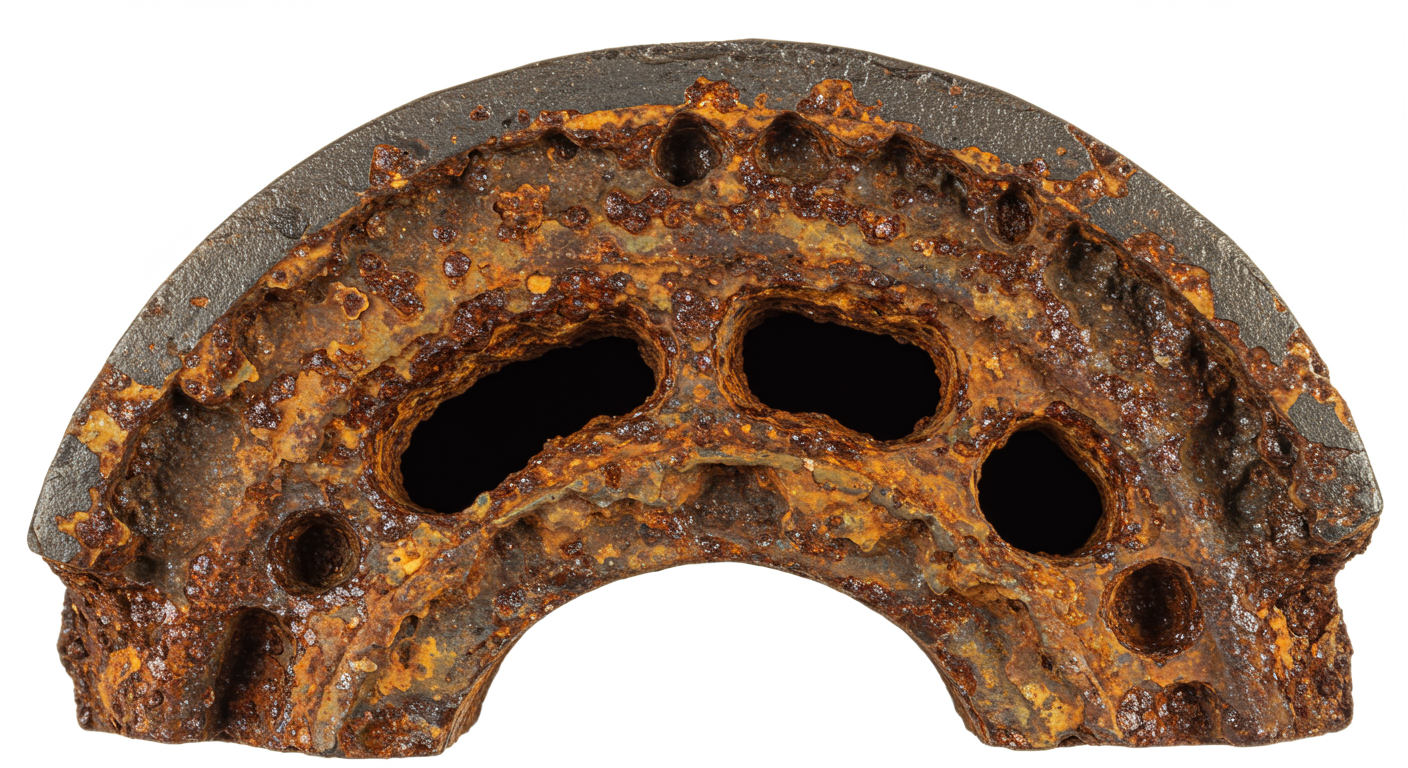
To help you practice, here is a sample data set showing how vague goals can be transformed into powerful, SMART objectives.
Sample Asset Management Objectives
| Policy Commitment | Vague Goal | SMART Objective |
|---|---|---|
| Ensure Public Safety and Asset Integrity | Make our bridges safer. | Reduce the number of bridges with a 'Poor' or 'Serious' structural condition rating from 15% to below 5% within the next 5 years by implementing the approved bridge rehabilitation and replacement program. |
| Promote Environmental Sustainability and Operational Efficiency | Reduce energy usage in our buildings. | Decrease overall energy consumption across all city-owned administrative buildings by 15% from the 2023 baseline by the end of fiscal year 2026, through the installation of LED lighting and upgraded HVAC control systems. |
| Provide Reliable and Resilient Utility Services | Improve the power grid's reliability. | Reduce the average customer outage duration (SAIDI) by 20% over the next 3 years by upgrading 50 miles of aging overhead conductors and replacing 200 obsolete pole-top transformers in high-risk zones. |
| Maintain an Effective and Efficient Water System | Fix the old water pipes. | Decrease the rate of water main breaks per 100 miles of pipe from 25 to 15 within 4 years by replacing 2% of cast iron pipes with the highest break frequency annually. |
| Deliver a High-Quality Transportation Network | Improve the condition of our roads. | Increase the percentage of arterial and collector roads with a Pavement Condition Index (PCI) of 'Good' or better from 60% to 75% within a 3-year period by executing the annual resurfacing and preventative maintenance program. |
| Enhance Community Livability and Recreation | Make our parks better for people. | Increase the Park Condition Assessment score for the 5 most utilized community parks from an average of 'C' to 'B+' within 2 years by investing $2.5M in playground equipment replacement, landscape refurbishment, and pathway repairs. |
| Ensure Compliance with Environmental Regulations | Upgrade the wastewater treatment plant. | Achieve 100% compliance with new nitrogen and phosphorus discharge limits by upgrading the biological nutrient removal (BNR) process at the main wastewater treatment plant before the regulatory deadline of December 31, 2025. |
| Optimize Asset Lifecycle Costs | Spend less on maintaining facilities. | Reduce the backlog of deferred maintenance for critical building systems (HVAC, roofing, electrical) by 30% from a baseline of $10M to $7M within three years by allocating an additional $1.2M annually to the capital maintenance budget. |
| Support Economic Development through Infrastructure | Improve internet access in the business park. | Install 5 miles of city-owned dark fiber optic cable to serve the Northside Industrial Park, making connections available to 90% of businesses in that zone by Q4 2025, to attract new high-tech tenants. |
Step 3: Defining the Strategy and the Plan
With your SMART objectives in place, you now know what you need to achieve. The next part of the SAMP is to outline how you will achieve it. This involves defining both the strategy and the plan. While often used interchangeably, these terms have distinct meanings in asset management.
A Strategy is your chosen approach. A Plan contains the specific actions to execute that strategy.
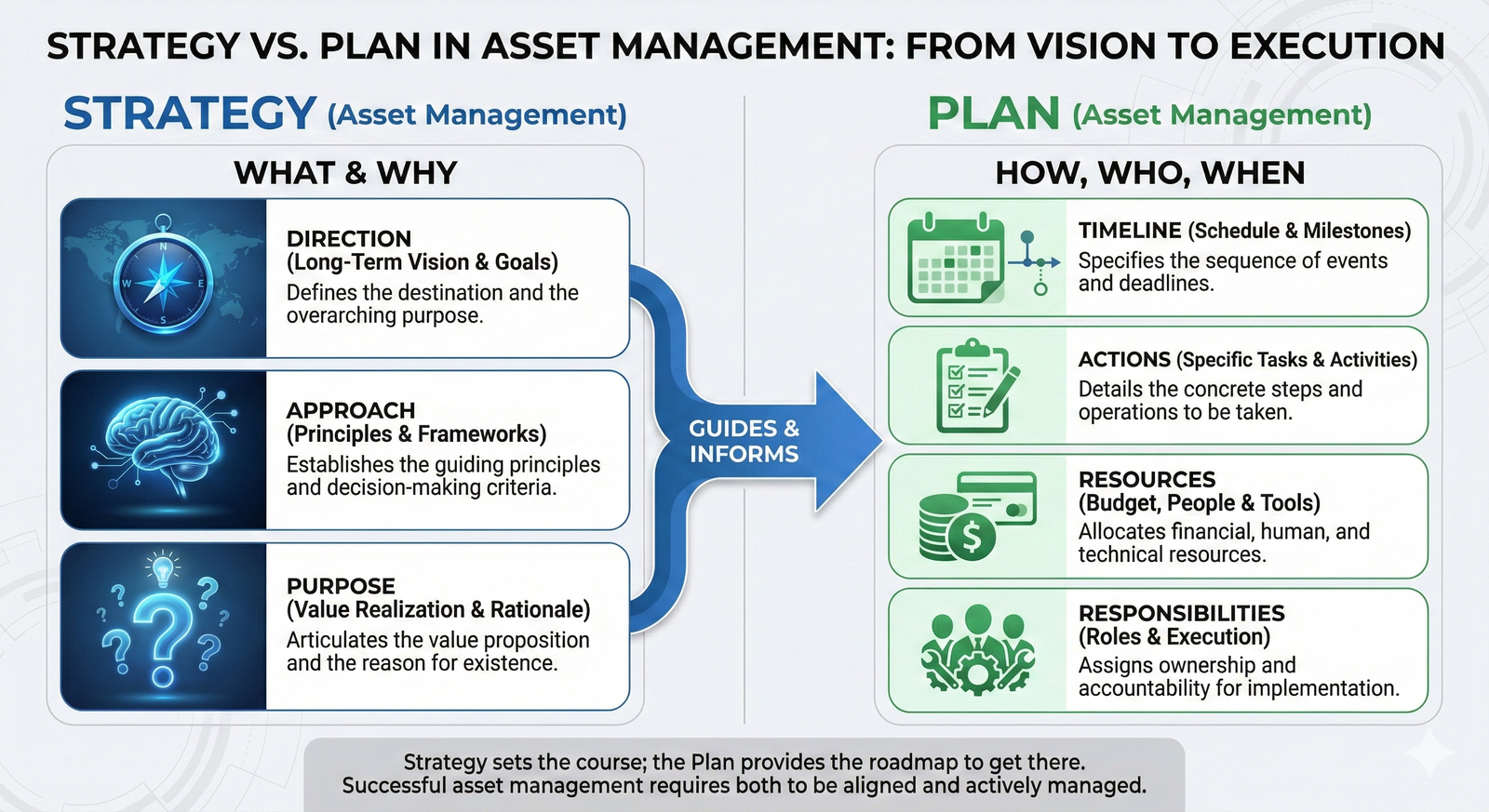
Let's go back to our water utility example:
- Objective: "Reduce the annual rate of water main breaks in Zone 4 from 15 to 10 breaks/100km within 3 years."
- Strategy: "Implement a risk-based capital replacement program that prioritizes the replacement of pipes with the highest likelihood and consequence of failure."
- Plan (Elements of the Asset Management Plan - AMP):
- Action 1: "By Q2 of this year, the Engineering team will complete a condition assessment of all cast iron mains in Zone 4 using acoustic leak detection and historical break data."
- Action 2: "By Q3, the Asset Management team will develop a risk matrix and score each pipe segment."
- Action 3: "By Q4, the Finance and Engineering teams will develop a 3-year capital budget to replace the top 20% of highest-risk pipes."
- Action 4: "The Operations team will execute the replacement of 5km of pipe in Year 1, 7km in Year 2, and 8km in Year 3."
The SAMP itself won't contain every single action. It will define the objectives and the overarching strategy. It then mandates the creation of the more detailed Asset Management Plans (AMPs) where these specific actions, timelines, and budgets are documented.
Step 4: The SAMP as a Living Document
A common mistake is to treat the SAMP as a one-time project. You write it, put it on a shelf, and it gathers dust. This completely defeats its purpose. The world changes: regulations are updated, new technologies emerge, customer expectations shift, and asset conditions degrade.
Your SAMP must be a living document. This means establishing a formal review cycle. A typical cycle is an annual review to check progress against objectives and a major update every 3-5 years.
This is where the "Measurable" part of your SMART objectives becomes so powerful. During your annual review, you will look at the data: * What is our current water main break rate? Are we on track to meet our 3-year target? * How many 'Poor' rated bridges are left? Is our rehabilitation plan on schedule? * What is our portfolio-wide energy consumption? Are our efficiency projects delivering the expected savings?
If you are not on track, the SAMP forces you to ask why. Do we need to adjust the strategy? Do we need more resources? Was the original objective unachievable? This continuous improvement loop is the hallmark of a mature asset management practice. The future of asset management will see this process become even more dynamic, with digital twins and real-time data from IoT sensors providing constant feedback, allowing the SAMP to be adjusted not just annually, but continuously.
Closing
We've journeyed from the high-level, principled statements of an Asset Management Policy to the actionable, data-driven framework of a Strategic Asset Management Plan. The SAMP is not just another piece of corporate paperwork; it is the engine that drives purposeful action across your organization. It ensures that every dollar spent and every hour of work is aligned with a common set of strategic goals.
By meticulously translating policy into SMART objectives, and by clearly defining the strategies to achieve them, you create a clear line of sight from the boardroom to the field. You provide every member of your team—from the senior executive to the frontline technician—with a clear understanding of not just what they are doing, but why it matters. Crafting a robust SAMP is a foundational step in moving your organization from a reactive, "fire-fighting" mode to a proactive, strategic, and sustainable asset management practice.
Learning Outcomes
In this reading, you have learned how to take the foundational steps in strategic asset management. You can now describe the critical process of translating the high-level commitments of an Asset Management Policy into a concrete Strategic Asset Management Plan (SAMP). You are also equipped to develop effective Asset Management Objectives using the SMART framework, ensuring they are specific, measurable, achievable, relevant, and time-bound. This involves understanding the key components like the SAMP itself, the objectives that drive it, and the difference between the high-level strategy and the detailed plan that brings it to life.
Assess Yourself
❓ Knowledge Check
Test your understanding of the key concepts from this section.
Next Steps
You have successfully completed this reading on crafting a Strategic Asset Management Plan. You've taken a significant step in understanding how to turn policy into action. Please navigate back to the course page to continue your learning journey.
