
Introduction
Have you ever been on a project team where the left hand didn't seem to know what the right hand was doing? Where maintenance teams were fixing the same pump repeatedly while the finance department was trying to cut their budget, and the executive board was talking about long-term sustainability goals that felt completely disconnected from your daily work? This isn't just frustrating; it's a symptom of a deeper issue: the absence of a clear, guiding strategy for managing the organization's physical assets.
This is where a robust Asset Management Policy comes in. It’s not just another document to be filed away and forgotten. Think of it as the constitution for your organization's asset management system. It’s a formal, high-level document that sets out the principles, commitments, and direction for how the organization will manage its physical assets to achieve its overarching goals. It’s the critical link that connects the strategic vision set in the boardroom to the practical, hands-on work happening on the plant floor, in the field, or in the boiler room. In this reading, we'll break down what a policy is, why it's the bedrock of effective asset management, and how to craft one that provides a clear 'line of sight' for everyone in the organization.
The Challenge of Ad-Hoc Asset Management
Imagine a large port authority responsible for miles of docks, dozens of cranes, and a fleet of service vehicles. Without a guiding policy, what happens? The maintenance team for the cranes might operate on a "run-to-failure" basis, only fixing a crane when it breaks down, causing massive shipping delays. The facilities team, responsible for the docks, might be using a different set of criteria for repair, prioritizing cosmetic fixes over structural integrity. Meanwhile, the vehicle fleet manager is replacing trucks based on age, not condition or usage, and the finance department is questioning every expenditure because they can't see how it connects to the port's main objective of increasing cargo throughput.
This is ad-hoc asset management. It’s characterized by: - Reactive Work: Constantly fighting fires instead of preventing them. - Siloed Decisions: Departments making choices that are optimal for them but detrimental to the organization as a whole. - Inconsistent Risk Management: Different teams having wildly different ideas of what constitutes an acceptable risk. - Opaque Value: An inability to clearly demonstrate to stakeholders or regulators how money spent on assets is delivering value.
This approach is inefficient, risky, and unsustainable. To move beyond it, you need a single source of truth that aligns everyone's efforts. That source is the Asset Management Policy.
The 'Line of Sight': Connecting Strategy to Action
The single most important function of an Asset Management Policy is to establish what we call a 'line of sight'.
Line of Sight
This concept ensures that the work of every individual, from the CEO to the technician, is visibly connected to the organization's strategic direction. It answers the "why" behind the "what." Why are we investing in this new sensor technology? Because it supports our objective of improving safety by predicting failures. Why are we following this specific maintenance procedure? Because it aligns with our commitment to optimizing the whole-life cost of our assets.
This alignment starts with understanding the organization's highest-level goals.
Organizational Objectives
The Asset Management Policy acts as a bridge, translating these broad objectives into specific principles and commitments for asset management. This then cascades down through the organization's planning documents.
📊 View Diagram: The Asset Management 'Line of Sight'
A Tool for Justification
The 'line of sight' is your most powerful tool for justifying budgets and investments. When you can draw a direct line from a requested expenditure (like a new pump) all the way up to a strategic objective (like ensuring regulatory compliance for water quality), you are no longer just asking for money. You are demonstrating how you will help the organization achieve its stated goals. This changes the conversation from 'cost' to 'value'.
Deconstructing the Asset Management Policy: The ISO 55001 Framework
While you could write a policy from scratch, there's no need to reinvent the wheel. The international standard for asset management, ISO 55001, provides a clear and globally accepted framework for what a good policy should contain. This standard evolved from an earlier British specification, PAS 55, which was a landmark effort to codify best practices in managing physical infrastructure. The creation of ISO 55001 in 2014 marked the maturation of asset management into a formal, recognized management discipline.
Let's first be clear on what we mean by a policy in this context.
Policy
So, the Asset Management Policy is the formal declaration of "how we do asset management around here." According to ISO 55001, a robust policy must include several key components.
1. Scope of the Asset Management System
The first step is to define the boundaries. The policy must state clearly what assets and asset systems it applies to. Is it for the entire organization, or just one division? Does it cover buildings, vehicles, IT hardware, and production equipment, or just the production equipment?
For a complex facility, this is not a trivial question.

A lack of clarity in the scope leads to confusion and gaps in management. The policy should unambiguously define its playing field.
2. Principles and Commitments
This is the heart of the policy. It's a series of statements that articulate the organization's fundamental beliefs and commitments regarding its assets. These are not vague platitudes; they are actionable principles that will guide decision-making.
Examples of commitment statements include: - "We are committed to managing our assets to ensure the safety of our employees, contractors, and the public above all other objectives." - "We will make asset investment and operational decisions based on a balanced consideration of performance, cost, and risk over the entire asset lifecycle." - "We commit to complying with all applicable legal, statutory, and regulatory requirements related to our assets." - "We will consider the impact of our asset management activities on the environment and actively seek opportunities for sustainable practices."
These commitments set the tone for the entire organization and provide the criteria against which decisions will be judged.
3. Link to Organizational Objectives
The policy must not exist in a vacuum. It must explicitly state how it supports the achievement of the organization's strategic plan and its objectives. This is the formalization of the 'line of sight'.
For example, it might state: "This Asset Management Policy directly supports the organization's strategic objectives of achieving top-quartile operational reliability and a 15% reduction in our carbon footprint by providing a framework for risk-based maintenance and energy-efficient asset selection." This sentence creates a direct, auditable link between the policy and the goals of the business.
4. Roles, Responsibilities, and Authorities
A policy is meaningless if no one is responsible for executing it. This section clarifies who is accountable for what. It should establish, at a high level, the key asset management roles.
- Who is ultimately accountable for the performance of the asset management system? (Hint: This should be someone in top management).
- Who is responsible for developing the Strategic Asset Management Plan (SAMP)?
- Who is responsible for ensuring resources are available?
- What authority do managers have to make decisions regarding assets?
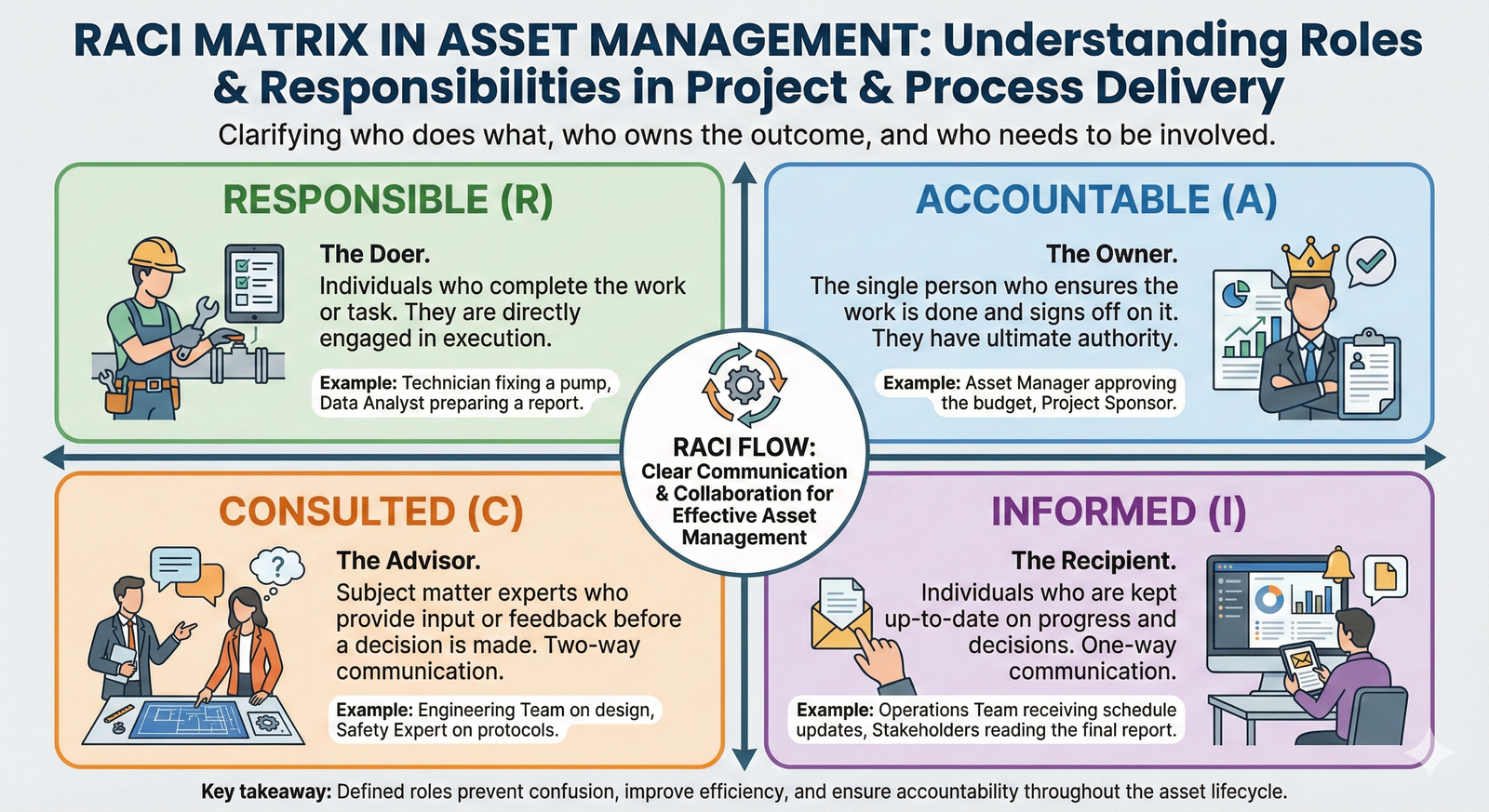
Clarifying these roles prevents finger-pointing and ensures that someone owns every aspect of the asset management system.
5. Commitment to Continual Improvement
Static systems fail. The world changes, technology evolves, and regulations are updated. A good policy acknowledges this by including a formal commitment to continually improve the asset management system. This means committing to: - Monitoring asset and system performance. - Auditing practices against the policy. - Learning from failures and successes. - Regularly reviewing and updating the policy and associated plans.
This commitment turns the asset management system into a living, evolving entity that gets smarter and more effective over time.
From the Field: Keep It Simple
I've seen too many Asset Management Policies that are 30 pages long and written in dense legalese. Nobody reads them. Your policy should be clear, concise, and accessible. Aim for 2-3 pages at most. Use direct language. The goal is for a new engineer or a senior executive to be able to read it and understand the organization's intent. The detailed 'how' belongs in the plans and procedures, not the policy.
From Document to DNA: Making the Policy Real
You and your team have drafted a brilliant, concise, and powerful Asset Management Policy. You've secured top management's signature. The job is done, right?
Wrong. The job has just begun. A policy on a server or in a binder is worthless. It must be embedded into the organization's DNA. This requires a deliberate and sustained implementation effort.
Leadership is Paramount: The most critical factor is visible leadership endorsement. When senior leaders consistently refer to the policy in their communications and use it to make and explain their decisions, it sends a powerful message that this matters.
Communicate, Communicate, Communicate: You cannot over-communicate the policy. This means more than just sending out a company-wide email. - Town Halls: Hold sessions where leaders explain the policy and, crucially, answer questions about what it means for different teams. - Workshops: Run targeted workshops for managers, engineers, and maintenance planners on how to apply the policy's principles to their specific work. - Visual Aids: Post the core principles in meeting rooms, control centers, and workshops. Make it visible.

Integrate and Embed: The principles of the policy must be woven into the fabric of the organization's processes. - Job Descriptions: Do the job descriptions for key roles reflect their asset management responsibilities? - Performance Management: Are managers and staff evaluated on their adherence to the policy's principles? - Procurement: Does the process for buying new assets include criteria for whole-life costing, as committed to in the policy? - Budgeting: Is the annual budget process aligned with the long-term investment needs identified in the asset management plans?
When the policy's principles become the default logic for how decisions are made, you have successfully moved it from a document to your organization's DNA.
The Future of Asset Management Policy
The world of asset management is not standing still, and our policies must evolve as well. Several key trends are shaping the future of how we define our asset management intent.
Digitalization: The rise of the Industrial Internet of Things (IIoT), digital twins, and artificial intelligence is providing unprecedented insight into asset condition and performance. Future policies will need to commit to being data-driven in a way that was previously impossible, leveraging predictive analytics to inform decision-making.
Sustainability and ESG: There is a growing, and entirely appropriate, demand for organizations to manage their assets in a way that is environmentally and socially responsible. Policies are increasingly including explicit commitments related to Environmental, Social, and Governance (ESG) criteria. This means formally committing to goals like reducing greenhouse gas emissions, conserving water, and ensuring the social impact of infrastructure projects is positive.
Resilience: In an era of climate change, extreme weather events, and cybersecurity threats, resilience has become a critical organizational objective. Asset management policies must now include commitments to assess and improve the resilience of critical asset systems, ensuring they can withstand, adapt to, and recover from disruptive events.
Your Future Role
As you move forward in your career, you won't just be implementing existing policies; you'll be shaping new ones. How will you incorporate principles of AI-driven decision-making or climate resilience into your organization's next Asset Management Policy? The principles we've discussed are the foundation, but you will be the architect of their evolution.
Closing
We've journeyed from the chaos of ad-hoc asset management to the clarity of a strategic, policy-driven approach. The Asset Management Policy is far more than a bureaucratic requirement; it is the strategic compass for your organization. By establishing clear principles and commitments, it creates the essential 'line of sight' that connects high-level organizational objectives to the vital, everyday work of managing your physical assets.
By understanding and applying the key components outlined in the ISO 55001 standard—defining scope, setting principles, linking to objectives, clarifying roles, and committing to improvement—you are equipped to build this foundational document. Remember, the goal is not to create a long and complicated document, but a clear, concise, and powerful statement of intent. A policy that is effectively communicated and embedded in the organization's processes will align your teams, justify investments, and ultimately drive more value from your assets for all stakeholders.
Learning Outcomes
In this reading, you have built a foundational understanding of one of the most critical documents in our profession. You can now:
- Explain how a well-crafted Asset Management Policy creates a 'line of sight,' ensuring that all asset-related activities are directly contributing to the organization's strategic goals.
- Identify and describe the essential components of a robust Asset Management Policy that aligns with the international standard, ISO 55001.
You have also been introduced to the key concepts and vocabulary necessary to discuss and develop this policy, including Asset Management Policy, Organizational Objectives, Policy, and Line of Sight.
Assess Yourself
❓ Knowledge Check
Test your understanding of the key concepts from this section.
Next Steps
Well done. You've grasped the strategic importance of the Asset Management Policy, a cornerstone of professional practice. Please navigate back to the course to continue your learning journey.
