
Introduction
What is the difference between a maintenance department that simply fixes what's broken and an asset management team that drives organizational value? The answer isn't just about efficiency or budgets; it's about direction. A team without a clear link to the organization's mission is like a ship's crew diligently swabbing the decks while the vessel drifts aimlessly. The tool that provides this direction, that acts as the rudder, is the Asset Management Policy.
Many professionals entering this field think of policy as just another piece of corporate paperwork. This is a fundamental misunderstanding. A well-crafted Asset Management Policy is a strategic declaration. It translates the high-level language of the C-suite—terms like 'market leadership', 'shareholder value', and 'public safety'—into tangible, actionable guidance for everyone who touches an asset. This article will guide you through the critical process of forging that link, ensuring that every decision, from a major capital investment to a routine maintenance check, purposefully serves the organization's ultimate mission.
Why Policy is Your North Star
Before we get into the mechanics of writing a policy, you need to fully grasp its strategic role. In any large organization, whether it's a public utility, a manufacturing giant, or a transportation authority, there are countless competing priorities. The finance department wants to minimize capital expenditure. Operations wants maximum uptime. The safety department wants zero incidents. Without a guiding framework, these competing interests can pull the organization in different directions, leading to suboptimal outcomes.
An effective Asset Management Policy acts as the arbiter. It sets the "rules of the game" by explicitly stating the organization's intentions for its assets, directly derived from its overarching goals. It answers the fundamental question: "How will we use our physical assets to achieve what we've set out to do as a business?"
Think about a municipal water utility. Their highest-level objective might be "to provide safe, reliable, and affordable drinking water to our community." This is their mission. An aligned asset management policy would then state principles like: * "We will prioritize investments that ensure regulatory compliance and protect public health above all else." * "We will manage our assets to meet or exceed defined levels of service for water pressure and availability." * "We will balance performance and cost over the entire asset lifecycle to ensure long-term affordability for our customers."
Now, every decision is framed by these principles. When a project manager proposes replacing a 50-year-old water main, the justification isn't just "it's old." The justification is "this replacement is critical to ensuring regulatory compliance and mitigating the risk of a catastrophic failure that would jeopardize public health and safety," directly referencing the policy. This is how you move from a reactive, tactical mindset to a proactive, strategic one.
From Mission to Mandate: Creating the "Line of Sight"
The real craft of policy development lies in translating abstract goals into concrete directives. This is where we establish a clear Line of Sight that connects the boardroom to the boiler room. Every single person, from the CEO to the technician on the ground, should be able to see how their work contributes to the organization's success.
The starting point is always the top-level Organizational Objectives. You can't write an asset management policy in a vacuum. You need to immerse yourself in the organization's strategic plan, its annual reports, and its vision and mission statements. What does the organization value most? Growth? Safety? Innovation? Environmental stewardship? Customer service?
Once you have a firm grasp of these, you can begin the translation process. A powerful method for this is creating a hierarchy of objectives.
📊 View Diagram: Cascading Objectives: Creating a Line of Sight
Let's walk through this cascade with an example from an airport authority:
- Organizational Objective: "Be the #1 ranked airport for passenger experience in the region." This is a high-level business goal.
- Asset Management Policy Principle: "Our assets will be managed to provide a clean, comfortable, and seamless journey for all passengers." This translates the business goal into a guiding principle for the asset base.
- Strategic Asset Management Plan (SAMP) Objective: "Achieve 99.5% uptime for all passenger-facing conveyance systems (elevators, escalators, moving walkways) during operating hours." This makes the policy principle measurable and specific.
- Asset Management Plan (AMP) Action: "Implement a predictive maintenance program for all escalators, utilizing vibration analysis and thermal imaging to identify potential failures before they occur." This is a specific plan for a particular asset class.
- Work Order: "Technician to perform quarterly vibration analysis on escalator unit #3 in Terminal B, per procedure PM-ESC-007." This is the tangible, on-the-ground task.
Do you see the connection? The technician working on that escalator isn't just "fixing an escalator." They are directly contributing to the airport's number one strategic goal. That is the power of a clear line of sight. It provides purpose and context to every action.
Mentor's Corner: The Workshop is Your Best Tool
Don't try to write the policy alone in your office. The most successful policies are forged through collaboration. Schedule workshops with senior leaders from every department: Finance, Operations, HR, Safety, and Legal. Your job is to facilitate the conversation, asking questions like, 'What does 'reliability' mean to your department?' or 'How would a major asset failure impact our financial goals?' This process not only ensures the policy reflects the entire business, but it also builds the buy-in you'll need to implement it successfully.
The Anatomy of a Robust Asset Management Policy
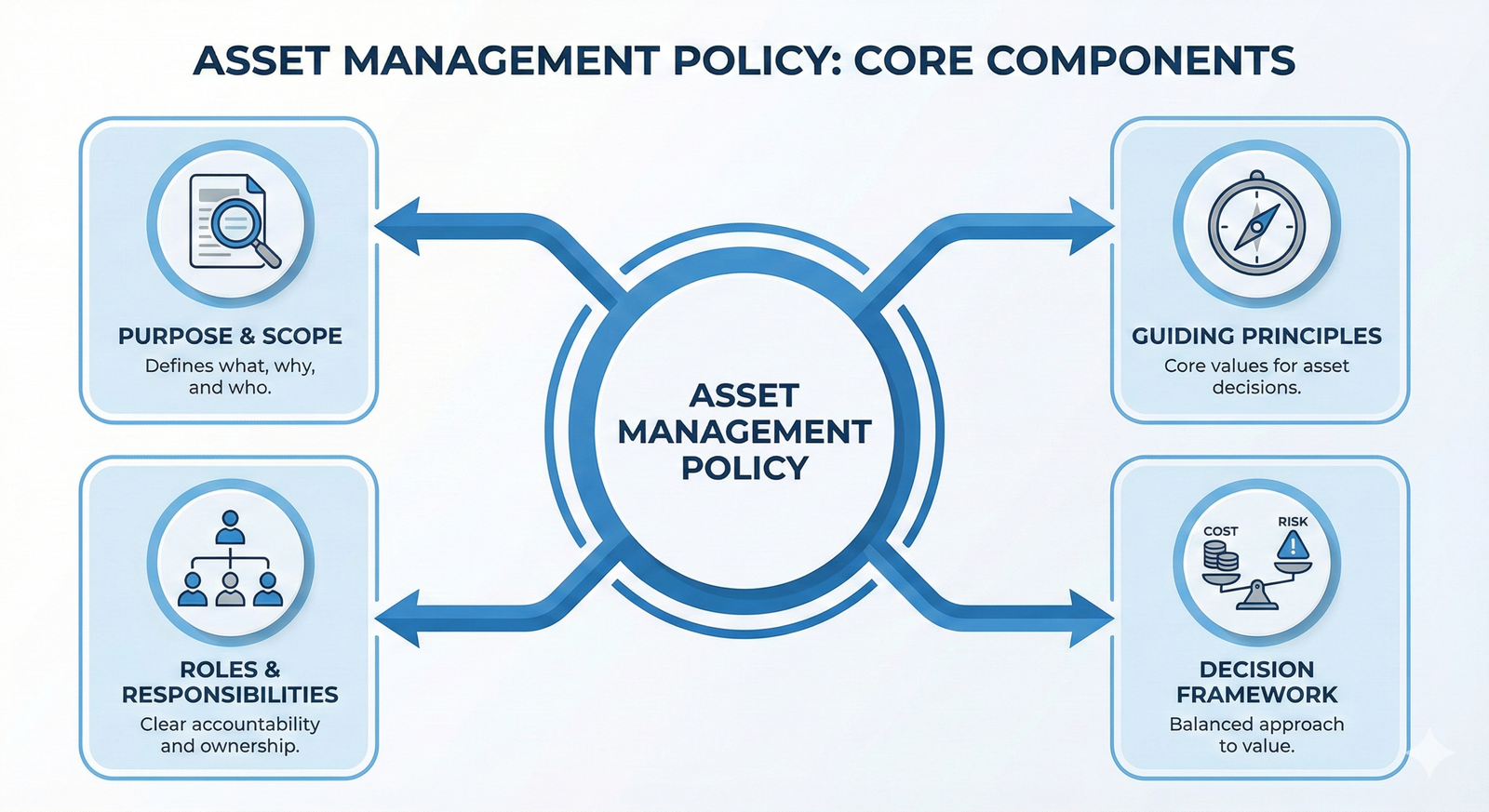
While the specifics will vary between organizations, a comprehensive asset management policy should contain several key components. It's not just a statement of intent; it's a foundational document that sets the stage for your entire asset management system. Think of it as the constitution for your assets.
A generic Policy is a set of principles, but an asset management policy needs to be more specific. Here are the essential building blocks:
1. Purpose and Scope
This section clearly defines why the policy exists and what it applies to. * Purpose: A concise statement linking asset management to the achievement of organizational objectives. * Scope: Defines the asset portfolio covered by the policy. Does it include all physical assets? Does it exclude IT hardware or fleet vehicles if they are managed under a separate system? Be explicit.

2. Guiding Principles and Commitments
This is the heart of the policy. It's a series of high-level "we will" statements that are directly linked to the organizational objectives. These are not detailed procedures; they are the enduring commitments that guide all subsequent decisions.
Examples of strong principle statements: * "We will make decisions based on a balanced consideration of performance, cost, and risk over the entire asset lifecycle." (Links to financial sustainability) * "We will comply with all applicable legal, statutory, and regulatory requirements." (Links to risk management and legal obligations) * "We will foster a culture of continuous improvement in our asset management practices and capabilities." (Links to operational excellence) * "We will ensure the safety of our employees, contractors, and the public in all activities related to our assets." (Links to social responsibility and safety goals)
3. Roles, Responsibilities, and Authorities
A policy is useless if no one is accountable for executing it. This section should define, at a high level, who is responsible for what. * Top Management: Responsible for authorizing the policy and providing the necessary resources for its implementation. * Asset Management Lead/Function: Responsible for developing, implementing, and maintaining the asset management system in accordance with the policy. * All Employees and Contractors: Responsible for understanding and adhering to the policy in their daily work.
This section doesn't need to name individuals, but it must clarify roles. It establishes that asset management is not just one person's job; it's everyone's responsibility.
4. Framework for Decision-Making
The policy should establish the fundamental concepts that will underpin asset management decisions. This includes commitments to: * Lifecycle Costing: Acknowledging that decisions will be based on total cost of ownership, not just initial purchase price. * Risk-Based Approaches: Stating that resources and attention will be prioritized based on an understanding of asset-related risks. * Defined Levels of Service: Committing to establishing and meeting measurable targets for asset performance from a stakeholder's perspective (e.g., system availability, product quality, passenger comfort).
5. Review and Improvement
A policy is a living document. The world changes, organizational objectives evolve, and asset performance provides new data. The policy must include a clause that mandates its own regular review (e.g., "This policy will be reviewed at least every two years, or in response to significant changes in the organizational or operational context"). This ensures the policy remains relevant and continues to provide effective guidance.
A Critical Distinction: Policy vs. Plan
A common mistake is to confuse the Asset Management Policy with the Strategic Asset Management Plan (SAMP) or other asset management plans. The Policy states the 'why' and the 'what' (our intentions and principles). The Plans state the 'how' (the specific activities, timelines, and resources we will use to achieve the policy's principles). Your policy should be a concise, high-level, and relatively stable document. The detailed, dynamic information belongs in your plans.
Bringing it All Together: The Policy in Practice
Let's look at a practical example. Imagine you are the new Asset Manager for a large-scale food manufacturing company. The CEO has just announced a new 5-year strategic objective: "To become the industry leader in sustainable and ethical production."
How do you, the asset manager, contribute? You start by drafting or updating the Asset Management Policy.
You would review this new Organizational Objectives and translate it. Your new policy draft might include principles like: * "We will prioritize the selection of assets with the highest energy efficiency ratings and lowest lifecycle carbon footprint." * "We will manage our water and waste treatment assets to exceed environmental regulatory requirements." * "We will invest in technologies that improve the traceability and ethical sourcing of our raw materials through the production line."
This revised policy is then approved by top management. Now, when your capital planning team evaluates two proposals for a new production line—one cheaper upfront, the other with higher efficiency and better waste handling—the policy provides the framework. The more expensive, sustainable option is no longer at a disadvantage; it is directly aligned with the stated commitments of the organization. The policy has done its job. It has forged the link between the CEO's vision and the engineering team's decision.
Closing
We've established that an Asset Management Policy is far more than a document to be filed away. It is the foundational link between your organization's highest aspirations and the practical, daily management of its physical asset base. Without this link, asset management activities can become disconnected, inefficient, and strategically adrift. With it, every action has a purpose.
By understanding the importance of this alignment, you can champion the development of a policy that provides a clear "line of sight" for everyone in the organization. The process involves deeply understanding your organization's objectives, translating them into clear and actionable principles, and structuring them within a comprehensive policy document that covers purpose, principles, responsibilities, and decision-making rules. This creates a powerful tool that not only guides decisions but also fosters a unified culture where everyone understands how their work with assets contributes to the overall mission.
Learning Outcomes
In this reading, you have explored the critical link between organizational strategy and asset management. You should now be better equipped to:
- Explain why a clear, well-defined Asset Management Policy is essential for ensuring that all asset-related activities contribute directly to achieving the organization's strategic goals.
- Apply methods, such as the cascading objectives framework, to translate broad organizational missions into specific, measurable principles within an Asset Management Policy.
- Recognize and describe the essential components of a complete Asset Management Policy, including its purpose, guiding principles, roles and responsibilities, and its framework for decision-making.
Assess Yourself
❓ Knowledge Check
Test your understanding of the key concepts from this section.
Next Steps
You have successfully completed this reading on the strategic importance of the Asset Management Policy. This foundational understanding is crucial for all subsequent topics in asset management. Please navigate back to the course page to continue with your next activity.
