
The Core of the Matter: Why Stakeholder Engagement is Non-Negotiable
In asset management, we often focus on the lifecycle of the asset itself—its design, construction, operation, maintenance, and eventual disposal. But there's a parallel lifecycle that's just as important: the lifecycle of the decisions made about that asset. And every one of those decisions impacts people.
Think about a decision to upgrade a regional water treatment plant. On the surface, it's a technical project. But who is affected? * The finance department has to approve a multi-million dollar budget. * The engineering team has to design and oversee the construction. * Operations staff will have to learn new systems and procedures. * Regulatory bodies need to ensure compliance with environmental standards. * Residential customers will experience rate changes and potential service disruptions during construction. * Local businesses might be impacted by construction traffic or benefit from the improved infrastructure.
Each of these groups is a Stakeholder, and ignoring any one of them can lead to budget overruns, project delays, political battles, and a loss of public trust. Effective Stakeholder Engagement isn't a "soft skill"; it's a critical risk management strategy.
From Compliance to Collaboration
Historically, 'stakeholder engagement' often meant the bare minimum required by law—a public notice in a newspaper or a town hall meeting. The modern, effective approach sees it as a source of value. Your stakeholders aren't obstacles to overcome; they are partners who can provide crucial insights, identify risks you might have missed, and become champions for your projects.
Part 1: Mapping Your Universe of Stakeholders
Before you can communicate, you need to know who you're talking to. The first step is to systematically identify and categorize your stakeholders. A common and effective way to do this is to separate them into two main groups: internal and external.
Internal Stakeholders: The People Inside the Tent
These are individuals and groups within your own organization. They are your colleagues, your bosses, and the teams you rely on every day. Underestimating their importance is a classic mistake.
Key internal stakeholders often include: * Executive Leadership (CEO, City Manager, Board of Directors): Their primary concern is strategic alignment, financial performance, and organizational reputation. They need high-level summaries, clear business cases, and confidence that asset management strategy supports the organization's mission. * Finance Department (CFO, Accountants): They speak the language of budgets, ROI, and lifecycle costing. They are the gatekeepers of funding and need to see a clear financial justification for any proposed investment. * Operations and Maintenance Teams: These are the hands-on people who keep the assets running. They have invaluable practical knowledge about asset condition and performance. They need to be consulted on maintenance plans and understand how changes will affect their daily work. * Engineering and Technical Services: They focus on design, specifications, and compliance with technical standards. They are key partners in developing capital projects and renewal strategies. * Human Resources: They are involved in workforce planning, training, and managing the "people" side of any change that asset management decisions might bring. * Legal and Risk Management: They focus on compliance, liability, and contractual obligations. They need to be aware of any risks associated with asset failure or project delivery.
External Stakeholders: The World Outside Your Walls
These are the individuals and groups outside your organization who have a vested interest in your assets. Their influence can be immense, and engaging them effectively is crucial for maintaining your social license to operate.
Key external stakeholders often include: * Customers or Service Users: The public, tenants, or passengers who directly use the services your assets provide. Their main concerns are service quality, reliability, safety, and cost. * Regulators and Government Agencies: Environmental protection agencies, safety authorities, and municipal governments that set the rules you must follow. Their focus is on compliance and public welfare. * Suppliers and Contractors: The business partners who provide materials, equipment, and services. They are critical to your supply chain and project execution. * Investors and Shareholders: For private sector organizations, these stakeholders are focused on financial returns and long-term value. * Community Groups and Local Residents: People who live or work near your assets. They are concerned with environmental impact, noise, traffic, and aesthetic issues. * The Media: They shape public perception and can amplify both positive and negative stories about your organization.
📊 View Diagram: Stakeholder Ecosystem in Asset Management
Part 2: Crafting and Delivering Your Message
Once you know your audience, you need to tailor your message and your delivery method. Sending a 300-page technical report to a community group is as ineffective as giving a vague, high-level presentation to your engineering team. The goal is to provide the right information, in the right format, at the right time.
The Communication Matrix: A Tool for a Targeted Approach
A powerful tool for planning your communications is a stakeholder communication matrix. It helps you think systematically about what each group needs to know and the best way to tell them.
Here’s a simplified example for a project to replace an aging downtown bridge:
Example Communication Matrix: Downtown Bridge Replacement
| Stakeholder Group | Key Interest/Concern | Key Message | Communication Method | Frequency |
|---|---|---|---|---|
| Local Residents | Traffic disruptions, construction noise, and project timeline. | We are implementing a phased construction plan with clear detour routes to minimize traffic impact. Construction hours are limited to 7 AM - 6 PM. The project is on track for completion in Q4 2025. | Project Website, Community Town Halls, Social Media Updates, Mailed Newsletter | Monthly |
| Downtown Business Association | Reduced foot traffic and customer access impacting revenue. | Clear signage will direct customers to all businesses. We are launching a 'Support Local' marketing campaign to encourage patronage. The new bridge will improve long-term downtown access. | Direct Email Updates, Bi-weekly Meetings with Association Leadership | Bi-weekly |
| City Council | Adherence to budget, project milestones, and positive public perception. | The project is currently on-budget and meeting all key performance indicators. Public sentiment is being managed through proactive communication. Milestone reports will be provided as scheduled. | Formal Council Briefings, Weekly Written Status Reports | Weekly |
| Emergency Services (Fire, Police, EMS) | Maintaining emergency response times and clear access routes during construction. | Dedicated emergency access routes will be maintained at all times. All planned detours will be communicated to dispatch 72 hours in advance to ensure no disruption to service. | Direct Liaison Meetings, 24/7 Project Hotline | As needed / Before phase changes |
| Local Media | Access to accurate information, key dates, and project spokespersons for reporting. | Press releases and media kits with updated timelines, photos, and traffic impacts will be provided at each project milestone. The Project Manager is available for scheduled interviews. | Press Releases, Media Briefings, One-on-one Interviews | At Key Milestones |
Strategies for Different Groups
Let's break down the strategies for communicating your asset management policy and plans.
Communicating Up (to Executive Leadership): * Focus: The "So what?" question. How does this support the strategic plan? How does it impact the bottom line? * Language: Business cases, risk mitigation, levels of service, and financial metrics (e.g., Net Present Value, Internal Rate of Return). * Tools: Executive summaries, dashboard reports with key performance indicators (KPIs), concise presentations. Avoid getting bogged down in technical jargon.
Pro Tip: Learn to Speak the Language of Finance
Your CFO doesn't need to know the specific failure mode of a bearing. They need to know the financial consequence of that failure and the ROI of preventing it. Frame your requests in terms of lifecycle cost savings, risk reduction, and protecting revenue streams. This is how you secure funding.
Communicating Across (to Peers and Other Departments): * Focus: Collaboration and coordination. How will this affect their work? What do you need from them? * Language: A mix of technical and operational language, focused on process and interdependencies. * Tools: Cross-functional team meetings, shared project plans, internal workshops, and clear process documentation. This is about building relationships before you need them.
Communicating Down (to Operations and Field Staff): * Focus: Practical implications. How does this change my job? What new skills or tools do I need? Is it safe? * Language: Clear, direct, and practical. Explain the "why" behind the changes to build buy-in. * Tools: Toolbox talks, training sessions, hands-on demonstrations, newsletters, and visible management presence in the field.

Communicating Out (to External Stakeholders): * Focus: Public value and impact. Why is this necessary? How will it benefit the community? What disruptions can be expected? * Language: Simple, non-technical, and empathetic. Acknowledge concerns and be transparent. * Tools: Public meetings, project websites with FAQs, social media updates, press releases, and dedicated community liaison officers.
Part 3: Closing the Loop - The Power of Stakeholder Feedback
Communication is not a one-way street. The final, and perhaps most critical, piece of the puzzle is establishing channels for stakeholders to talk back to you. Stakeholder feedback is not a problem to be managed; it's a resource to be mined. It can help you identify unforeseen risks, discover innovative solutions, and build the trust needed for long-term success.
Why Feedback Matters
- Early Warning System: The community group complaining about noise from your pump station might be the first to notice a change in sound that indicates an impending failure.
- Source of Innovation: The operations team might have a simpler, cheaper idea for a repair that wasn't considered by the engineering department.
- Builds Ownership: When people feel heard, they are more likely to support the final decision, even if it wasn't their first choice. They become part of the solution.
Methods for Gathering Feedback
The methods you use should be appropriate for the stakeholder group. * For Internal Teams: Regular meetings, suggestion boxes, "lessons learned" workshops after a project, and an open-door policy. * For the Public and Customers: Surveys, public hearings, focus groups, online feedback portals, and social media monitoring. * For Regulators: Formal consultation processes and regular relationship management meetings.
From Feedback to Action: The Refinement Cycle
Gathering feedback is useless if you don't do anything with it. A robust process for analyzing and acting on feedback is essential for refining your asset management plans.
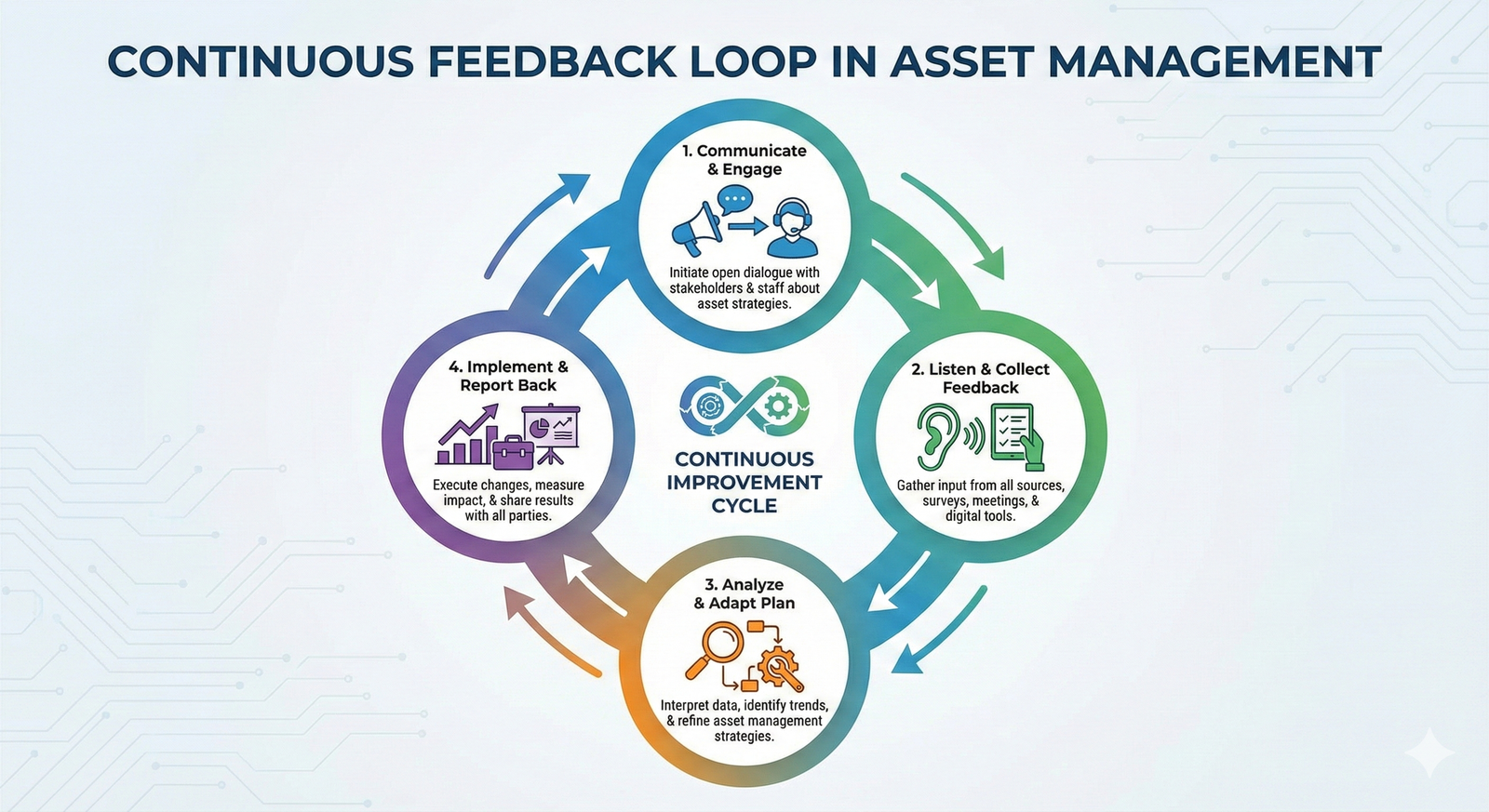
1. Acknowledge and Analyze: The first step is to acknowledge the feedback. Let people know you've received their input. Then, categorize and analyze it. Is this a one-off complaint or a recurring theme? What is the root cause of the concern?
2. Evaluate and Prioritize: You can't act on every single piece of feedback. Evaluate suggestions based on criteria like feasibility, cost, alignment with strategic goals, and risk. A formal risk matrix can be helpful here to decide which issues pose the greatest threat if left unaddressed.
3. Integrate and Adapt: This is where feedback leads to real change. The analysis might lead you to: * Modify an asset management plan: A capital project might be re-prioritized based on public concern over service failures. * Change a maintenance strategy: Feedback from technicians might lead to a change in the frequency or type of preventative maintenance. * Update a communication plan: If a stakeholder group consistently misunderstands your messaging, the plan itself needs to be adapted.
4. Report Back: This is the step that builds trust. Close the loop by communicating back to stakeholders what you heard and what you did about it. Even if you decide not to act on a suggestion, explaining the rationale shows respect for their input and builds credibility for future engagements.
The future of asset management is increasingly transparent. With the rise of social media and open data initiatives, organizations are more accountable than ever. Mastering the art and science of stakeholder engagement is no longer optional; it's the foundation upon which resilient, trusted, and successful infrastructure is built.
Closing
We've covered the essential framework for building consensus in asset management. It starts with a clear understanding that your assets exist within a complex ecosystem of people. Your first task is to map this ecosystem by identifying your internal and external stakeholders, from the boardroom to the local community. Once you know your audience, you must move beyond one-size-fits-all communication, developing targeted strategies that deliver the right message through the right channel to each distinct group.
But the process doesn't end when you send the message. True engagement is a cycle. By establishing clear channels for feedback, you transform stakeholders from a passive audience into active partners. Their insights are an invaluable resource for refining your asset management plans, mitigating risks, and ultimately, delivering better value. This continuous loop of communication, listening, and adaptation is what builds the trust and buy-in necessary to effectively manage your organization's most critical assets for the long term.
Learning Outcomes
By completing this reading, you have taken a significant step toward mastering a critical professional competency. You can now: * Identify and categorize the diverse range of internal and external stakeholders who have a vested interest in your organization's physical assets. * Develop and describe tailored communication strategies to effectively convey asset management policies and plans to different audiences, from financial executives to the general public. * Explain and appreciate the crucial role of stakeholder feedback as a tool for risk management, innovation, and the continuous improvement of asset management plans.
Assess Yourself
Ready to check your understanding? This short quiz will help you confirm you've grasped the key concepts from this reading.
❓ Knowledge Check
Test your understanding of the key concepts from this section.
Next Steps
Excellent work. You've just reviewed the foundational principles of effective stakeholder engagement, a skill that will serve you throughout your career in asset management.
Please navigate back to the course to continue with the next activity.
