
The Skill Being Assessed
Effective asset management depends on measuring what matters. For a public transit authority, the reliability and availability of its fleet are not just numbers on a spreadsheet—they directly impact public trust, operational efficiency, and rider safety. The ability to translate high-level strategic goals into specific, measurable Key Performance Indicators (KPIs) is a core competency for any asset management professional.
This assessment challenges you to apply this skill in a realistic context. You will step into the role of an asset manager and develop a set of KPIs that will drive performance and provide clear insight into the health of a transit fleet. This involves not only selecting the right metrics but also defining how they will be calculated and justifying their relevance to a strategic objective.
Your Task
You are an Asset Manager for the Metropolis Transit Authority (MTA). Your director has tasked you with creating a framework to measure progress against a new, critical strategic objective: "Improve fleet reliability by 10% over the next fiscal year."
Your task is to prepare a formal recommendation document. This document must identify a balanced set of six KPIs to track this objective. Specifically, you must: 1. Develop three leading KPIs that can predict future reliability performance. 2. Develop three lagging KPIs that measure historical reliability outcomes. 3. For each of the six KPIs, you must clearly define: * The Data Source (e.g., Computerized Maintenance Management System, On-board diagnostics). * The Calculation Method (the formula used to derive the number). * A realistic Target that aligns with the overall 10% improvement goal. 4. Provide a concise Justification for each KPI, explaining why it is a valid and valuable measure for achieving the strategic objective.
Resources and Data
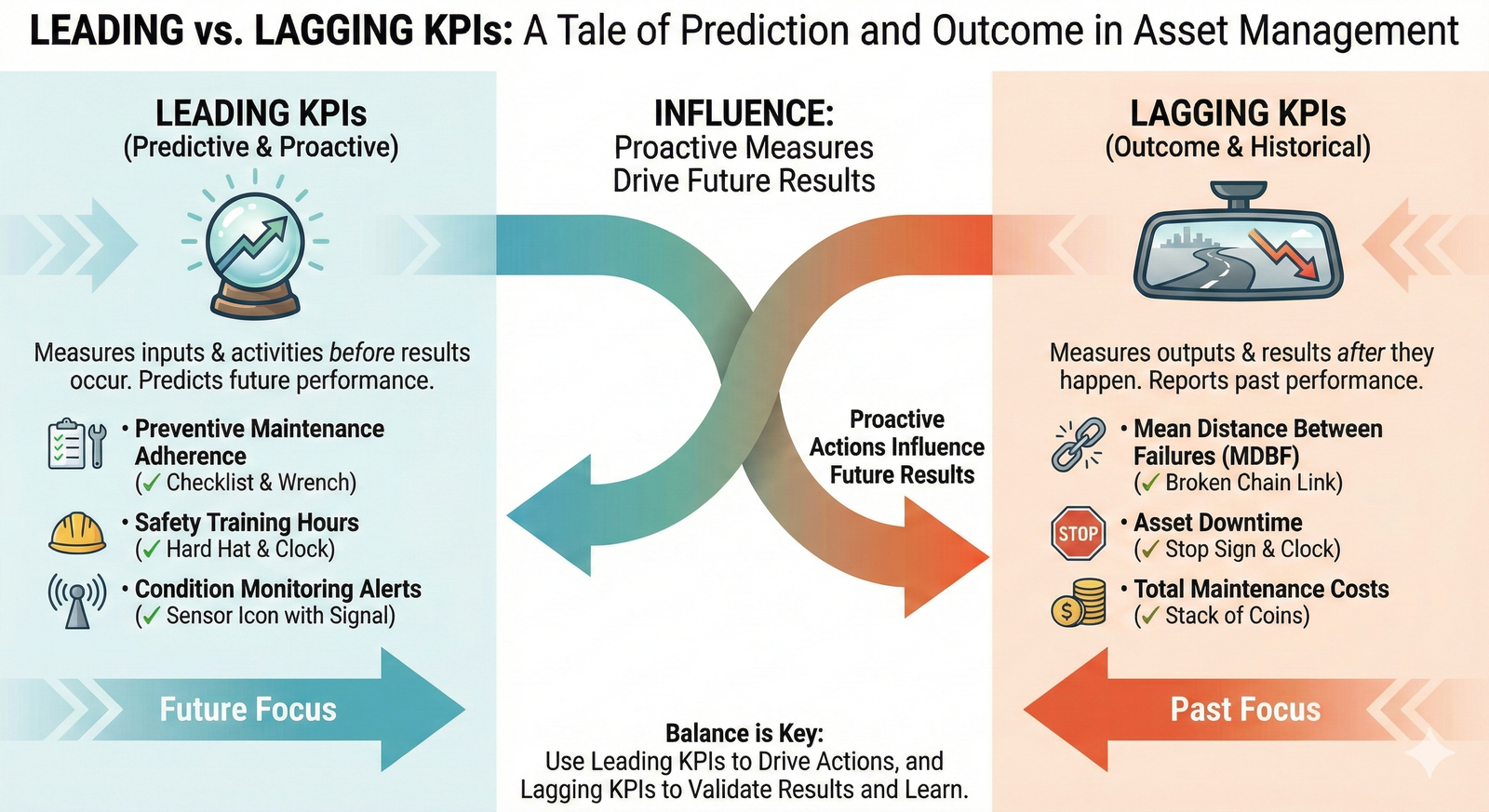
Use the following resources to inform your response. The memo from your director provides the official directive, the infographic clarifies the types of indicators you must develop, and the data sample gives you a realistic sense of the information you might have available.
Key Document: MEMORANDUM: KPI Development for Fleet Reliability
MTA Fleet Maintenance Log (Sample)
| Bus ID | Maintenance Type | Date of Service | Days Since Last Service | Odometer Reading km | Component Failure |
|---|---|---|---|---|---|
| MTA-101 | Preventive | 2023-03-15 | 90 | 125430 | No |
| MTA-205 | Inspection | 2023-03-20 | 32 | 250112 | No |
| MTA-310 | Corrective | 2023-04-02 | 55 | 89542 | Yes |
| MTA-101 | Corrective | 2023-05-10 | 56 | 138715 | Yes |
| MTA-415 | Preventive | 2023-06-01 | 120 | 310500 | No |
| MTA-205 | Preventive | 2023-06-18 | 90 | 268433 | No |
| MTA-310 | Inspection | 2023-07-05 | 94 | 108311 | No |
| MTA-101 | Preventive | 2023-08-08 | 90 | 156940 | No |
| MTA-415 | Corrective | 2023-08-21 | 81 | 326705 | Yes |
| MTA-205 | Inspection | 2023-09-01 | 75 | 283501 | Yes |
| MTA-205 | Corrective | 2023-09-02 | 1 | 283690 | Yes |
| MTA-310 | Preventive | 2023-10-03 | 90 | 126219 | No |
| MTA-101 | Inspection | 2023-11-06 | 90 | 175055 | No |
| MTA-415 | Preventive | 2023-11-19 | 90 | 344810 | No |
| MTA-205 | Preventive | 2023-12-01 | 90 | 301488 | No |
Submit Your Work
Insert DropBox here
Next Steps
Excellent work applying your knowledge to a practical asset management challenge. Developing meaningful KPIs is a fundamental skill that drives strategic success.
When you are ready, please navigate back to the main course page to continue your learning journey.