
Introduction
If you were to step back in time 30 or 40 years and ask someone what they did with their organization's physical assets—their buildings, pipes, vehicles, or machinery—the answer would likely have been simple: "We fix them when they break." This reactive, tactical approach was the undisputed reality for generations. The 'asset manager' of the day was the head of maintenance, a hero in moments of crisis but rarely a voice in the strategic planning of the organization.
Fast forward to today. That same question would elicit a very different response. You would hear about balancing costs against performance, mitigating risks, optimizing lifecycle value, and aligning asset strategies with the core objectives of the business. The conversation has shifted from fixing things to delivering value. This article traces that remarkable journey. We will explore how the discipline has evolved from a reactive maintenance function into a sophisticated, strategic field that is critical to the success and sustainability of any modern organization. Understanding this evolution is the first step to becoming a professional in this field, moving beyond the 'what' to grasp the 'why' behind modern Physical and Infrastructure Asset Management.
The Age of Reaction: "If It Ain't Broke, Don't Fix It"
For a long time, the prevailing wisdom regarding physical assets was straightforward. An asset, be it a water pump, a delivery truck, or a production line machine, was installed and run until it failed. This approach, known as reactive maintenance or "run-to-failure," was the default mode of operation.
The focus was entirely on repair. Maintenance departments were structured like fire departments, waiting for an alarm—a breakdown—to spring into action. Their success was measured by how quickly they could restore a failed asset to service. While this approach seems simple, its hidden costs were enormous. Unplanned downtime, collateral damage to other equipment, expensive emergency repairs, safety incidents, and frustrated customers were all common consequences. The organization was constantly in a state of catching up, never getting ahead.
A Step Toward Proactivity: The Rise of Preventive Maintenance
By the mid-20th century, engineers and managers began to realize the immense cost of unplanned failures. This led to the rise of preventive maintenance. The logic was sound: performing regular, scheduled maintenance on an asset could prevent many failures from happening in the first place. This was a significant philosophical shift. Instead of just reacting to failure, organizations started trying to prevent it.
This era saw the introduction of maintenance schedules based on time (e.g., service this vehicle every six months) or usage (e.g., overhaul this motor after 10,000 hours of operation). This approach brought more predictability and reduced the frequency of catastrophic failures. It was the first time organizations began to think systematically about the entire Asset Lifecycle of their assets, not just the operational phase.
However, preventive maintenance had its own drawbacks. It could be inefficient. Assets were often over-maintained, with parts being replaced and services performed based on a generic schedule, not the asset's actual condition. This meant resources were wasted on healthy assets, while others might still fail before their scheduled maintenance was due. A better way was needed.
The Information Age: Data-Driven Decisions and Condition-Based Maintenance
The computer revolution of the late 20th century was a game-changer. The emergence of the Computerized Maintenance Management System (CMMS) allowed organizations, for the first time, to systematically collect and analyze data about their assets. They could track work orders, maintenance costs, failure histories, and spare parts inventory.
This data unlocked a more intelligent approach: condition-based maintenance (CBM). Instead of relying on a calendar, maintenance could be triggered by the actual condition of the asset. This was made possible by new diagnostic technologies.

Techniques like vibration analysis, thermography, and oil analysis could detect the early signs of a developing fault. An unusual vibration pattern in a bearing or a hot spot on an electrical panel could signal an impending failure long before it became critical. Maintenance was no longer just preventive; it was becoming predictive. This focus on data allowed organizations to start measuring and managing asset Performance in a much more sophisticated way.
The Strategic Leap: The Birth of Modern Asset Management
While these advances in maintenance tactics were powerful, a bigger realization was dawning in boardrooms and executive suites. Managing physical assets was not just a technical problem to be solved in the basement; it was a strategic imperative that directly impacted the entire organization's success. Assets exist for a reason: to create value for the organization and its stakeholders.
This strategic perspective was formalized with the publication of standards like PAS 55 and its successor, the ISO 55000 series. These standards didn't prescribe specific maintenance techniques. Instead, they provided a framework for a management system. They defined Asset Management as a coordinated, top-down discipline focused on a single, crucial goal: realizing value from assets.
This was the most significant evolution of all. It shifted the focus from the assets themselves to the value they deliver.
The Core Principle: From Asset to Value
The fundamental shift in modern asset management is moving the conversation from 'What is the condition of this asset?' to 'What value does this asset provide, and how can we sustain and enhance that value?'. Every decision—whether to repair, replace, or upgrade—must be justified through its impact on value, risk, and performance.
This new paradigm is built on the careful balancing of three core elements: cost, risk, and performance. The goal is no longer simply to maximize performance or minimize cost. The goal is to find the optimal balance between them to deliver sustainable value.
The Central Role of Value
In this modern context, Value is not just about money. For a municipal water utility, value is the safe, reliable delivery of clean drinking water to its citizens. For an airport, value includes passenger safety, on-time departures, and a positive travel experience. For a power generation company, value is reliable electricity delivered to the grid while meeting environmental regulations. The organization must first define what value means to its stakeholders, and then align its asset management activities to deliver that value.
Understanding and Managing Risk
With any physical asset, there is always the possibility of failure. Modern asset management doesn't try to eliminate all risk—that would be prohibitively expensive. Instead, it seeks to understand and manage it. Risk is the combination of the likelihood of an asset failing and the consequences of that failure.
A leaking faucet in an office breakroom has a high likelihood of happening eventually, but the consequences are low (a small puddle, a minor repair bill). A failure of a critical support beam on a major bridge has a very low likelihood, but the consequences are catastrophic. An asset manager must focus their resources on mitigating the highest risks.
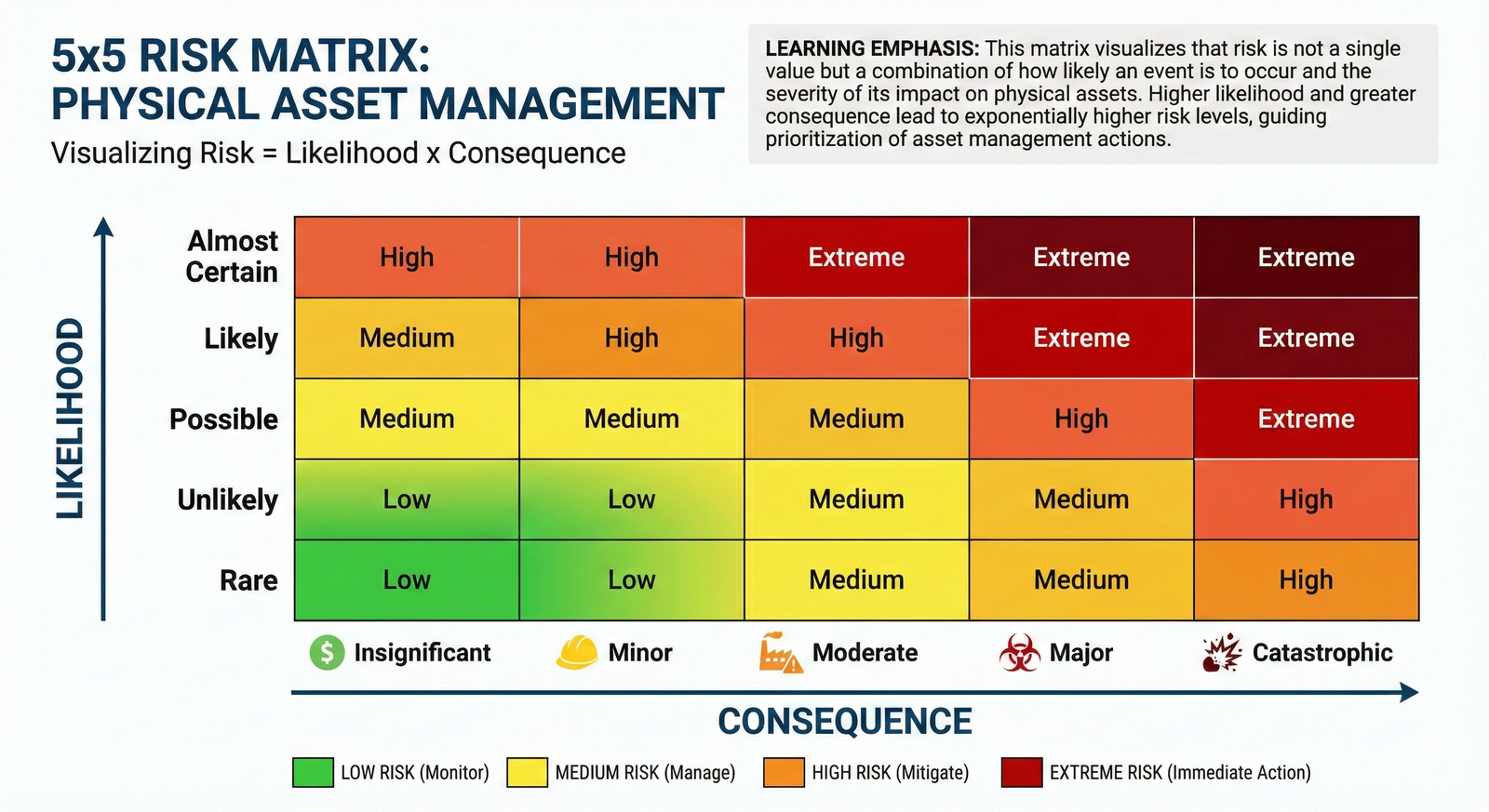
By analyzing risk, an organization can make informed decisions. It might be acceptable to let that breakroom faucet run-to-failure, but the bridge beam requires a rigorous inspection and monitoring program. This risk-based approach ensures that money and effort are spent where they matter most.
The Journey of an Asset: A Lifecycle View
This strategic approach requires thinking about an asset through its entire life. The decisions made when an asset is specified and purchased have huge implications for its operating costs, reliability, and eventual disposal cost.
📊 View Diagram: The Asset Management Lifecycle
For example, buying the cheapest pump available (a low acquisition cost) might seem like a good decision. But if that pump is inefficient, unreliable, and difficult to service, it will cost far more over its 20-year life than a more expensive, higher-quality alternative. Modern asset management uses techniques like Life Cycle Costing (LCC) to analyze these trade-offs and make the decision that provides the best long-term value.
The Future: The Digital Asset and Sustainable Value
The evolution is far from over. Today, we are entering a new phase driven by digitalization and a broader definition of value.
- Digital Twins: We can now create a virtual replica of a physical asset—a "digital twin"—that is continuously updated with real-time data from IoT sensors. An engineer can simulate the effect of a storm on a bridge, test a new operating parameter on a virtual turbine, or predict a failure months in advance, all from a computer.
- AI and Machine Learning: Artificial intelligence is taking predictive maintenance to the next level. AI algorithms can analyze vast amounts of complex data from thousands of sensors to identify subtle patterns that precede failure, patterns that a human analyst would never find.
- Sustainability and ESG: The definition of value is expanding. Organizations are now judged not just on their financial performance, but on their environmental, social, and governance (ESG) performance. Asset management is central to this. Decisions about asset efficiency directly impact an organization's carbon footprint. Decisions about asset location and failure risk impact community safety. A modern asset manager must balance financial objectives with these critical sustainability goals.
The journey from the maintenance shed to the boardroom has been a long one. It has transformed the discipline from a necessary, blue-collar expense to a strategic, white-collar profession critical for long-term, sustainable success.
Closing
We've traced the path of asset management from a simple, reactive function to a complex and vital strategic discipline. The focus has decisively shifted from merely 'fixing things' to the sophisticated challenge of 'delivering sustainable value'. This is the core of modern Physical and Infrastructure Asset Management. It’s no longer enough to be a good engineer or technician; you must also be a strategist, a financial analyst, and a risk manager.
As you move forward in your career, remember this evolution. The principles of balancing cost, risk, and performance across an asset's entire lifecycle are the foundation of every decision you will make. By understanding how these concepts work together to deliver value, as outlined in frameworks like ISO 55000, you are equipped not just to manage assets, but to drive the strategic objectives of your organization. This is how you will contribute to building a more resilient, efficient, and sustainable future.
Learning Outcomes
In this reading, you have explored the history and principles that define modern asset management. You can now explain the evolution of asset management from a reactive maintenance function to a strategic, value-driven discipline.
You are also now able to define and describe the core concepts that form the foundation of this field: * Asset Management: You can explain it as a coordinated, strategic system for realizing value from assets. * Value: You can define value in both financial and non-financial terms as it relates to an organization's objectives. * Risk: You can describe risk as the combination of the likelihood and consequence of failure. * Performance: You can explain performance as the measure of how well an asset fulfills its intended function. * Asset Lifecycle: You can identify the key stages of an asset's life and understand the importance of making decisions across the entire cycle.
Assess Yourself
❓ Knowledge Check
Test your understanding of the key concepts from this section.
Next Steps
You have successfully completed this reading and have a solid foundation in the history and core principles of modern asset management. Please navigate back to the course module to continue with your next activity.
