
Welcome to Asset Management
Welcome to the first module of your journey into Physical and Infrastructure Asset Management (PIAM). When you turned on the lights this morning or had a glass of water, you interacted with a complex network of assets. The power grid, the water treatment plant, the pipes—these are the silent, essential systems that support our daily lives. The discipline of managing these systems, ensuring they deliver value safely and reliably, is at the heart of PIAM.
This isn't just a field for engineers or finance managers; it's a multidisciplinary profession that requires a holistic view of how an organization's physical backbone supports its strategic goals. In this module, we'll establish the foundational principles of PIAM, exploring what it is, why it's essential, and who is involved in making it happen.
This first module sets the stage for everything that follows. My role is to be your learning coach, helping you connect the dots and focus on what's most important. For this module, concentrate on grasping the "big picture"—don't get too lost in the details just yet. The goal is to build a solid mental framework you can hang future knowledge on.
The Core Idea: What is Asset Management?
At its core, Asset Management is a systematic approach to decision-making. Think of a city's public transit authority. It doesn't just buy buses and run them until they break down. It makes coordinated decisions about which buses to buy, how to maintain them, when to refurbish them, and when to replace them, all while balancing budgets, rider safety, and service reliability. That coordinated activity is asset management in action.
The assets themselves fall into two broad categories.
Physical Assets are the individual, tangible items. In our transit example, a single bus, a specific signal light, or a maintenance depot are all physical assets.
from them. This isn't just about profit. For a municipal water utility, value includes public health and environmental protection. For a power company, it includes grid reliability.
Achieving this value requires a constant balancing act between three competing factors:
- Performance: How well does the asset do its job? Does the bridge handle the required traffic load? Does the power plant generate the expected amount of electricity?
- Cost: What are the total costs of owning and operating the asset over its entire life? This includes not just the initial purchase price but also maintenance, operations, and eventual disposal.
- Risk: What is the chance of something going wrong, and what would be the consequences?
Imagine you are the asset manager for a fleet of delivery trucks. Spending more on preventative maintenance (higher cost) improves reliability (higher performance) and reduces the chance of a breakdown on a critical delivery (lower risk). Spending less saves money upfront but could lead to costly failures and unhappy customers down the road. Asset management is the science and art of finding the optimal balance point.
📊 View Diagram: The Asset Management Balancing Act
This concept of balancing cost, risk, and performance is the absolute heart of PIAM. You'll see it again and again throughout this course. Take a moment to think of an asset you interact with daily—your car, your apartment building, or even your laptop. How do you personally balance these three factors? This simple exercise can make the concept much more concrete.
To explore this foundational concept further, your first reading provides a deeper look into how the profession has evolved from a simple focus on maintenance to a strategic focus on value.
Reading: The Evolution of Asset Management: From Maintenance to Value Creation
Launch the reading to explore a key course topic.
The Framework: Lifecycle, Standards, and Plans
To manage assets effectively, we need a structured approach. This starts with understanding the Asset Lifecycle. Decisions made in the early design stage can have massive impacts on maintenance costs decades later. A holistic view is essential.
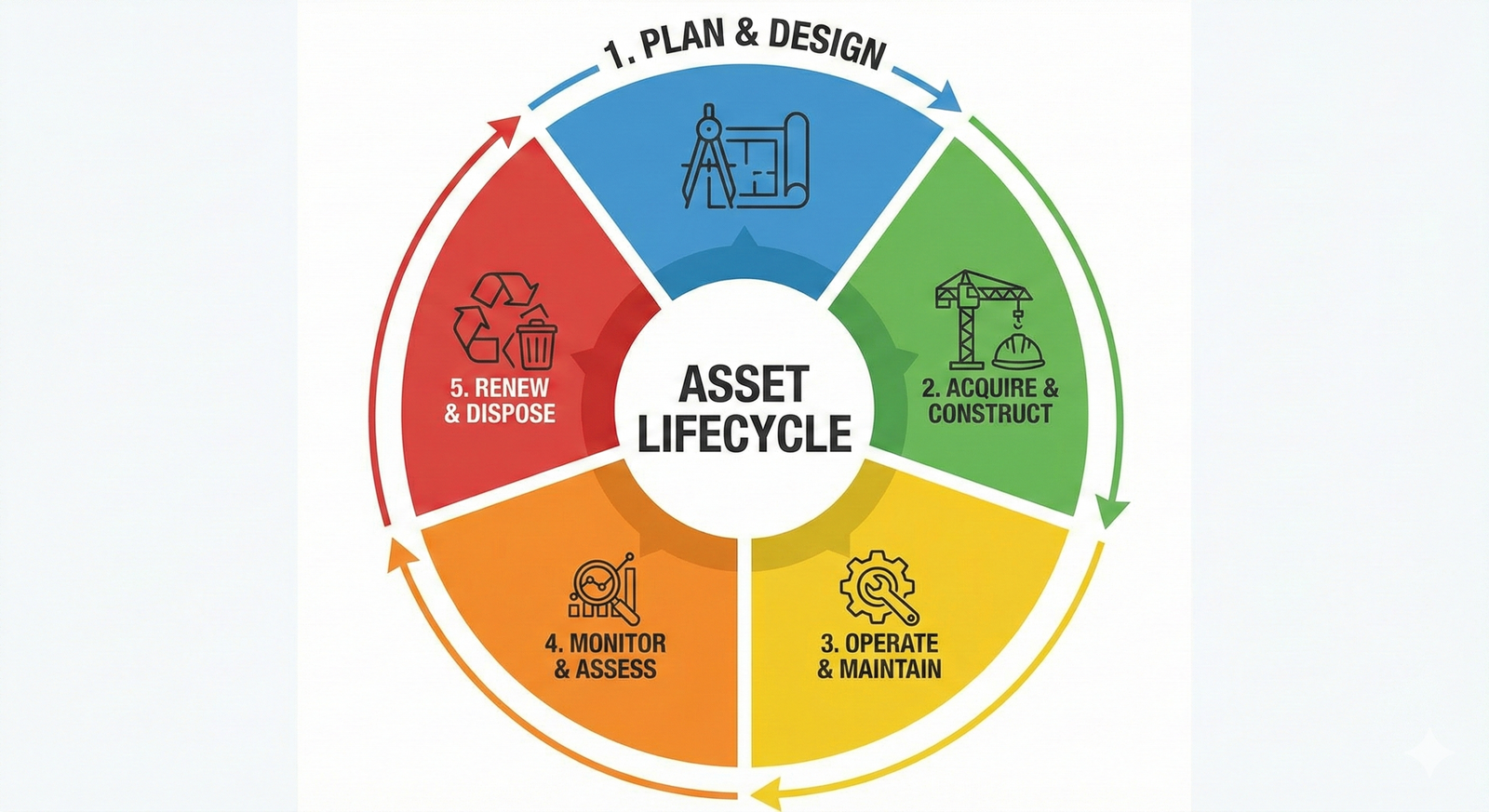
This lifecycle approach is formalized in a set of international standards known as ISO 55000. These standards don't tell you exactly how to manage your assets, but they provide a globally recognized framework for what a good asset management system should look like.
Within this framework, organizations create a hierarchy of documents to guide their actions:
- Asset Management Policy: This is the top-level statement from leadership, aligning asset management with the organization's overall mission.
- Asset Management Strategy: This translates the policy into a long-term approach, setting objectives for the asset portfolio.
- Asset Management Plan: These are the detailed, on-the-ground plans for specific assets or asset systems.
Document Hierarchy
Think of it like this: The Policy is the destination (e.g., 'We will provide the safest municipal bridges'). The Strategy is the map (e.g., 'We will achieve this through a 20-year inspection and renewal program'). The Plan is the turn-by-turn directions for a specific bridge (e.g., 'Bridge A-101 will be inspected in Q3 and repainted in Q4').
Your second reading for this module uses a story-based approach to show how these documents and a proactive mindset can make a world of difference in real-world outcomes.
Reading: A Tale of Two Cities: Proactive vs. Reactive Asset Management
Launch the reading to explore a key course topic.
The People: Identifying Key Stakeholders
Asset management doesn't happen in a vacuum. It involves a wide range of people and groups, both inside and outside the organization. We call these individuals or groups Stakeholder.
Identifying stakeholders and understanding their interests is a critical skill. The finance department is a stakeholder, concerned with budgets and return on investment. The maintenance crew is a stakeholder, concerned with safety and the workability of a repair plan. Government regulators are stakeholders, concerned with compliance. The public who uses the asset is perhaps the most important stakeholder of all. A successful asset manager must be able to navigate the often-competing interests of these groups.
Now we're moving from the 'what' to the 'who'. The following activity is a skills instructional. It's designed to give you a structured method for a core professional task. Pay close attention to the steps involved, as this is a process you'll use throughout your career.
Skills Practice: Stakeholder Identification and Analysis in PIAM
Launch the interactive skills practice to build and apply your new abilities.
Great work on that skills exercise. To help you synthesize everything we've covered in this module—from the core principles to stakeholder analysis—we'll use an instructional case study. This is a low-stakes way to apply your new knowledge to a realistic scenario. It's a chance to practice thinking like an asset manager.
Case Study: The Case of the Aging Municipal Bridge
Launch the interactive case study to analyze a real-world scenario.
Assess Yourself
It's time for a quick self-check. This ungraded quiz is for you to gauge your understanding of the key terms and concepts from this module. Read the feedback on each question, whether you get it right or wrong. It's designed to reinforce the main ideas before you move on.
❓ Knowledge Check
Test your understanding of the key concepts from this section.
Wrapping Up
Congratulations on completing your first module! You've laid the essential groundwork for the rest of this course. You can now explain the fundamental principles of PIAM—that it's a coordinated activity to realize value from assets by balancing performance, cost, and risk. You've also learned to identify the key stakeholders involved and appreciate their different perspectives. This is the foundation upon which all other asset management competencies are built.
Next Steps
You have successfully completed the learning activities for this module. Please navigate back to the main course page to review your upcoming assessments and continue to the next module.
