
Introduction
Imagine you've just been hired as the new Director of Public Works. You have two cities vying for your leadership: Reactia and Proactivia.
In Reactia, your phone never stops ringing. A water main has burst downtown, flooding streets and closing businesses. Last week, a bridge was closed for emergency structural repairs, causing city-wide gridlock. The budget is a constant battleground of unexpected costs, and public trust is at an all-time low. Your days are spent lurching from one crisis to the next.
In Proactivia, things are different. Your calendar is filled with scheduled reviews of asset performance data and planned maintenance projects. The budget is predictable. When a major water main replacement is due, it's been on the books for years, funded, and planned to minimize public disruption. Your conversations with city council are about long-term value and improving service levels.
Both cities have the same types of assets—roads, pipes, buildings, and bridges. The difference isn't in their infrastructure; it's in their philosophy. This is the fundamental divide between reactive and proactive asset management. One approach leads to chaos and escalating costs, while the other leads to stability, reliability, and long-term value. In this reading, we'll walk through the streets of both cities to understand not just the "what" but the "why" behind these two opposing worlds.
Welcome to Reactia: The City of Perpetual Crisis
Life in Reactia is defined by the "run-to-failure" model. Things are fixed only after they break, often spectacularly. The city's public works department is seen as a collection of heroic firefighters, rushing to the latest disaster.

This approach feels intuitive to some. Why spend money on something that isn't broken? The problem is that this ignores a fundamental truth of physical assets: failure is never a matter of "if," but "when." And when failure occurs, it is almost always at the worst possible time, with the highest possible cost.
In Reactia, there's no overarching plan. Decisions are made based on the loudest complaint or the most visible failure. This creates a vicious cycle:
- Asset Failure: A critical component breaks down unexpectedly.
- Emergency Response: All resources are diverted to fix the immediate problem. This often involves overtime pay, rush orders for parts, and expensive contractors.
- Collateral Damage: The failure causes secondary problems—business interruption, damage to adjacent property, loss of service to customers.
- Budget Strain: The unplanned, premium costs of the emergency repair consume funds that could have been used for planned work.
- Deferred Maintenance: With time and money spent on the latest crisis, other assets continue to degrade, bringing them closer to their own failure point. The cycle repeats.
This entire system is operating without a structured understanding of Risk. In Reactia, risk isn't managed; it's simply experienced. Every potential failure is treated as equally (un)important until it becomes a crisis.
The True Cost of Reactive Maintenance
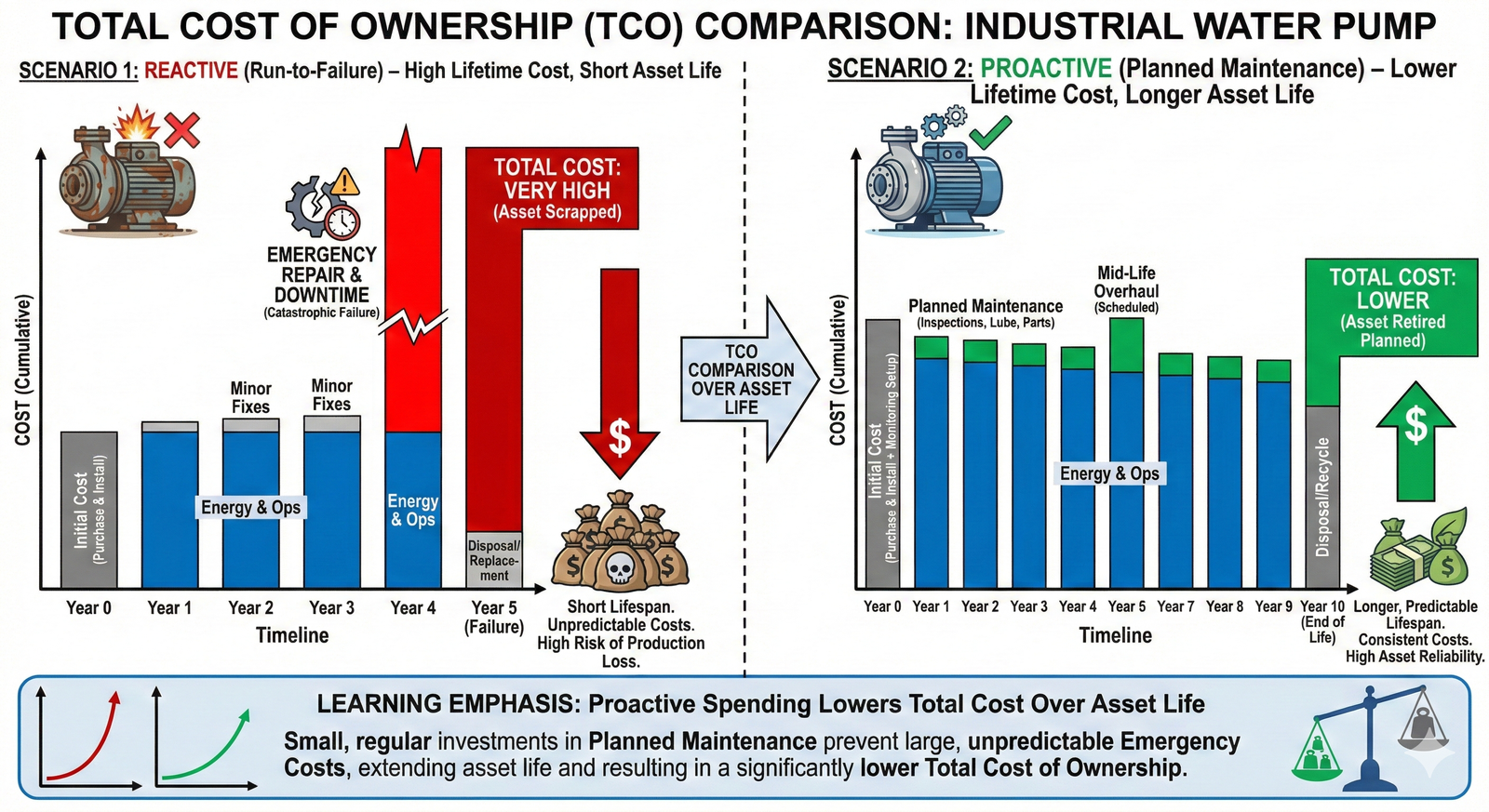
Studies consistently show that reactive maintenance is three to five times more expensive than proactive, planned maintenance. This doesn't even account for the indirect costs of lost production, safety incidents, reputational damage, and decreased asset lifespan. Running to failure is a direct path to financial and operational instability.
The Turning Point: A New Philosophy
No organization can survive in the Reactia model forever. The financial and political costs become unsustainable. The turning point comes when leadership decides to stop fighting fires and start preventing them. This requires a fundamental shift from being a reactive repair service to a proactive value-delivery organization.
This shift doesn't happen with a single decision. It's built on a foundation of clear, documented principles and plans. This is the framework that turns Reactia into Proactivia. It's a system of connected documents that align the entire organization, from the city council to the technician in the field.
📊 View Diagram: The Asset Management Hierarchy
This hierarchy provides the clarity and direction that Reactia so desperately lacks. Let's break down how Proactivia is built on this foundation.
Welcome to Proactivia: The City of Planned Value
Proactivia looks and feels different because it operates on a different set of rules. The work is deliberate, data-informed, and strategic. This is all guided by the formal asset management framework.
The Foundation: The Asset Management Policy
Everything in Proactivia starts with the "why." Before they even talk about which pipes to replace, they establish their guiding principles. This is the Asset Management Policy.
Think of it as the city's mission statement for its physical assets. It's a short, powerful document that answers questions like: * Why do we have assets? (e.g., "To provide safe, reliable, and cost-effective public services.") * What are our commitments? (e.g., "We commit to complying with all regulatory requirements, managing risk, and pursuing continual improvement.") * Who is responsible? (e.g., "Top management is accountable for establishing and supporting the asset management system.")
This policy provides the authority and mandate for the entire program. It's the document the Director of Public Works can point to when requesting a budget for condition assessments, proving that their work is directly tied to the city's stated goals.
The Blueprint: The Asset Management Strategy
With the "why" established, Proactivia defines the "what" and "how" over the long term. This is the Asset Management Strategy, sometimes called a Strategic Asset Management Plan (SAMP).
This document looks at the big picture. It considers the current state of the assets, the desired future state (levels of service), and the financial resources available. It sets long-term objectives, such as: * "Reduce water main breaks by 50% over the next 10 years." * "Ensure 95% of city-owned bridges have a 'Good' or 'Fair' condition rating by 2035." * "Implement a new asset information system to improve data-driven decision-making within 3 years."
The strategy is where the concept of managed risk becomes central. The city analyzes its asset portfolio to understand which failures would have the biggest consequences. This allows them to prioritize their efforts, focusing on critical assets first.
The Playbook: The Asset Management Plan
The strategy sets the long-term direction. The Asset Management Plan details the specific actions to get there. This is the "who, what, where, when, and how" of asset management.
Proactivia doesn't have one single plan; it has a collection of them, often grouped by asset type. There's an Asset Management Plan for the water distribution network, another for roads and bridges, and another for public buildings.
Each plan contains detailed information, such as: * An inventory of the assets covered. * The current condition and performance of those assets. * The planned maintenance activities (e.g., inspections, cleaning, component replacements). * The capital renewal projects (e.g., which 50-year-old water mains will be fully replaced in the next 5 years). * The budget required for these activities. * The risk associated with not performing the work.
This is where data becomes king. Proactivia invests in condition assessments, predictive modeling, and a robust asset registry. They don't guess which assets need attention; they know.

The Guiding Standard: ISO 55000
Where did Proactivia get this framework of Policy, Strategy, and Plans? While the principles are decades old, they were formalized and globally standardized in a series of documents known as ISO 55000.
This standard doesn't tell you how to manage your assets. It tells you what a good management system looks like. It emphasizes the importance of leadership, planning, risk management, and continual improvement. It provides a common language and a benchmark for excellence, ensuring that an organization's asset management activities are directly linked to achieving its overall business objectives. Adopting this framework is what gives Proactivia its structure and discipline.
The Financial Payoff
The difference between the two cities is starkly visible in their budgets. Let's look at a simplified comparison of annual costs for a segment of their water network.
Table 1: Annual Water Network Costs - Reactia vs. Proactivia
| City | Planned Maintenance & Inspection | Emergency Repairs | Indirect Costs (Estimated) | Total Annual Cost |
|---|---|---|---|---|
| Reactia | 50000 | 800000 | 400000 | 1250000 |
| Proactivia | 250000 | 75000 | 25000 | 350000 |
As the data shows, Proactivia spends more on being prepared. That investment, however, pays for itself many times over by avoiding the exorbitant costs of failure. This is the core financial argument for proactive asset management.
Closing
The tale of Reactia and Proactivia is more than just a story; it's a daily reality for organizations everywhere. The path of Reactia is the path of least resistance in the short term, but it leads to a future of escalating costs, unacceptable risk, and eroding public trust. It is fundamentally unsustainable.
Proactivia represents a conscious choice to manage the future. By implementing a structured system guided by an Asset Management Policy, a long-term Strategy, and detailed Asset Management Plans—all aligned with the principles of a standard like ISO 55000—an organization can move from a state of chaos to one of control. This journey transforms public works from a cost center focused on repairs into a value-delivery function focused on achieving strategic objectives. As a professional in this field, your primary role is to be an architect of Proactivia, building a foundation for reliability, predictability, and long-term value for the communities and organizations you serve.
Learning Outcomes
By completing this reading, you have taken a significant step in understanding the core philosophies of modern asset management. You can now effectively compare and contrast the chaotic, costly nature of reactive management with the stable, value-driven approach of proactive management.
Furthermore, you can now identify and describe the foundational elements that enable a proactive system:
- Asset Management Policy: The high-level commitment and "why" behind the program.
- Asset Management Strategy: The long-term "what" that translates policy into objectives.
- Asset Management Plan: The tactical "how" that details specific actions and resources.
- ISO 55000: The international standard that provides a framework for excellence.
- Risk: The combination of an event's probability and consequences, which is central to prioritizing proactive work.
Assess Yourself
Ready to check your understanding? This brief quiz will help you confirm you've grasped the key distinctions between the concepts we've discussed.
❓ Knowledge Check
Test your understanding of the key concepts from this section.
Next Steps
Excellent work. You've explored the fundamental choice that every asset-owning organization must make. This understanding of proactive versus reactive management is the bedrock upon which all other asset management competencies are built.
Please navigate back to the course page to continue to your next activity.
