
The Skill
Stakeholder analysis is the process of identifying individuals, groups, or organizations that could be affected by a project or business venture. The process also involves assessing their respective interests, influence, and potential impact on the project's success.
For physical and infrastructure asset management, this means looking beyond the technical specifications of a project. You must systematically identify who has a stake in the outcome—from government regulators and investors to local communities and internal maintenance teams—and understand their motivations and level of power.
Why Is This Skill Important?
In asset management, projects often involve significant public and private investment, impact communities, and require regulatory approval. Failing to manage stakeholder relationships effectively can lead to project delays, budget overruns, negative public perception, and even outright project cancellation.
A thorough stakeholder analysis allows you to anticipate potential conflicts, build supportive coalitions, and tailor your communication strategies. By understanding who holds power and who has a high interest in your project, you can allocate your time and resources efficiently, turning potential obstacles into project advocates and ensuring a smoother path from planning to execution.
Your Task
The City of Northwood is planning a major upgrade to its central water treatment plant, a facility built in the 1970s. The project aims to increase capacity, improve water quality to meet new federal standards, and enhance the plant's energy efficiency. This is a high-profile, multi-year project with a significant budget.
Your task is to conduct a stakeholder analysis for the Northwood Water Treatment Plant Upgrade project. You will identify the key stakeholders, map them using the Power/Interest Grid, and propose initial strategies for engaging with them.
Your Process
- Review the provided project memo and stakeholder list.
- Identify and list all potential stakeholders.
- Assess each stakeholder's level of power and interest in the project.
- Map each stakeholder to the appropriate quadrant on a Power/Interest Grid.
- Recommend a primary engagement strategy for each quadrant.
Resources and Data
Use the following resources to complete your analysis. The project memo provides the official context, while the stakeholder list gives you a starting point for your identification process.
Key Document: Project Memo: Northwood Water Treatment Plant Upgrade
Potential Project Stakeholders
| Stakeholder | Affiliation | Initial Notes |
|---|---|---|
| Mayor's Office, City of Northwood | City Government Leadership | Primary concerns are the project budget, timeline, and positive public perception. Key approver for funding and political support. |
| Northwood Department of Public Works | Project Owner / Operator | Focused on operational efficiency, long-term reliability, ease of maintenance, and meeting regulatory requirements. Will be the primary technical contact. |
| City of Northwood Finance Department | Internal City Staff | Responsible for securing funding (bonds, grants), managing the budget, and analyzing the impact on resident water rates. |
| U.S. Environmental Protection Agency (EPA) Region 5 | Federal Regulatory Body | Concerned with compliance with the Clean Water Act and Safe Drinking Water Act. Will review and approve designs and monitor discharge permits. |
| State Department of Environmental Quality | State Regulatory Body | Enforces state-level water quality standards. Will be involved in permitting, construction oversight, and final operational approval. |
| Northwood Chamber of Commerce | Business Community Representative | Interested in opportunities for local contractors and minimizing disruption to local businesses. Concerned about potential water rate hikes for commercial users. |
| Oak Creek River Keepers Alliance | Environmental Advocacy Group | High interest in the environmental impact of treated water discharge into the Oak Creek. Will likely advocate for the highest possible treatment standards. |
| Residents of the Millbrook Neighborhood | Adjacent Community | Directly impacted by construction noise, traffic, and potential odors. Will require proactive communication and mitigation plans. |
| HydraBuild Construction Inc. | Potential General Contractor | Seeking to win the construction bid. Interested in project scope, bidding process, and timeline. |
| Northwood Ratepayers Alliance | Community Group | A citizen group focused on the financial impact to residents. Will scrutinize project costs and any proposed increases in water bills. |
Detailed Steps
Follow these steps to build your stakeholder analysis.
Step 1: Understand the Core Concepts
Before you begin, be certain you understand the two dimensions of the grid.
Power
Interest
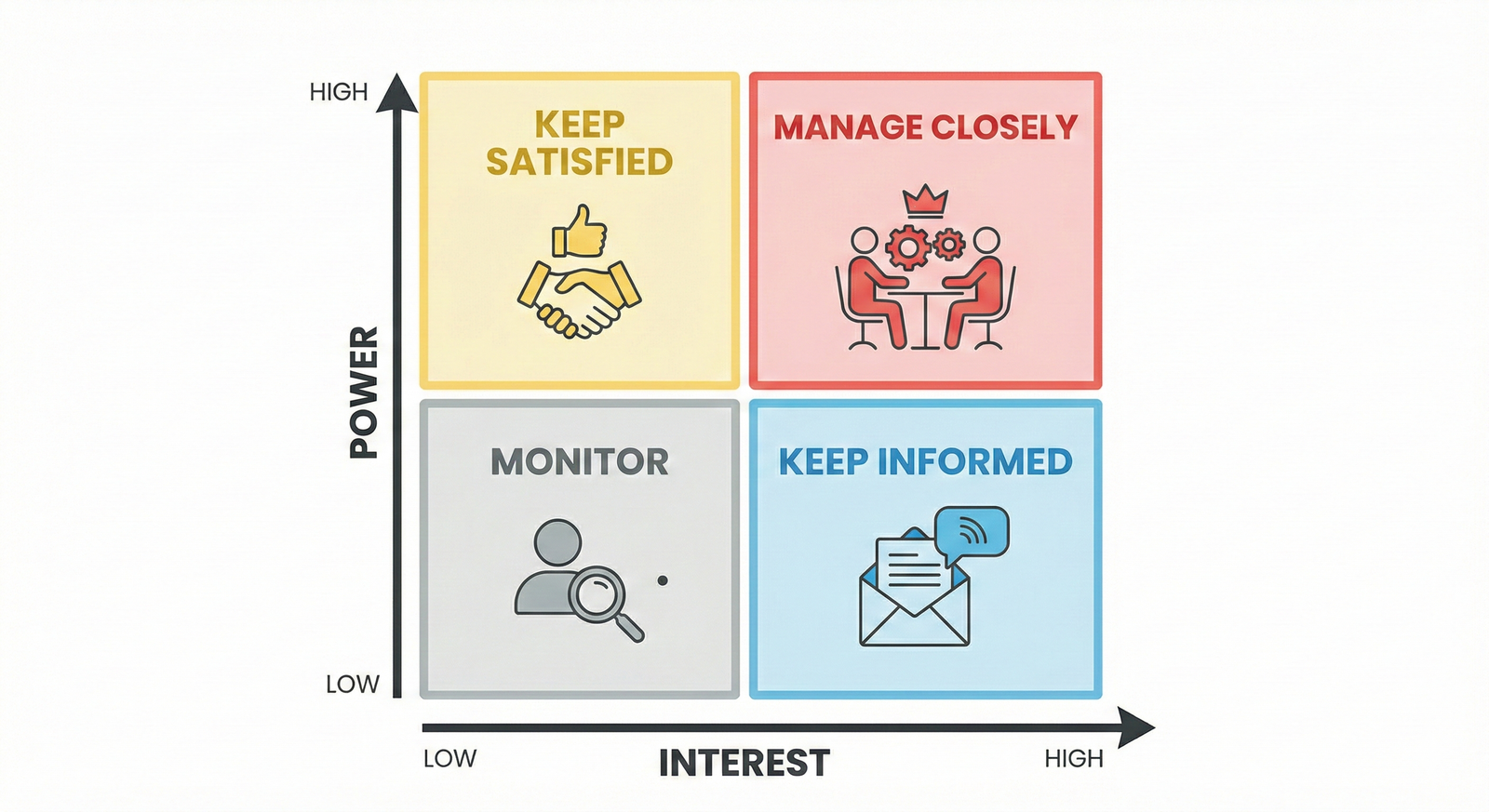
The Power/Interest Grid uses these two dimensions to create four quadrants, each with a specific engagement approach.
📊 View Diagram: Stakeholder Engagement Strategies
Step 2: Identify Your Stakeholders
Review the Project Memo and the initial Stakeholder List provided in the Resources section. Brainstorm any other individuals or groups that might have a stake in this project. Think broadly. Who will do the work? Who will pay for it? Who will be impacted by construction? Who regulates the outcome?
Pro Tip: Think in Categories
To ensure a comprehensive list, think in categories: Internal (within the city organization), External (government, community), Supply Chain (contractors, suppliers), and Financial (investors, taxpayers).
Step 3: Assess Power and Interest
For each stakeholder you identified, assign a "High" or "Low" rating for both Power and Interest. Justify your reasoning.
For example: * Stakeholder: Federal EPA * Power: High. They have regulatory authority and can impose fines or halt the project if standards are not met. * Interest: High. They are mandated to ensure compliance with federal water quality standards.
- Stakeholder: A single taxpayer living across town.
- Power: Low. An individual has little direct ability to influence the project.
- Interest: Low. The project has a minor, indirect financial impact and no direct effect on their daily life.
Step 4: Map Stakeholders to the Grid
Now, place each stakeholder into the appropriate quadrant of the Power/Interest Grid based on your assessment in Step 3. You can sketch this out on paper or create a simple table.

Step 5: Propose Engagement Strategies
For each quadrant, define the primary engagement strategy you will use. Your goal is to use your resources effectively by tailoring the communication and engagement effort to the stakeholder's position on the grid.
Engagement Strategy Guide
Manage Closely (High Power, High Interest): Collaborate directly. Involve them in decision-making and consult with them regularly.
Keep Satisfied (High Power, Low Interest): Keep them happy but don't overwhelm them with details. Provide executive summaries and ensure their primary needs are met.
Keep Informed (Low Power, High Interest): Communicate regularly through newsletters, public meetings, and project websites. Acknowledge their concerns and demonstrate how they are being addressed.
Monitor (Low Power, Low Interest): No specific, targeted communication is needed, but monitor their sentiment for any changes. General public information is sufficient.
Use this guide to write a specific recommendation for at least one key stakeholder in each quadrant. For example, "For the Mayor (Manage Closely), we will schedule bi-weekly project briefings and include her in key decision-making meetings."
An Expert Response
Note on This Response
This is a sample expert response that demonstrates a thorough and well-reasoned analysis. Your own analysis may differ in some assessments, and that is perfectly acceptable as long as your reasoning is sound. The goal is the quality of the analysis, not a single 'correct' answer.
Stakeholder Analysis: Northwood Water Treatment Plant Upgrade
1. Identified Stakeholders: A comprehensive list includes: * Internal: City Manager, Mayor & City Council, Department of Public Works (DPW), City Finance Department, Plant Employees. * External: Federal EPA, State Environmental Agency, Local Residents (especially those near the plant), Broader City Taxpayers, Local Businesses/Chamber of Commerce, "River Keepers Alliance" (environmental group), Local Media. * Supply Chain: General Contractor, Engineering & Design Firm, Equipment Suppliers.
2. Power/Interest Grid Mapping:
-
Manage Closely (High Power, High Interest):
- Mayor & City Council: High political power, high interest in project success and public perception.
- Department of Public Works (DPW): High operational power and responsibility, high interest as the project owner.
- Federal EPA: High regulatory power, high interest in compliance.
-
Keep Satisfied (High Power, Low Interest):
- City Manager: High administrative power, but lower interest than DPW as they manage many city projects.
- General Contractor: High power over construction, but interest is primarily commercial/contractual, not long-term operational.
- City Finance Department: High power over budget and bonds, lower interest in technical details.
-
Keep Informed (Low Power, High Interest):
- Local Residents near the plant: Low individual power, but high interest due to construction noise, traffic, and proximity.
- "River Keepers Alliance": Low direct power, but high interest in environmental impact. Can gain power through media and public campaigns.
- Plant Employees: Low individual power, but very high interest in job security, training, and future working conditions.
-
Monitor (Low Power, Low Interest):
- Broader City Taxpayers: Low individual power and interest, concerned about tax impact but not project details.
- Local Businesses (not near the plant): Low power and interest, generally supportive of infrastructure improvement but not directly affected.
3. Proposed Engagement Strategies:
-
For 'Manage Closely' (e.g., Mayor & Council):
- Strategy: Active Collaboration.
- Action: Establish a formal steering committee with representatives. Conduct bi-weekly progress briefings. Consult on all major scope, budget, or schedule changes.
-
For 'Keep Satisfied' (e.g., General Contractor):
- Strategy: Maintain a strong professional relationship.
- Action: Hold regular, efficient project management meetings focused on contractual obligations, timelines, and issue resolution. Ensure prompt payment and clear communication channels.
-
For 'Keep Informed' (e.g., Nearby Residents):
- Strategy: Proactive and Transparent Communication.
- Action: Create a project-specific page on the city website with updates. Send quarterly newsletters. Host a town hall meeting before construction begins to address concerns about noise, traffic, and safety. Provide a dedicated contact person for inquiries.
-
For 'Monitor' (e.g., Broader City Taxpayers):
- Strategy: General Public Awareness.
- Action: No targeted communication needed. Rely on general media coverage and information available on the city's main website.
Assess Yourself
Evaluate Your Work
Use the following criteria to evaluate the quality and completeness of your stakeholder analysis. Compare your response to the expert example to identify areas for improvement.
- Comprehensive Identification: Your list should go beyond the obvious and include a wide range of internal, external, and supply chain stakeholders.
- Logical Assessment: Your assignments of "Power" and "Interest" should be based on a clear and defensible rationale derived from the project context.
- Accurate Mapping: Stakeholders must be placed in the quadrant that directly corresponds to your power and interest assessments.
- Strategic Alignment: The engagement strategies you propose must be appropriate for the stakeholders' position on the grid and should be specific and actionable.
- Clarity of Communication: Your final analysis should be organized, easy to understand, and present a professional evaluation of the stakeholder landscape.
Learning Progress
In this activity, you have practiced the essential skill of performing a stakeholder analysis for a complex infrastructure project. You successfully identified and categorized key stakeholders, applied the Power/Interest Grid to map their relative importance, and proposed targeted engagement strategies based on your findings.
Next Steps
You have successfully completed this skill-building activity. Your ability to analyze and manage stakeholders is a critical competency in asset management. Please navigate back to the main course page to continue your learning.
