
Introduction
Have you ever dispatched a maintenance crew to repair a critical pump, only to find they brought the wrong parts because the asset ID was incorrectly entered years ago? Or perhaps you've sat in a capital planning meeting where no one could agree on which assets were most in need of replacement because the condition data was inconsistent, incomplete, or just plain wrong. These aren't hypothetical scenarios; they are the costly, everyday realities in organizations that lack control over their asset information. The problem isn't a lack of data. We are drowning in it. The problem is a lack of trustworthy data.
This is where the discipline of data governance comes in. It’s not just an IT function or a box-ticking exercise. For an asset management professional, it is the foundational practice that turns raw data into reliable information, and reliable information into sound, defensible decisions. This article will introduce you to the core principles of data governance, showing you how to build a framework of trust for the information that underpins every aspect of physical and infrastructure asset management.
The High Cost of "Good Enough" Data
In asset management, decisions are our primary product. We decide when to inspect, when to maintain, when to repair, and when to replace. Every one of these decisions is a bet, and the quality of our data determines the odds. When we operate with poor data, we are essentially gambling with operational stability, public safety, and millions of dollars in capital and operational expenditure.
The impacts are felt across the organization. Finance can't produce accurate depreciation schedules or asset valuations. Operations struggles with unplanned downtime because predictive models fail. Compliance teams are exposed to audit failures and potential fines. The cumulative effect is an organization that is constantly reactive, inefficient, and carrying an unacceptable level of risk. The belief that data is "good enough" is one of the most expensive assumptions an asset-intensive organization can make.
The Ripple Effect of Bad Data
A single incorrect entry in an asset register—a wrong installation date, a mistyped model number—can cascade through your systems. It can lead to ordering the wrong spare part, calculating incorrect maintenance intervals, underestimating asset risk, and ultimately, a preventable failure that impacts service delivery and safety.
At the heart of this issue is a concept called Data Quality. This isn't an abstract idea; it's a measurable state. Is the data accurate? Is the location of that underground valve recorded to within a meter or a kilometer? Is it complete? Do we know the installation date, manufacturer, and maintenance history for all our critical transformers? When you can't answer "yes" with confidence, you don't have a data problem; you have a trust problem.

Introducing Data Governance: Your Framework for Trust
If poor data quality is the disease, then Data Governance is the cure. It is a strategic program, not a one-off project. It establishes the rules of the road for how data is created, stored, used, and retired. Think of it as creating a system of "checks and balances" for your organization's data.
A robust data governance framework is built on several key principles:
- Accountability: Someone is formally responsible for specific sets of data. This includes defining what "good" looks like and ensuring it stays that way.
- Standardization: The organization agrees on common definitions, formats, and values for its data. An asset's "criticality" should mean the same thing in the engineering department as it does in the finance department.
- Quality: Processes are put in place to measure, monitor, and remediate data quality issues. This moves the organization from reactive cleanup to proactive management.
- Security & Access: Data is protected from unauthorized access or alteration, and rules define who can view, create, and edit data based on their role.
- Stewardship: Individuals are appointed who are responsible for the day-to-day management of data assets within their specific business domain. A maintenance supervisor might be the steward for work order data, for example.
📊 View Diagram: The Pillars of Asset Data Governance
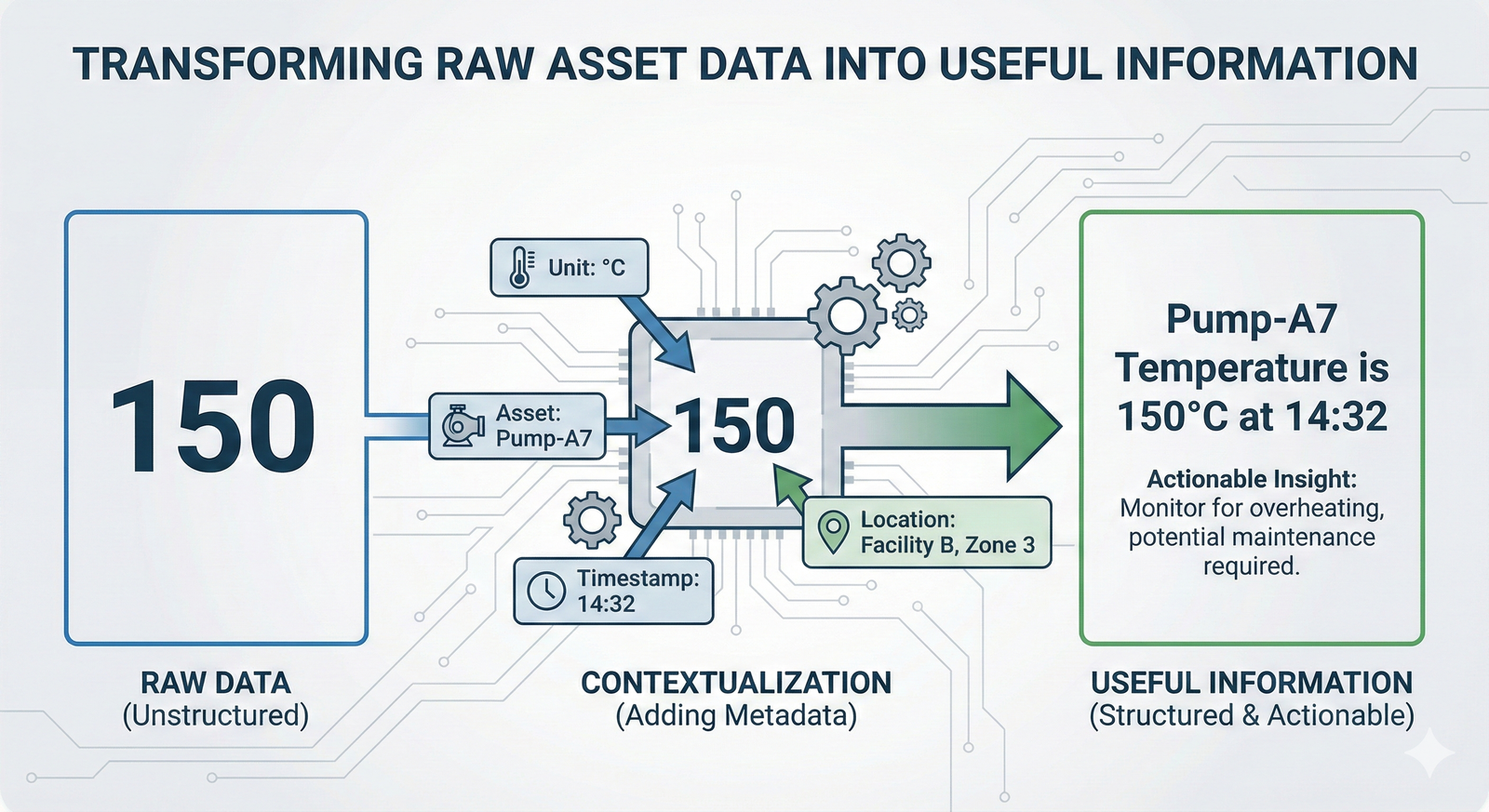
A critical component that enables all of this is Metadata. Without it, you just have a collection of numbers and text. With it, you have information. For example, a pressure reading of "75" is meaningless. Metadata tells you it's "75 PSI," was recorded on "June 10th, 2023," by "Sensor P-101," which was last calibrated on "January 5th, 2023." Now you have information you can act on.
From Theory to Practice: The Role of ISO 55000
For many organizations, the journey into formal asset management begins with adopting a standard. The preeminent global standard for asset management is ISO 55000. While it is a standard for managing assets, not data, it is impossible to comply with ISO 55001 without having robust control over your asset information.
The standard doesn't tell you how to govern your data, but it makes it clear that you must. For example, Clause 7.5 on "Information requirements" states that the organization shall determine what information it needs to support its assets, its asset management system, and the achievement of its asset management objectives. It goes on to require processes for managing this information, including its creation, maintenance, and availability.
ISO 55000: The 'Why' for Data Governance
Think of it this way: ISO 55000 and your Strategic Asset Management Plan (SAMP) define the decisions you need to make to achieve your organizational objectives. Data governance provides the trusted information required to make those decisions with confidence. You cannot achieve the goals of one without the discipline of the other.
Let's look at a practical example. A water utility needs to decide which 10km of cast iron water mains to replace next year. To do this in line with ISO 55001 principles, they need to balance cost, risk, and performance. This requires trustworthy data on: * Asset attributes (diameter, material, installation year) * Condition (leak history, break frequency, soil corrosivity) * Criticality (number of customers affected by a failure, proximity to hospitals)
Without a governance framework, this data might be spread across spreadsheets, old paper records, and the institutional memory of a senior employee. The data will be inconsistent, with different ways of recording breaks or missing installation dates. The resulting replacement plan would be a guess at best. With data governance, the utility has defined data stewards, clear standards for data entry, and regular quality checks. The output is a defensible, risk-based plan that optimizes capital investment.
Here is a small sample of what a clean, governed asset register snippet might look like.
Pump Asset Register (Governed Data)
| Asset ID | Asset Type | Install Date | Manufacturer | Condition Score | Last Inspection Date |
|---|---|---|---|---|---|
| PS1-PUMP-001 | Centrifugal Pump | 2011-08-15 | KSB | 3 | 2023-10-20 |
| PS1-PUMP-002 | Centrifugal Pump | 2011-08-15 | KSB | 4 | 2023-10-22 |
| PS1-PUMP-003 | Submersible Pump | 2019-05-21 | Flygt (Xylem) | 1 | 2024-01-15 |
| PS1-PUMP-004 | Centrifugal Pump | 2015-02-10 | Grundfos | 2 | 2023-11-05 |
| PS1-PUMP-005 | Submersible Pump | 2019-05-21 | Wilo | 2 | 2024-01-18 |
Building Your Governance Program: Roles and Responsibilities
Data governance is not an automated process; it is driven by people. Establishing clear roles is one of the first and most important steps. While titles may vary, the functions are generally consistent.
📊 View Diagram: Key Roles in Data Governance
- Data Owner: A senior leader (e.g., Director of Operations) who is ultimately accountable for the quality of a specific data domain (like operational data). They don't manage the data day-to-day, but they are responsible for securing resources and providing strategic direction.
- Data Steward: A subject matter expert from the business (e.g., a Maintenance Planner, an Operations Supervisor) who is responsible for defining and managing a subset of data. They define the business rules, quality thresholds, and are the go-to person for that data. This is the most critical role for making governance work in practice.
- Data Custodian: Typically a role within the IT department. They are responsible for the technical environment where the data lives—the databases, servers, and applications. They ensure the data is secure, backed up, and accessible, but they are not responsible for its content or quality.
Implementing these roles shifts the responsibility for data quality from a vague, shared problem to a clear, assigned responsibility.
The Future is Data-Driven
The need for data governance is only becoming more acute. The future of asset management is being built on technologies that are entirely dependent on high-quality, well-governed data. Consider the concept of a Digital Twin—a virtual representation of a physical asset. To be effective, this twin must be fed a constant stream of accurate, timely data from sensors, inspections, and work orders. Without governance, the digital twin becomes a distorted reflection of reality, providing misleading insights.
Likewise, the promise of Artificial Intelligence (AI) and Machine Learning (ML) for predictive maintenance—forecasting failures before they happen—rests entirely on the quality of the historical data used to train the models. If your historical maintenance data is messy and inconsistent, your predictive model will be useless. The old adage "garbage in, garbage out" has never been more true. Investing in data governance today is the only way to prepare your organization to take advantage of these transformative technologies tomorrow.
Closing
We began by acknowledging a familiar pain point for many asset management professionals: the high cost and risk of making critical decisions based on untrustworthy data. We've established that "good enough" is a dangerous fallacy and that the root cause is often not a lack of data, but a lack of a framework for managing it.
The solution is a dedicated, strategic approach to data governance. By establishing clear principles of accountability and standardization, and by appointing people to roles like data stewards, you can transform your data from a liability into a strategic asset. We've seen how standards like ISO 55000 don't explicitly detail data governance but implicitly demand it by requiring evidence-based, risk-informed decision-making. Building this foundation of trust in your data is no longer optional; it is the prerequisite for sound, modern asset management and the launching pad for future innovations like AI and digital twins.
Learning Outcomes
By completing this reading, you have taken a significant step toward understanding how to build a foundation of trust in your organization's asset information. You can now:
- Explain the core principles of data governance, including accountability, standardization, and stewardship, as they apply to managing physical assets.
- Describe the significant financial, operational, and reputational impacts of poor data quality and articulate the benefits of implementing a strong data governance program.
- Identify how the requirements for information management within the ISO 55000 asset management standard create a powerful business case for establishing a formal data governance framework.
You have also been introduced to the key concepts of Data Quality, Data Governance, Metadata, and the role of the ISO 55000 standards family.
Assess Yourself
❓ Knowledge Check
Test your understanding of the key concepts from this section.
Next Steps
You have successfully completed this introduction to asset data governance. This foundational knowledge is essential for every asset management professional. Please navigate back to the course page to continue with your next activity.

