
The Digital Bedrock: Using Asset Information for Smart Decisions
Imagine you are the Asset Manager for a mid-sized city's water utility. You have thousands of kilometers of underground pipes, some of which were installed before the first World War. Your budget for pipe replacement is limited, and you face pressure from city council to keep water rates low while avoiding catastrophic failures like a major water main break downtown. How do you decide which 10 kilometers of pipe to replace this year?
This isn't a decision you can make based on a hunch. You need facts. You need data. You need high-quality information. This is the central challenge that this module addresses: how to build and use a solid foundation of asset information to make defensible, effective, and strategic decisions. Without good information, asset management is just guesswork.
What is Asset Information?
At its core, asset management is a discipline of decision-making. Every decision—from whether to repair or replace a pump, to setting the annual maintenance budget, to planning a 20-year infrastructure renewal program—depends on having the right asset information.
This information doesn't just appear out of thin air. It is collected, stored, and managed. The starting point for this is the asset register. Think of it as the definitive phone book for all your assets.
An asset register tells you what you have and where it is. But to make the tough decisions, you need to know much more.
The Building Blocks: Key Types of Asset Data
A robust understanding of your assets comes from integrating several different types of data. Each type provides a different lens through which to view your asset portfolio.
- Condition Data: This tells you the physical state of an asset. Is it new, worn, corroded, or failing? This data might come from physical inspections, sensor readings, or non-destructive testing.
- Performance Data: This measures how well an asset is doing its job. For a pump, this could be flow rate and energy consumption. For a road, it could be traffic volume and surface roughness.
- Financial Data: This includes all the cost-related information, such as the original purchase price, maintenance costs, operational costs, and estimated replacement value.
- Geospatial Data: This tells you the location of your assets. For linear assets like pipes or roads, or for assets spread over a large area like a university campus, this is absolutely critical.
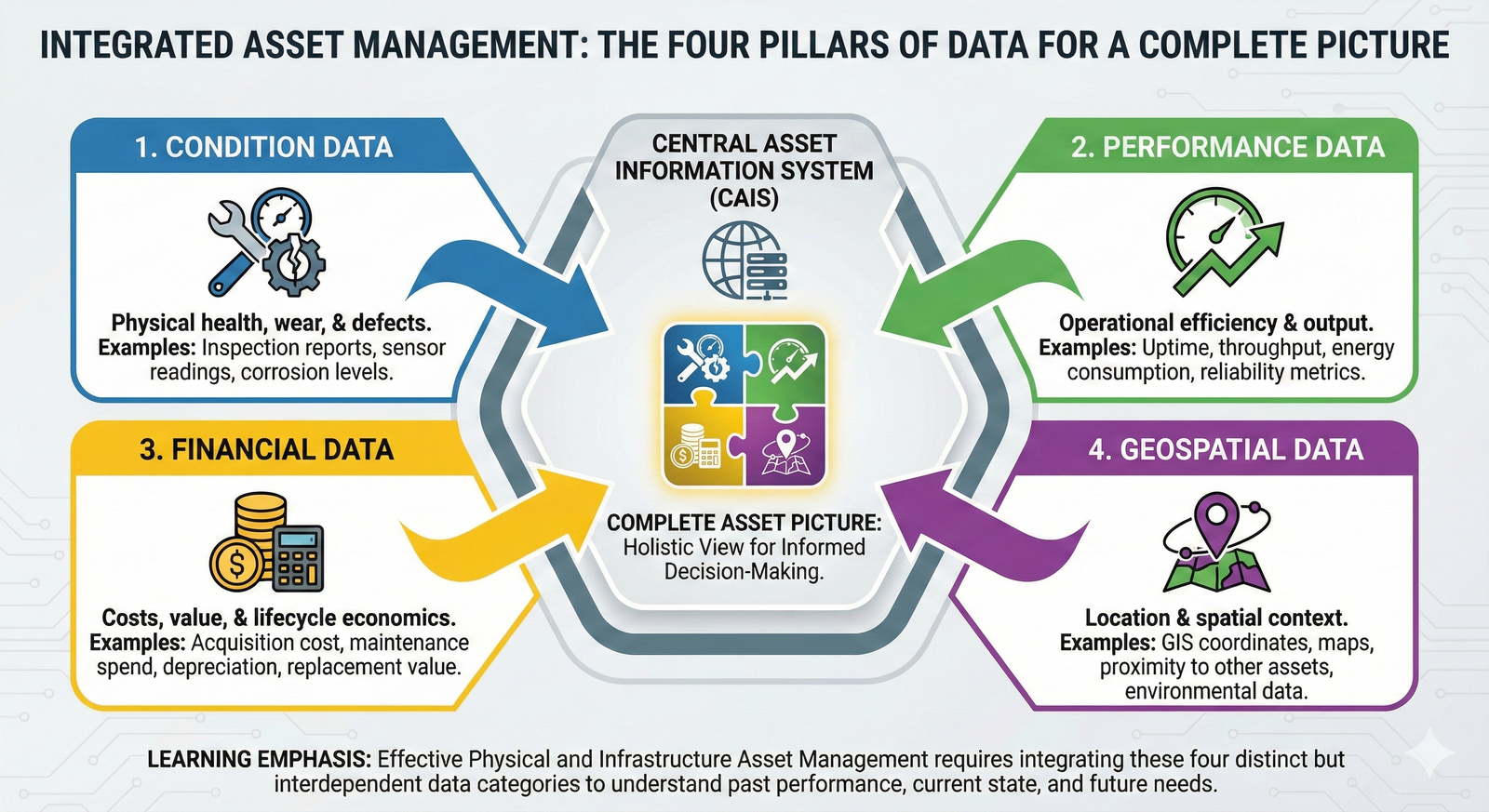
These data types are the ingredients for good decision-making. The following reading will take you on a deeper dive into how asset managers use these ingredients to cook up effective strategies. Pay close attention to the examples of how different data types are combined.
Reading: From Data to Decisions: A Practical Guide to Using Asset Information
Launch the reading to explore a key course topic.
The Toolbox: Asset Information Systems
Having all this data is one thing; managing and using it effectively is another. You can't run a city's water system from a collection of disconnected spreadsheets. You need a dedicated system. This is where an Asset Information System (AIS) comes in.
An AIS isn't usually a single piece of software. It's often an ecosystem of connected systems. You will frequently encounter these specific types of systems in the field:
- CMMS (Computerized Maintenance Management System): The workhorse for the maintenance team. It's used to manage work orders, track maintenance history, and manage spare parts inventory.
- EAM (Enterprise Asset Management) System: A more comprehensive system that builds on a CMMS. It integrates maintenance management with financial, procurement, and materials management across an asset's entire lifecycle.
- GIS (Geographic Information System): The mapping powerhouse. A GIS is essential for visualizing and analyzing assets that are spread out geographically, like pipes, roads, and power lines.
In a mature organization, these systems talk to each other, feeding data into a central hub where it can be analyzed to support high-level strategic decisions.
📊 View Diagram: Components of an Asset Information System
Now it's time to apply what you've learned. The following case study will put you in the shoes of an Asset Management Analyst. Your task is to think through the information needs of a real-world organization. This is a great chance to practice connecting the concepts of data types and information systems to a practical problem.
Case Study: Evaluating the Asset Information Needs for a Public Transit Authority
Launch the interactive case study to analyze a real-world scenario.
The Quality Imperative: Data Governance
There's a classic saying in the world of data: "Garbage in, garbage out." You can have the most sophisticated EAM system on the market, but if the data you feed into it is inaccurate, incomplete, or inconsistent, your decisions will be flawed. This is why the concepts of data quality and data governance are not just IT issues; they are core business issues for any asset-intensive organization.
Data Quality
Ensuring data quality requires a deliberate, organization-wide effort. This effort is managed through data governance.
A good data governance framework defines who is responsible for what data, how data should be formatted, and how its quality is checked. It also includes managing the data about your data, known as Metadata.
International standards provide a valuable framework for thinking about this. The ISO 55000 series of standards for asset management, for example, explicitly requires that organizations establish processes for managing asset information.
The topic of data governance can seem a bit abstract, but its impact is incredibly concrete. The next reading explores why building trust in your data is so important and how a formal governance program, guided by standards like ISO 55000, is the way to achieve it.
Reading: Building Trust in Your Data: An Introduction to Asset Data Governance
Launch the reading to explore a key course topic.
Assess Yourself
❓ Knowledge Check
Test your understanding of the key concepts from this section.
Wrapping Up
Congratulations on completing this module! You've just laid one of the most important foundation stones in your asset management knowledge. You can now explain the critical role that asset information plays in making sound asset management decisions. You've seen how different types of data—from condition to cost—come together in information systems to create a complete picture, and you understand that the quality of that picture depends on strong data governance. This is a competency that separates proactive, strategic asset managers from reactive ones. Well done!
Next Steps
You have successfully completed the module. Please navigate back to the main course page to continue your journey.
