
Introduction
Welcome to the field of asset management. If you're picturing someone in a hard hat with a clipboard, you're only seeing a small piece of a much larger picture. For decades, managing physical assets—the bridges, pipes, power plants, and facilities that form the backbone of our society—was often a reactive cycle of breakdown and repair. Today, that approach is no longer sustainable, safe, or financially viable.
Modern asset management is a strategic discipline. It's about making informed, data-driven decisions to maximize value and minimize risk over the entire life of an asset. It connects the engineer on the ground to the financial planner in the boardroom. In this reading, we'll explore how this critical shift happened, what core principles guide the profession today, and how we structure our work within a formal system to deliver consistent, predictable results. This is where your career begins, moving from simply fixing things to strategically delivering value.
The Long Road from Reactive to Strategic
Think about the last time you saw a news report about a major water main break or a sudden bridge closure. These events are often the dramatic, public-facing consequences of an outdated approach to managing infrastructure. For a long time, the prevailing philosophy was "run-to-failure." An asset was installed and largely ignored until it broke, at which point a crew was dispatched to fix it. This was reactive maintenance.
This approach has obvious flaws. It's unpredictable, often more expensive due to emergency repairs, and carries significant safety and service-level risks. A burst pipe doesn't just waste water; it can shut down businesses, flood homes, and disrupt traffic for days.
The first major shift was towards preventive maintenance. Organizations began to realize they could avoid some failures by performing scheduled maintenance based on time or usage—like changing the oil in your car every 5,000 miles, whether it seems to need it or not. This was a step forward, but it could also be inefficient. You might replace a part that still had years of useful life left, or miss a component that was degrading faster than the schedule predicted.
The real transformation began with the rise of predictive and reliability-centered maintenance, fueled by better data and technology. Instead of relying on a fixed schedule, we started using sensors and analytics to monitor the actual condition of an asset. This allowed for interventions only when necessary, optimizing resources and reducing downtime.
📊 View Diagram: The Evolution of Asset Management Strategy
This technological leap set the stage for the final, and most important, evolution: the move to a truly strategic view. This is the essence of modern Asset Management. It's no longer just about preventing failure; it's about aligning every decision with the organization's overall objectives. We don't just ask, "Is this bridge safe?" We ask, "What is the most cost-effective way to ensure this bridge provides the required level of service for the next 50 years, considering traffic growth, climate change, and funding constraints?" This is a boardroom-level conversation, not just a maintenance-shed discussion.
The Four Pillars: Core Principles of Asset Management
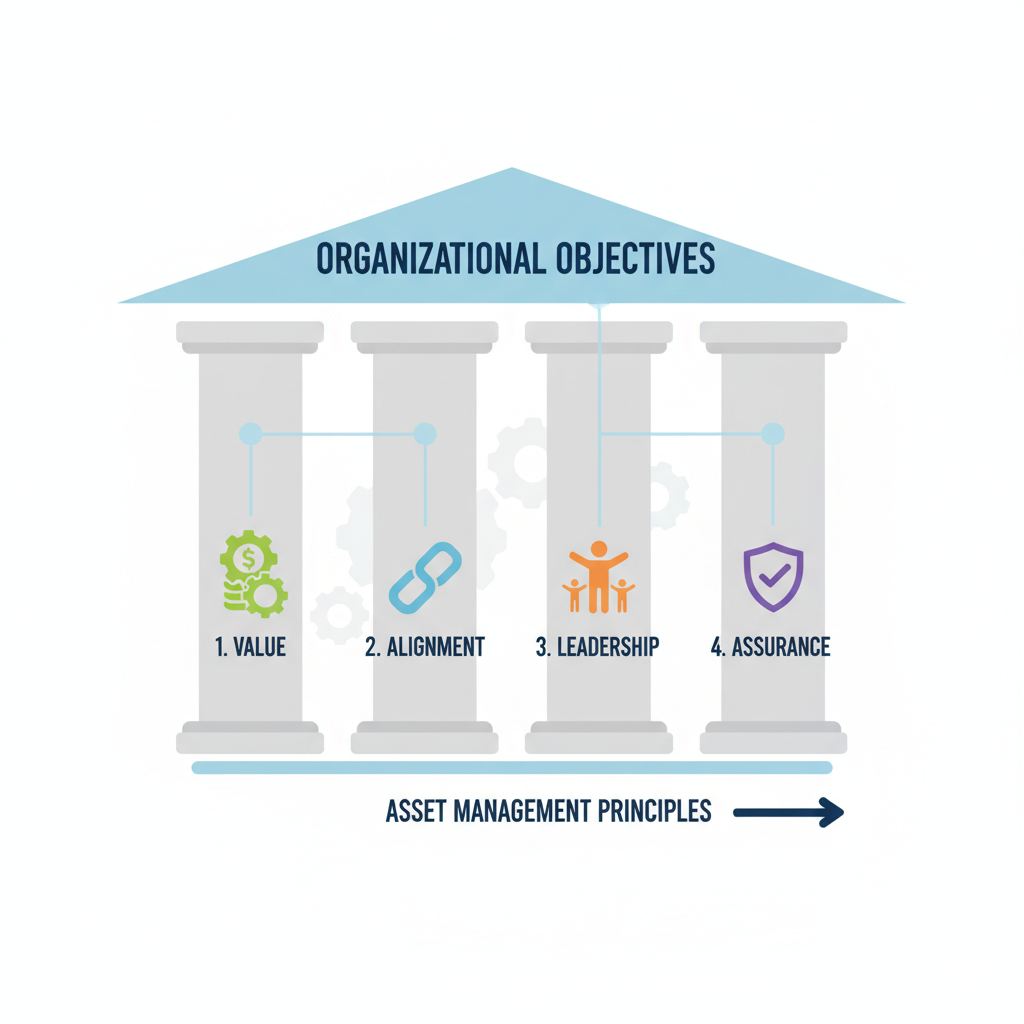
To guide these complex decisions, the international standard for asset management, ISO 55000, establishes a set of fundamental principles. Think of these as the four pillars that support a strong asset management practice. They ensure that your activities are purposeful, coordinated, and effective.
-
Value: Assets exist to provide value to the organization and its stakeholders. This seems obvious, but it's a profound shift in thinking. The value isn't the physical asset itself (the pump, the building), but what it enables (clean water delivery, a place for business). Every asset management decision must be explicitly linked to how it creates, preserves, or enhances this value. This could be financial value (revenue, cost savings) or non-financial value (public safety, environmental compliance, customer satisfaction).
-
Alignment: This principle ensures that asset management activities are not performed in a silo. The asset management strategy and plans must be directly aligned with the organization's overall strategic plan, objectives, and policies. It means the engineering department, finance department, and operations team are all working from the same playbook, making decisions that support, rather than contradict, each other.
-
Leadership: Effective asset management requires a clear commitment from the top of the organization. Leadership is responsible for establishing the asset management Policy, providing the necessary resources, and building a culture that understands and supports its importance. Without this top-down commitment, even the best-laid plans will struggle to gain traction.
-
Assurance: This is about having confidence that your assets and your asset management activities will achieve their intended purpose. Assurance involves establishing processes to monitor performance, manage risks, and ensure compliance with legal, statutory, and regulatory requirements. It's the mechanism that answers the question, "Are we doing what we said we would do, and is it working?"
Mentor's Insight: It's Not About the Asset, It's About the Service
Early in my career, I was focused on the technical specifications of a pump station. A senior manager pulled me aside and asked, 'What's our business here?' I said, 'Managing pumps.' He replied, 'No, our business is delivering 10 million gallons of safe drinking water a day. The pump is just a tool.' That completely changed my perspective. Always start with the value you are delivering, not the equipment you are managing.
The Framework for Action: The Asset Management System
Principles are essential, but they need a practical framework to be put into action. This is the role of the Asset Management System. An AMS is not a piece of software, though software is a key enabler. It is the entire management framework—the policies, plans, business processes, and information systems—that an organization uses to direct, control, and coordinate its asset management activities.
Think of it like the quality management system (like ISO 9001) that a manufacturer uses to ensure every product meets specifications. An AMS does the same for the management of physical assets, ensuring a consistent, systematic, and auditable approach.
The key components of an effective AMS typically include:
- Asset Management Policy: As we've discussed, this is the high-level statement of intent from leadership.
- Strategic Asset Management Plan (SAMP): This is a crucial document that translates the organization's overall objectives into specific, long-term asset management objectives. It outlines how the AMS will be used to achieve the goals set out in the policy. The SAMP is the primary link between the corporate strategy and the day-to-day work of asset managers.
- Asset Management Plans (AMPs): These are more detailed, tactical plans that specify the activities, resources, and timescales required for managing specific asset groups or systems to achieve the objectives in the SAMP. You might have an AMP for your vehicle fleet, another for your water treatment plants, and another for your IT infrastructure. These plans consider the entire asset Lifecycle, from acquisition to disposal.
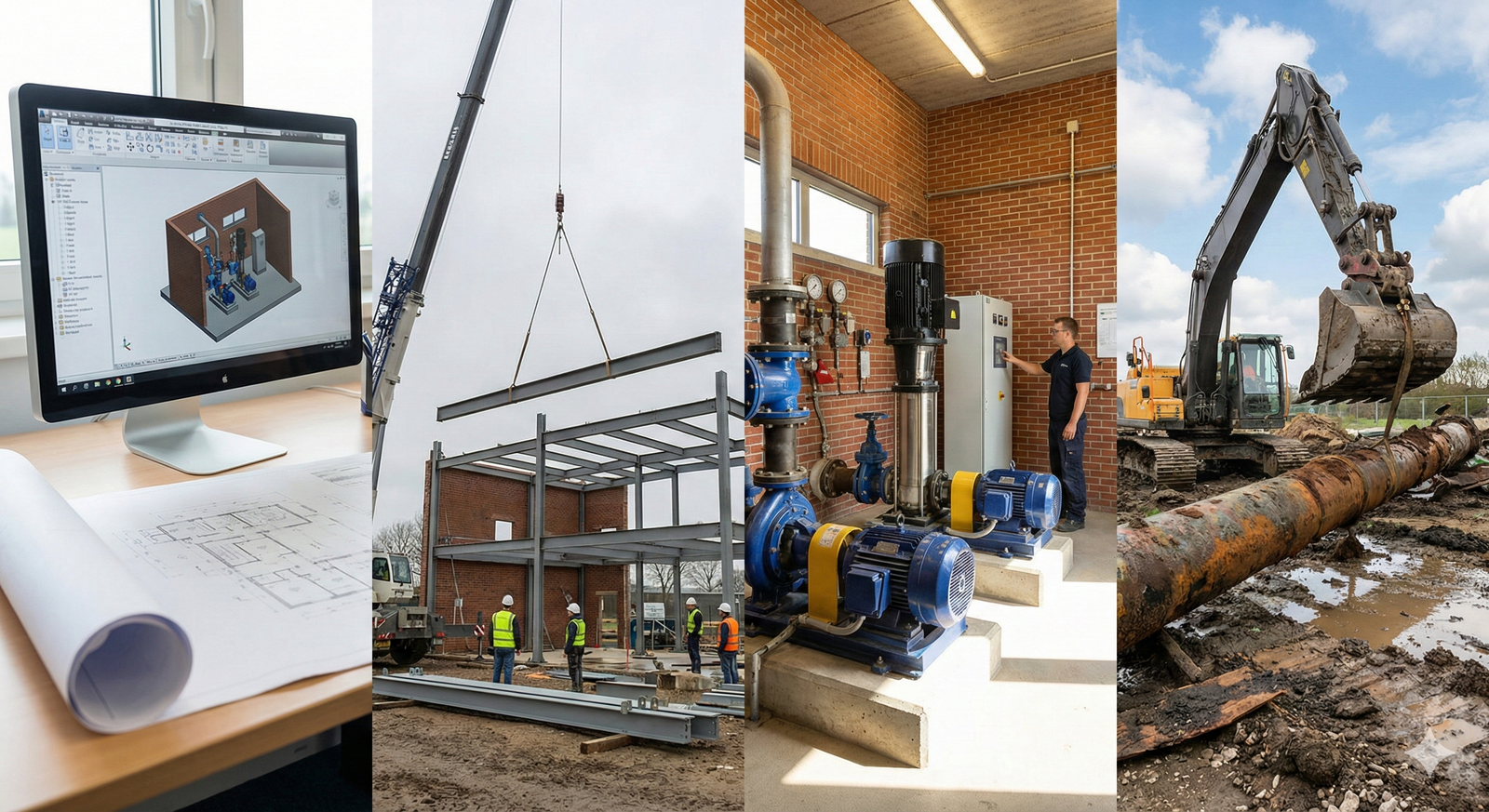
- Implementation Processes: These are the documented procedures for carrying out the activities defined in the AMPs. This includes everything from maintenance work execution, capital project management, risk assessment procedures, and competency management for staff.
- Performance Evaluation and Improvement: An AMS is not static. It incorporates a "Plan-Do-Check-Act" cycle. You must constantly monitor the performance of your assets and your AMS itself. This involves collecting data, conducting audits, reviewing incidents, and using that information to make improvements. This is where good Governance is critical, ensuring clear roles, responsibilities, and authorities for decision-making.
📊 View Diagram: Core Components of an Asset Management System (AMS)
Putting an AMS in place is a significant undertaking. It requires a cultural shift, investment in systems and training, and unwavering leadership. But the payoff is immense. Organizations with mature asset management systems see improved safety, better financial performance, more reliable service, enhanced environmental compliance, and a stronger reputation with stakeholders. They move from a state of constant fire-fighting to one of strategic control, able to justify their decisions and demonstrate the value they provide to society. This is the future of our profession, and it's a future you are now helping to build.
Closing
We've journeyed from the simple, reactive world of "fix it when it breaks" to the sophisticated, strategic discipline of modern asset management. This evolution wasn't just about adopting new technologies; it was a fundamental change in philosophy. We now understand that physical assets are not just costs to be managed, but instruments for delivering value.
By grounding our work in the core principles of value, alignment, leadership, and assurance, we ensure our efforts are focused and effective. We implement these principles through a structured Asset Management System, which provides the framework for translating high-level organizational goals into concrete actions. This systematic approach, encompassing policy, strategy, and detailed plans, allows us to manage the entire asset lifecycle proactively, balancing performance, cost, and risk. As you move forward, hold onto these foundational concepts. They are the bedrock upon which a successful and impactful career in asset management is built.
Learning Outcomes
In this reading, you have built a foundational understanding of modern asset management. You can now:
- Trace the professional practice of asset management from its origins in reactive maintenance to its current role as a strategic business function.
- Articulate the four core principles—value, alignment, leadership, and assurance—that guide all asset management activities.
- Identify and describe the essential components of a formal Asset Management System, including the policy, strategic plans, and the processes that bring them to life.
You have also been introduced to the core vocabulary of the profession, including Asset Management, Asset Management System, Lifecycle, Governance, and Policy.
Assess Yourself
Take a moment to check your understanding of the key concepts introduced in this reading. This is not for a grade, but to help you confirm you're ready to build on this knowledge.
❓ Knowledge Check
Test your understanding of the key concepts from this section.
Next Steps
Excellent work completing this foundational reading. You've taken the first step in understanding the strategic importance of asset management. When you are ready, please navigate back to the course page to continue your learning journey.

