
Introduction
What separates an organization that simply reacts to its aging infrastructure from one that strategically directs its assets to achieve long-term goals? The answer isn't just about having a bigger budget or more engineers. It's about having a clear, documented strategy.
Imagine you're the asset manager for a major metropolitan water utility. The city council has a 20-year vision to be the most resilient and sustainable city in the region. How do you translate that high-level ambition into a concrete decision about whether to repair a 75-year-old water main or invest in a new smart-pumping station?
This is where the Strategic Asset Management Plan comes in. It's the critical link between your organization's overall objectives and the day-to-day, year-to-year decisions you make about managing your physical assets. It’s the document that provides the "why" for every major maintenance, repair, and replacement decision. Without it, you're just fixing things. With it, you're building value.
The North Star of Asset Management
Think of the last time you worked on a major project. Was there a single document you could point to that clearly explained how your work contributed to the organization's top-level goals? For many, the answer is no. Work happens in silos, and the connection between a specific task and the company's annual report can feel abstract.
The Strategic Asset Management Plan (SAMP) is designed to solve this problem. It's not a detailed maintenance schedule or an inventory list; you have Asset Management Plans (AMPs) for that. The SAMP operates at a higher altitude. It’s a directional document, a North Star that ensures everyone involved in the asset lifecycle—from the CFO allocating capital to the technician on the ground—is pulling in the same direction.
Establishing a 'Line of Sight'
A well-crafted SAMP creates a clear 'line of sight' from the highest-level organizational goals down to individual asset activities. An executive should be able to see how their strategic objectives are being implemented, and an engineer should understand how their project supports the organization's mission. This alignment is the hallmark of a mature asset management practice.
From Boardroom Vision to Boiler Room Reality
An organization's strategic plan might state a goal like, "Achieve a 10% improvement in operational efficiency within five years." That's a great goal, but it doesn't tell you what to do with your fleet of aging delivery vehicles or your factory's HVAC system. The SAMP is the mechanism that translates that corporate-speak into tangible action.
This translation process follows a clear hierarchy. It’s a cascade of objectives, where each level adds more specific detail.
📊 View Diagram: The Asset Management Hierarchy
As you can see, the SAMP is the central hub. It takes the broad organizational goals and refines them into specific, measurable Asset Management Objectives. These are not vague aspirations; they are concrete targets that the asset management function is accountable for delivering.
This entire process is informed by the needs and expectations of your stakeholders. A Stakeholder analysis is fundamental to a good SAMP. Regulators, for instance, demand compliance with safety and environmental standards. Customers demand reliable service. Shareholders demand a return on investment. The SAMP must balance these often-competing demands in a transparent and logical way.
The Anatomy of a World-Class SAMP
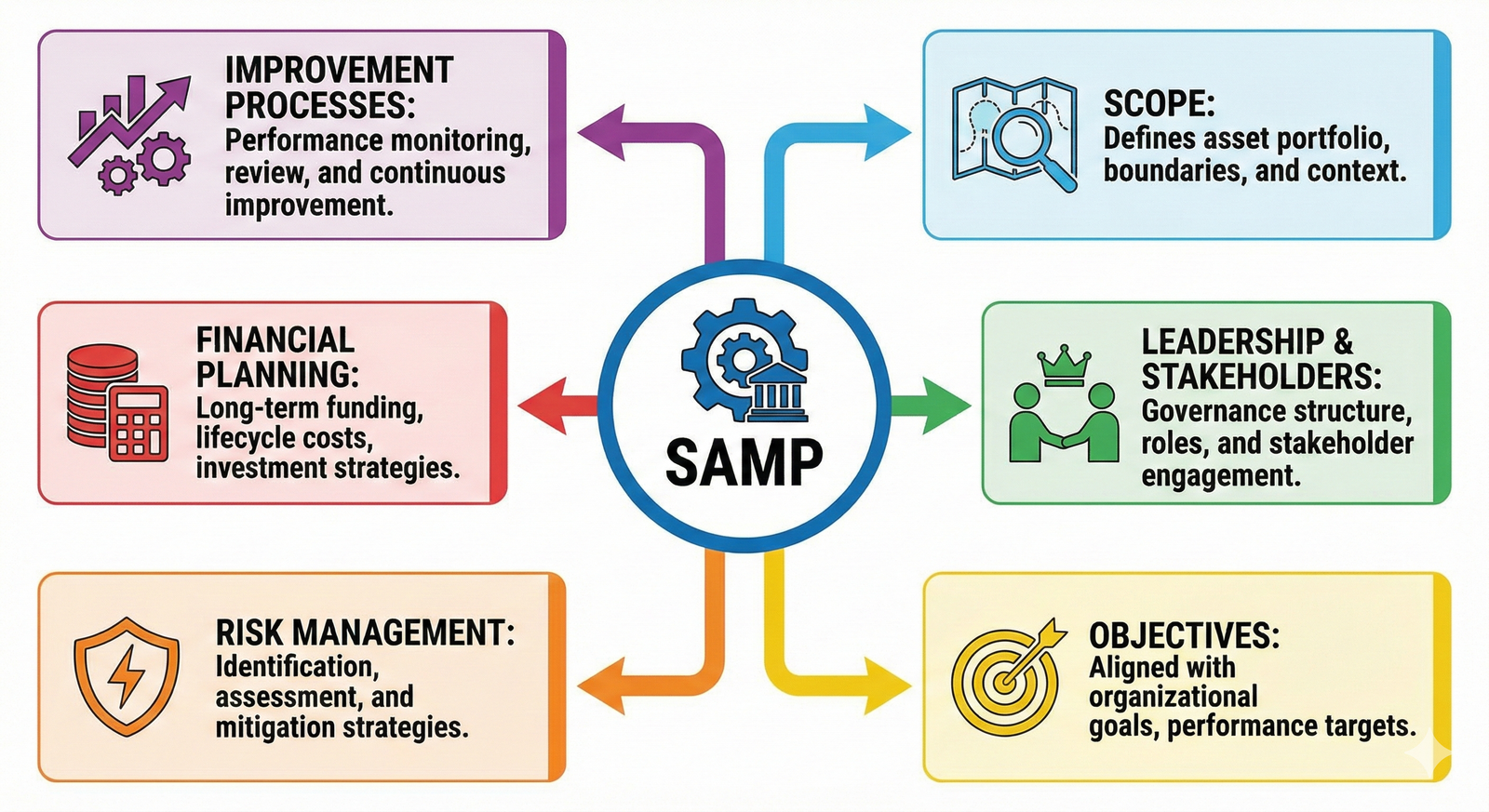
So, what actually goes into this document? While the specifics will vary based on your organization's size, industry, and maturity, a robust SAMP, often guided by the ISO 55000 family of standards, will contain several core elements.
1. The Asset Management Policy & Scope
This section sets the stage. It includes a formal statement from top management endorsing the principles of asset management. It also defines the boundaries of the asset management system. Does it cover all assets in the organization, or just the critical operational assets at a specific plant? For example, a large manufacturing company might scope its initial SAMP to the production assets of its most profitable factory, like the stamping presses and robotic arms that are essential for production.

2. Linking Organizational Objectives to Asset Management Objectives
This is the heart of the SAMP. It explicitly documents the "line of sight" we discussed earlier. It should contain a table or matrix that maps each high-level organizational goal to one or more supporting asset management objectives.
- Organizational Goal: "Become an industry leader in environmental sustainability."
- Asset Management Objective: "Reduce energy consumption of our asset portfolio by 15% by 2028" and "Achieve 99.9% compliance with all environmental discharge permits."
3. The Role of Leadership, Competence, and Stakeholders
A plan is useless without people to execute it. This section outlines the roles, responsibilities, and authorities for asset management across the organization. It answers questions like: Who is ultimately accountable for the performance of our assets? What competencies do our people need? How will we continue to engage with and report to our key stakeholders?
4. Strategic Planning and Risk Management
You can't plan for the future without understanding the risks you face. This part of the SAMP details the approach to managing risk. It's not just about safety or environmental risks; it includes financial risks (an asset costs more to maintain than it generates in value), reputational risks (a major failure damages public trust), and operational risks (an asset failure halts production). The SAMP sets the criteria for what constitutes an acceptable level of risk and outlines the high-level strategies for treating unacceptable risks.
5. Financial Planning and Decision-Making
This is where the financial reality hits. The SAMP must describe the financial resources and investment plans required to achieve the asset management objectives. It outlines the criteria for making investment decisions. How do you decide between two competing projects? You use a whole-life cost and value-based methodology. This section ensures that capital is allocated in a way that provides the best long-term value, rather than just funding the "squeakiest wheel."
A Lesson from History
The modern emphasis on strategic, risk-based asset management has roots in major public infrastructure failures. In the mid-20th century, many cities operated on a 'run-to-failure' model. It wasn't until catastrophic events, like bridge collapses or widespread power blackouts, that organizations realized the immense societal and financial cost of reactive maintenance. The SAMP is the modern answer to this historical lesson, forcing a proactive, long-term view.
6. Continual Improvement
The SAMP is not a document that you write once and file away. It's a living plan. This final section describes the processes for monitoring performance, auditing the asset management system, and reviewing the SAMP itself. Is the plan working? Are we achieving our objectives? What has changed in our operating context? A good SAMP includes a schedule for its own review and update, typically on an annual or bi-annual cycle.
The Future is a Living SAMP
Looking ahead, the very nature of the SAMP is evolving. Historically, it was a static document, reviewed periodically. Today, with the rise of the Industrial Internet of Things (IIoT), digital twins, and predictive analytics, we are moving toward the concept of a "living SAMP."
Imagine a SAMP that is continuously updated with real-time data from your assets. A digital twin model simulates the future performance of a critical water pump, automatically flagging a change in its risk profile. This information feeds directly into the decision-making framework outlined in your SAMP, allowing for dynamic and optimized planning. The annual review cycle becomes a process of continuous, data-driven adjustment. This is the future of strategic asset management—transforming the SAMP from a static roadmap into a dynamic GPS.
Closing
We began by asking what separates reactive organizations from strategic ones. The answer is the Strategic Asset Management Plan. The SAMP is far more than an administrative requirement; it is the foundational document that gives purpose and direction to all your asset management activities.
It provides the crucial link that translates your organization's highest-level ambitions into measurable asset management objectives. By clearly defining the scope, outlining the key elements from risk to finance, and establishing a framework for decision-making, the SAMP ensures your assets are not just maintained, but are actively working to create sustainable, long-term value. It transforms asset management from a technical function buried in the organization into a strategic capability that drives competitive advantage.
Learning Outcomes
In this reading, you have explored the core concepts behind the Strategic Asset Management Plan. You can now:
- Explain the purpose of a SAMP and why it is a cornerstone of mature asset management, providing a clear "line of sight" throughout the organization.
- Identify and describe the essential elements of a comprehensive SAMP, from defining the scope to planning for continual improvement.
- Describe the critical process of how a SAMP forges a direct link between high-level organizational goals and specific, actionable Asset Management Objectives.
You have also been introduced to key vocabulary, including the definitions and contexts for Strategic Asset Management Plan (SAMP), Asset Management Objectives, and Stakeholder.
Assess Yourself
Check your understanding of the key concepts covered in this reading.
❓ Knowledge Check
Test your understanding of the key concepts from this section.
Next Steps
You have successfully completed this introduction to the Strategic Asset Management Plan. Your work has helped you build a strong foundation for understanding how strategy drives asset management. Please navigate back to the course to continue to your next activity.
