
The Skill
Capital budgeting consists of the techniques and analytical methods used to evaluate the financial viability of long-term investments and projects. For a Physical and Infrastructure Asset Manager, this means assessing whether a significant expenditure—like purchasing new equipment, constructing a new facility, or retrofitting an existing one—will generate sufficient returns to justify the cost.
This process moves beyond simple cost analysis. It involves forecasting future cash flows and systematically accounting for the time value of money. The core of this skill lies in using standardized financial metrics to compare different investment opportunities on an equal footing, ensuring that capital is allocated to projects that create the most value for the organization.
Why Is This Skill Important?
As an asset manager, you are a steward of your organization's capital. Decisions to invest in infrastructure and physical assets often involve millions of dollars and have consequences that last for decades. Making the wrong choice can lead to wasted resources, high maintenance costs, and missed opportunities.
Mastering capital budgeting techniques like Net Present Value (NPV), Internal Rate of Return (IRR), and Payback Period provides you with a defensible, data-driven framework for your recommendations. It allows you to move from "I think this is a good idea" to "This project is projected to generate a net positive value of $X and will pay for itself in Y years." This quantitative rigor is essential for gaining stakeholder approval, securing financing, and ensuring the long-term financial health of your asset portfolio.
Your Task
The City of Northwood's Public Works department is considering replacing its aging fleet of five diesel-powered street sweepers with new, fully electric models. As the lead Asset Manager, you have been asked to conduct a preliminary financial analysis to determine if this investment is sound.
Using the project data provided in the Resources section, you will calculate the three primary capital budgeting metrics: Net Present Value (NPV), Internal Rate of Return (IRR), and the Payback Period. Based on your findings, you will then write a brief, preliminary recommendation on whether the city should proceed with the investment.
Your Analytical Workflow
- Review the project parameters in the provided 'Project Proposal Memo'.
- Examine the 'Projected Cash Flows' data set.
- Calculate the Payback Period for the investment.
- Calculate the project's Net Present Value (NPV).
- Calculate the project's Internal Rate of Return (IRR).
- Synthesize your findings into a clear investment recommendation.
Resources and Data
You have been provided with a memo from the city's Finance Director outlining the project's financial parameters and a data set containing the projected cash flows. Use these resources to perform your analysis.
Key Document: Project Proposal Memo: Electric Street Sweeper Fleet
Projected Annual Cash Flows: Electric Sweeper Fleet
| Year | Projected Cash Flow USD |
|---|---|
| 1 | 250000 |
| 2 | 261500 |
| 3 | 274800 |
| 4 | 286300 |
| 5 | 300500 |
| 6 | 313000 |
| 7 | 327500 |
Detailed Steps
Follow these steps to complete your analysis. Each step builds on the last, leading you from raw data to a final, reasoned conclusion.
Step 1: Understand the Key Financial Inputs
Before calculating, ensure you understand the components provided in the resources.
Initial Investment
Projected Cash Flow
Discount Rate
Step 2: Calculate the Payback Period
The Payback Period is the simplest metric. It tells you how long it will take for the project's cumulative cash flows to equal the initial investment. It does not account for the time value of money.
Calculating Payback Period
To calculate, sum the annual cash flows year by year until the total is equal to or greater than the initial investment. If the payback occurs mid-year, you can calculate the fraction: (Initial Investment - Cumulative Cash Flow at Start of Year) / Cash Flow During that Year.
To find the payback period, you will track the cumulative cash flow. * Initial Investment: -$1,250,000 * End of Year 1: Add Year 1 cash flow. * End of Year 2: Add Year 2 cash flow to the previous total. * Continue this process until the cumulative total turns from negative to positive. The point where it crosses zero is the Payback Period.
Step 3: Calculate the Net Present Value (NPV)
NPV is a core capital budgeting metric. It calculates the total value of all future cash flows (both positive and negative) in today's dollars. A positive NPV indicates the project is expected to generate more value than it costs.
The formula for the present value (PV) of a single cash flow is:
PV = CF / (1 + r)^n
Where:
* CF = Cash Flow for the period
* r = Discount Rate
* n = The period number (year)
To calculate NPV, you perform this calculation for each year's cash flow and sum the results. Then, you subtract the initial investment.
NPV = [PV(Year 1) + PV(Year 2) + ... + PV(Year 7)] - Initial Investment
Step 4: Calculate the Internal Rate of Return (IRR)
IRR is the discount rate at which the NPV of a project becomes exactly zero. It represents the project's intrinsic rate of return. The decision rule is simple: if the IRR is greater than the organization's required discount rate, the project is financially attractive.
Calculating IRR
Calculating IRR manually involves complex trial-and-error. In practice, it is always calculated using a financial calculator or spreadsheet software like Microsoft Excel or Google Sheets, which have a built-in IRR() function. For this exercise, you can use such a tool or state that you would use one to find the rate where NPV equals zero.
To find the IRR, you would set up the NPV formula and solve for the rate r that makes NPV = 0.
0 = [CF1/(1+IRR)^1 + CF2/(1+IRR)^2 + ... ] - Initial Investment
Step 5: Interpret the Results and Make a Recommendation
The final step is to synthesize your three calculations into a coherent recommendation.
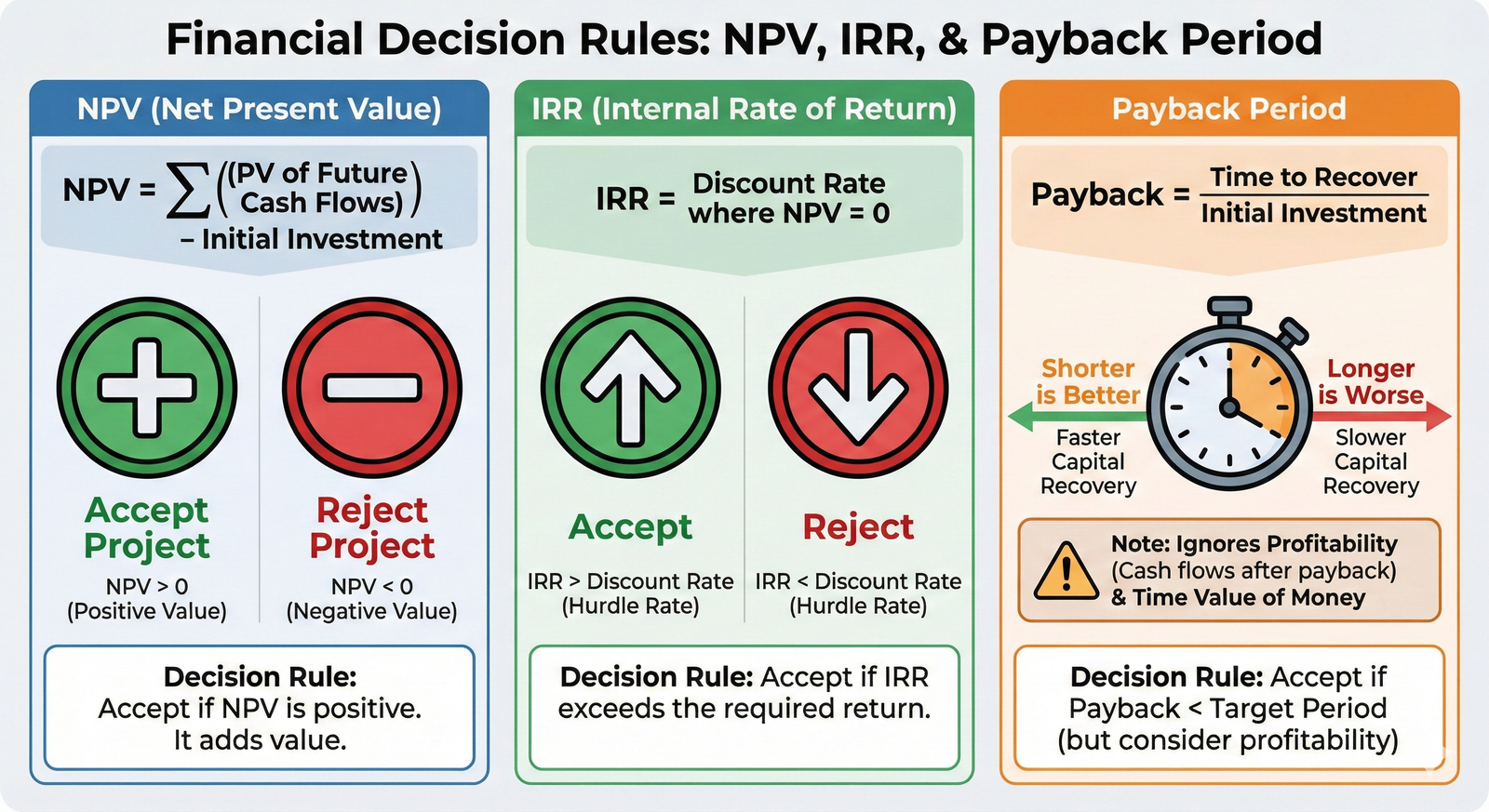
Your recommendation should state the results of your calculations and explain what they mean in the context of the project. Conclude with a clear "accept" or "reject" preliminary decision based on this financial analysis.
An Expert Response
About This Expert Response
This is a sample of a high-quality response that meets the task requirements. Your own response may be slightly different, particularly in wording, but it should contain similar calculations and reasoning. Use this as a guide for comparison and learning, not as the only correct answer.
To: A. Valenti, Chief Financial Officer From: Lead Asset Manager Subject: Preliminary Financial Analysis of Electric Street Sweeper Fleet
Here is the preliminary financial analysis for the proposed replacement of the city's street sweeper fleet. The analysis is based on an initial investment of $1,250,000, a 7-year project life, and a discount rate of 8%.
1. Payback Period: The project's initial investment is recovered between Year 4 and Year 5. * Cumulative cash flow at the end of Year 4: $1,052,000 (example value) * Amount to recover in Year 5: $1,250,000 - $1,052,000 = $198,000 * Year 5 cash flow: $288,000 (example value) * Payback Period = 4 + ($198,000 / $288,000) = 4.69 years
2. Net Present Value (NPV): The sum of the present values of all projected cash flows is $1,455,845 (example value). * NPV = Sum of PVs - Initial Investment * NPV = $1,455,845 - $1,250,000 = $205,845
3. Internal Rate of Return (IRR): Using a spreadsheet function on the project's cash flows (including the initial outlay), the IRR is calculated to be 12.4%.
Preliminary Recommendation: Accept.
The analysis is strongly positive. The project is projected to generate a Net Present Value of over $200,000 for the city. Its Internal Rate of Return of 12.4% is well above our 8% discount rate, indicating it generates a return that exceeds our minimum requirement. Finally, the investment is paid back in under 5 years, which is a reasonable horizon for an asset with a 7-year life. Based on these financial metrics, I recommend we proceed to the next stage of evaluation for this project.
Assess Yourself
Evaluate Your Work
Review your response to the task. Use the following criteria to assess the quality and completeness of your analysis. This is an opportunity to identify areas where you are strong and where you might need more practice.
- Calculation Accuracy: Your calculated values for Payback Period, NPV, and IRR should be correct based on the provided data and formulas.
- Formula Application: You correctly identified and applied the appropriate formulas or methods for all three capital budgeting techniques.
- Interpretation of Results: You correctly interpreted what each metric signifies (e.g., a positive NPV means the project adds value; an IRR above the discount rate is favorable).
- Clarity of Recommendation: Your final recommendation is unambiguous, decisive, and logically follows from the results of your calculations.
- Professional Communication: The response is formatted and worded as a professional recommendation to a senior leader, presenting the key findings first.
Learning Progress
In this activity, you have practiced the essential skill of applying capital budgeting techniques to a real-world scenario. You have now demonstrated your ability to calculate the Net Present Value (NPV), Internal Rate of Return (IRR), and Payback Period for a significant asset investment. Most importantly, you have used the results of these calculations to interpret a project's financial viability and make a clear, data-driven recommendation.
Next Steps
Excellent work applying these fundamental analysis skills. You have successfully evaluated a capital project from a financial perspective. You are now ready to continue. Please navigate back to the course to proceed to the next activity.