
The Language of Money in Asset Management
Welcome to the first module of Financial & Risk Analysis for PIAM. As an asset management professional, you are a steward of valuable physical and infrastructure assets. Your decisions—whether to repair, replace, or invest in new infrastructure—have significant financial consequences. To make sound, defensible decisions, you need to speak the language of finance.
Imagine you're the Asset Manager for a regional water utility. An essential 50-year-old water main is nearing the end of its service life. You know from an engineering standpoint that it needs to be replaced. But how do you convince the board or city council to approve a multi-million dollar project? You do it by building a compelling business case grounded in solid financial analysis. This module provides the foundational financial literacy you'll need to build that case.
This module is all about building your foundation. We'll be introducing a lot of new terms and concepts. Don't worry about memorizing everything at once. Focus on understanding the *purpose* behind each concept. Why does an asset manager need to know this? Keep asking that question as you go.
Understanding an Organization's Financial Health
Before you can propose a new investment, you must first understand the current financial position of your organization. The primary tools for this are an organization's core financial reports.
These reports, known as Financial Statements, are the bedrock of financial analysis. They tell the story of where the organization's money came from, where it went, and where it is now. Understanding them is a non-negotiable skill for any manager.
We're about to dive into the details of these statements. The following reading will walk you through the three key reports. As you read, try to connect the concepts back to our water utility example. How would a major pipeline replacement show up on these statements?
Reading: Interpreting the Three Core Financial Statements
Launch the reading to explore a key course topic.
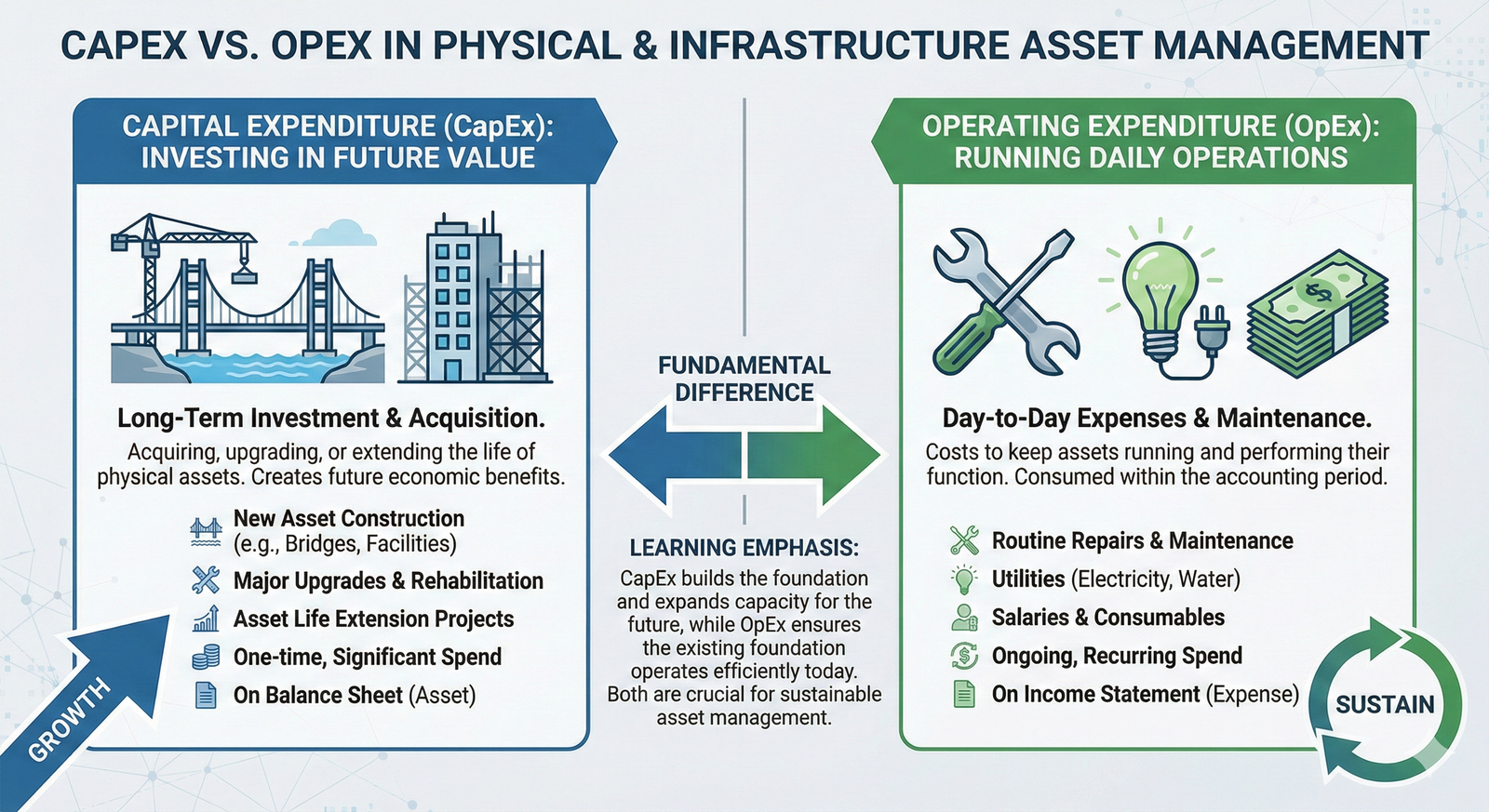
As you saw in the reading, spending on assets is typically categorized as either a Capital Expenditure (CapEx) or an Operating Expenditure (OpEx). This distinction is fundamental to asset management finance. CapEx creates a long-term asset, while OpEx covers the day-to-day costs of running it.
Making Smart Investment Decisions
With a grasp of your organization's financial standing, you can now evaluate potential projects. This is the domain of Capital Budgeting. At its heart, capital budgeting is about comparing the value of money today versus its value in the future.
This core principle is known as the Time Value of Money (TVM). A dollar today can be invested and earn interest, making it worth more than a dollar received a year from now. To compare costs and benefits that occur at different points in time, we use calculations to determine an investment's Net Present Value (NPV) or its Internal Rate of Return (IRR). Another, simpler metric is the Payback Period.
These concepts—NPV, IRR, and Payback Period—are the tools you'll use to build your business case. They translate engineering needs into financial arguments. The next activity is a hands-on skills lab where you'll get to practice using them. This is a great opportunity to move from theory to practice.
Skills Practice: Applying Capital Budgeting Techniques
Launch the interactive skills practice to build and apply your new abilities.
Measuring Performance and Value
After an investment is made, your job isn't over. You need to monitor the performance of your assets and the overall financial health of your portfolio. This involves using Financial Ratios to assess everything from short-term stability to long-term profitability. It also involves the complex task of Asset Valuation.
This next reading covers a lot of different ratios. Don't get bogged down in the formulas on the first pass. Instead, focus on the *question* each category of ratio is trying to answer. For example, "How easily can we pay our short-term bills?" (liquidity) or "How much profit are we making from our assets?" (profitability).
Reading: Using Financial Ratios for Asset Performance Analysis
Launch the reading to explore a key course topic.
Tying It All Together
You've now been introduced to the key financial statements, the methods for evaluating new projects, and the ratios for measuring ongoing performance. The final piece of the puzzle is understanding the Cost of Capital, which acts as a hurdle rate for your IRR and a key input for your NPV calculations.
Now, let's apply everything you've learned.
This is your first instructional case study. It's designed to simulate a real-world task. You'll be given a scenario and some data, and you'll be guided through the process of applying the concepts from this module to make a recommendation. Take your time and refer back to the readings and your notes from the skills activity.
Case Study: Financial Analysis for a Bridge Replacement Project
Launch the interactive case study to analyze a real-world scenario.
Assess Yourself
❓ Knowledge Check
Test your understanding of the key concepts from this section.
Wrapping Up
Congratulations on completing your first module! You've taken a huge step into the financial side of asset management. You've laid a critical foundation by learning to explain the fundamental financial concepts and principles that drive decisions in this field. You've seen how to interpret financial statements, practiced using capital budgeting tools like NPV and IRR, and learned how financial ratios tell a story about performance. This is the language you'll use to advocate for your assets and demonstrate their value throughout your career.
Next Steps
You have successfully completed this module. Well done.
Please navigate back to the main course page to review your assessment tasks for this module and to continue your learning journey.