
The Case
Anya Sharma’s new coffee mug, a gift from her team, reads “Lead Asset Manager.” It still feels a bit surreal. For the past five years, she’d been a junior analyst, but two weeks ago, she was promoted to oversee the critical infrastructure for the entire Northern Region. Her portfolio includes dams, highways, and dozens of bridges. The one keeping her up at night is the Old Mill Bridge.
Built in 1958, the two-lane steel truss bridge is the only direct route connecting the town of Riverbend to the main highway. It’s a lifeline for local businesses and the primary route for emergency services. It’s also showing its age. The latest biennial inspection report just landed on her desk, and the findings are more concerning than anyone anticipated. The lead inspector, a seasoned engineer named Ben Carter, flagged several issues with “accelerated deterioration.”
The timing couldn’t be worse. The regional council just passed an austerity budget, slashing capital project funding by 30%. Anya’s director, Maria Flores, has made it clear that any request for unbudgeted funds needs an airtight business case. To complicate matters, the Riverbend Business Association is actively lobbying against any potential bridge closures or even single-lane traffic restrictions, arguing that it would devastate the local economy during the peak tourist season, which starts in just three months.
Anya stares at the inspection summary, the stark numbers painting a grim picture. She can’t ignore the safety flags, but a full-scale rehabilitation project is financially impossible right now. A complete closure is politically toxic. Doing nothing, however, feels like a gamble she isn't willing to take. She has to find a path forward that protects public safety without bankrupting her department or alienating the community she serves. Her first big test as a leader is to develop a clear, defensible risk mitigation plan to present to Maria.
Resources and Data
Anya has gathered the following documents to begin her analysis.
Key Document: MEMORANDUM: Q3 Budget and Old Mill Bridge
Old Mill Bridge (OMB-07) - Critical Findings Summary
| ItemID | Component | Hazard Description | Condition Rating | Inspector Notes |
|---|---|---|---|---|
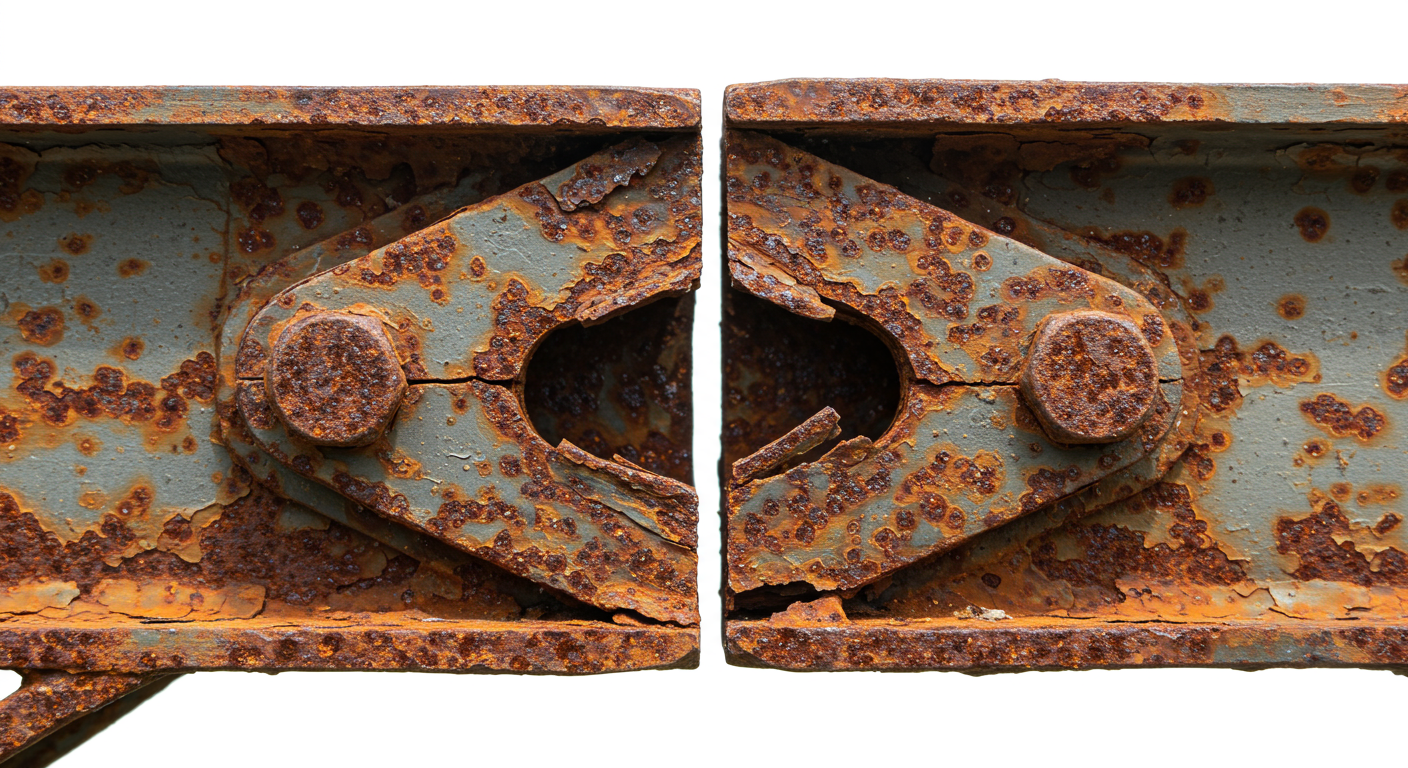
| ITM-BRG-4401 | Steel Truss Gusset Plates | Severe Section Loss from Corrosion | 5 | Connection point at L04 shows section loss exceeding 30%. Could compromise load path if not addressed. Requires immediate shoring and plate replacement plan. |
| ITM-BRG-4402 | Bearing Assemblies | Frozen from Corrosion | 5 | East abutment rocker bearing is completely seized. This is inducing unintended thermal stresses into the main truss members. |
| ITM-BRG-4403 | Concrete Abutment | Spalling and Exposed Rebar | 4 | Large area of spalled concrete on the west abutment backwall. Exposed rebar shows significant corrosion. Water is penetrating behind the wall. |
| ITM-BRG-4404 | Deck Joints | Seal Failure and Debris Impaction | 4 | Expansion joint seal is torn, allowing water and de-icing salts to drain directly onto the pier cap below. Joint is packed with incompressible debris. |
| ITM-BRG-4405 | Deck Surface | Extensive Potholing | 3 | Multiple large potholes in the driving lane. Poses immediate risk to vehicle suspension and is a significant hazard for motorcycles. |
| ITM-BRG-4406 | Guardrail | Non-compliant height | 3 | Due to multiple asphalt overlays, the effective height of the guardrail is below the current standard, increasing risk of vehicle override. |
📊 View Diagram: Qualitative Risk Assessment Matrix
Risk Register
Your Task
You are Anya Sharma, the Lead Asset Manager. Your director has tasked you with developing a preliminary risk mitigation plan for the Old Mill Bridge. Using the inspection data, the director's memo, and the risk assessment matrix, you must analyze the situation and prepare a response.
Your goal is to create a draft risk register that identifies the key hazards, assesses their risk level, and proposes justified treatment options for each. Your recommendations should balance safety requirements with the clear budget and political constraints.
How to Approach This Task
Structure your analysis by following these four steps:
- Define the Problem: Briefly summarize the overall situation and the core conflict you need to resolve.
- Identify Core Issues: Use the inspection data to list the specific, tangible hazards facing the bridge.
- Analyze and Prioritize: For each hazard, use the risk matrix to assess its likelihood and consequence, determining an overall risk level (Low, Medium, High, Extreme).
- Recommend Solutions: Propose a specific, justified treatment option for each identified risk. Consider a range of actions, such as immediate repair, increased monitoring, or planned future work.
Guiding Questions
Use these questions to focus your analysis and structure your response.
- Based on the Director's memo, what are the primary constraints you must work within?
- Looking at the inspection summary, which 2-3 hazards appear most severe based on the condition ratings and inspector notes alone?
- What is the difference between a physical hazard (e.g., corrosion) and an operational hazard (e.g., traffic disruption)? Does the case present both?
- Using the Qualitative Risk Assessment Matrix, how would you rate the likelihood and consequence for the "Severe Section Loss from Corrosion" on the gusset plates? What is the resulting risk level?
- Now, do the same for the "Non-compliant height" of the guardrail. How does its risk level compare to the gusset plate corrosion?
- For a high or extreme risk item, what immediate treatment options could you propose that might avoid a full bridge closure?
- For a medium or low risk item, what justification would you provide for deferring action or simply increasing monitoring frequency?
- How will you structure your preliminary risk register? What columns will you include to clearly communicate your plan to the director?
An Expert Response
Note on the Expert Response
This is a sample response from an experienced asset manager. It demonstrates a strong, well-structured approach to the problem. Your own response may have different but equally valid recommendations, as long as they are well-justified with the evidence provided.
To: Maria Flores, Director of Public Works From: Anya Sharma, Lead Asset Manager Subject: Preliminary Risk Assessment and Mitigation Plan for Old Mill Bridge (OMB-07)
Maria,
Following your request, I have completed a preliminary risk assessment for the Old Mill Bridge based on the recent inspection findings. The core problem is balancing the undeniable need to address accelerated structural deterioration with our current budget limitations and the socio-economic importance of the bridge to the Riverbend community.
My analysis focused on translating the inspection findings into a prioritized action plan using a standard risk-based approach. The attached draft risk register provides the full details, but the key takeaways are summarized below.
Risk Analysis and Prioritization:
I have identified two hazards that fall into the Extreme risk category and require immediate attention:
- Gusset Plate Corrosion (ItemID: 102): Severe section loss on critical load-bearing components presents a potential structural failure risk. I've assessed this as Likely (Likelihood) and Catastrophic (Consequence).
- Frozen Bearing Assemblies (ItemID: 104): Corroded bearings prevent thermal expansion, which can transfer unintended stresses to the main trusses. This is Possible (Likelihood) but also Catastrophic (Consequence).
Other significant findings, such as the abutment spalling and deck joint failure, have been assessed as High risk. Issues like the non-compliant guardrail and deck potholing are Medium risk—they pose a safety concern but do not threaten structural integrity.
Proposed Risk Treatments:
My recommendations are designed as a phased, cost-conscious approach:
- Extreme Risks (Immediate Action): I recommend contracting an engineering team for immediate ultrasonic testing on the gusset plates to determine the exact extent of section loss. Simultaneously, we should perform urgent cleaning and lubrication of the bearing assemblies. This may require short, overnight single-lane closures but avoids a full shutdown. This is our top priority for emergency funds.
- High Risks (Near-Term Action): For the abutment and deck joints, I propose we scope a targeted repair project for the next budget cycle (6-12 months). In the interim, we will increase monitoring frequency from biennial to semi-annually.
- Medium Risks (Planned Action/Monitoring): The guardrail can be upgraded as part of a planned capital project in the next 1-2 years. The potholing will be addressed by our internal maintenance crews as part of their standard seasonal work.
This plan allows us to address the most critical safety issues immediately while deferring other necessary work until funding can be properly allocated. It provides a defensible, safety-first rationale for our actions while minimizing disruption to the Riverbend community.
Assess Yourself
Evaluate Your Own Plan
Before reviewing the expert response, take a moment to reflect on the plan you formulated. Use the criteria below to evaluate your analysis and recommendations. This is not about being 'right' or 'wrong,' but about refining your professional judgment.
- Hazard Identification: A high-quality response accurately identifies and lists the specific hazards presented in the inspection data, distinguishing between structural and safety issues.
- Risk Assessment: The response correctly uses the concepts of likelihood and consequence to assign a defensible risk level (Low, Medium, High, Extreme) to each hazard.
- Analysis of Constraints: The recommendations clearly acknowledge and operate within the stated financial and political constraints outlined in the director's memo.
- Justification of Treatments: The proposed solutions are logically linked to the assessed risk level. The rationale for prioritizing, repairing, or deferring each item is clear and persuasive.
- Solution Practicality: The plan proposes a realistic and balanced set of actions, avoiding overly simplistic solutions (e.g., "close the bridge") or impractical ones (e.g., "rebuild it now").
- Clarity of Communication: The response is structured professionally (like a memo or report) and communicates the plan in a clear, concise manner suitable for a senior leader.
Learning Progress
By working through this case, you have practiced the core skills of an asset manager. You successfully identified physical and operational hazards for a critical asset, conducted a qualitative risk assessment to prioritize them, and developed justified treatment options to form the basis of a risk management plan.
Next Steps
Excellent work analyzing this complex scenario. You've successfully applied a systematic risk management framework to a realistic problem. Please navigate back to the course to continue with the next topic.
