
From Theory to Practice: Managing Risk in Asset Management
Welcome to the second module. In the previous module, we established the financial foundations of asset management. Now, we shift our focus to one of the most critical responsibilities of an asset manager: managing risk.
Imagine you are the lead asset manager for a major coastal city. A recent engineering report indicates that a critical seawall, protecting a low-lying substation that powers the downtown core, has a 15% chance of being overtopped during a severe storm surge in the next five years. The consequences would be catastrophic: a multi-week power outage, billions in economic losses, and a significant public safety crisis. What do you do? How do you decide which risks to tackle first, and how much to spend?
This is not a hypothetical exercise; it's the reality of modern infrastructure management. Answering these questions requires a structured, defensible, and repeatable process. This module provides you with that process.
The Blueprint for Defense: Risk Management Frameworks
You can't manage what you don't measure, and you can't measure what you don't systematically identify. Ad-hoc approaches to risk are a recipe for disaster. This is why the profession relies on formal Risk Management Frameworks . These frameworks provide the principles, processes, and a common language for managing uncertainty.
While several frameworks exist, one of the most widely adopted in asset management is ISO 31000. It's valued for its flexibility and its focus on integrating risk management into an organization's governance and decision-making.
We're about to dive into the details of the risk management process. To get a solid grounding in the principles that guide this work, I want you to complete the following reading on the ISO 31000 framework. Pay close attention to the key principles and the process model, as we'll be applying them throughout this module.
Reading: A Deep Dive into the ISO 31000 Risk Management Framework
Launch the reading to explore a key course topic.
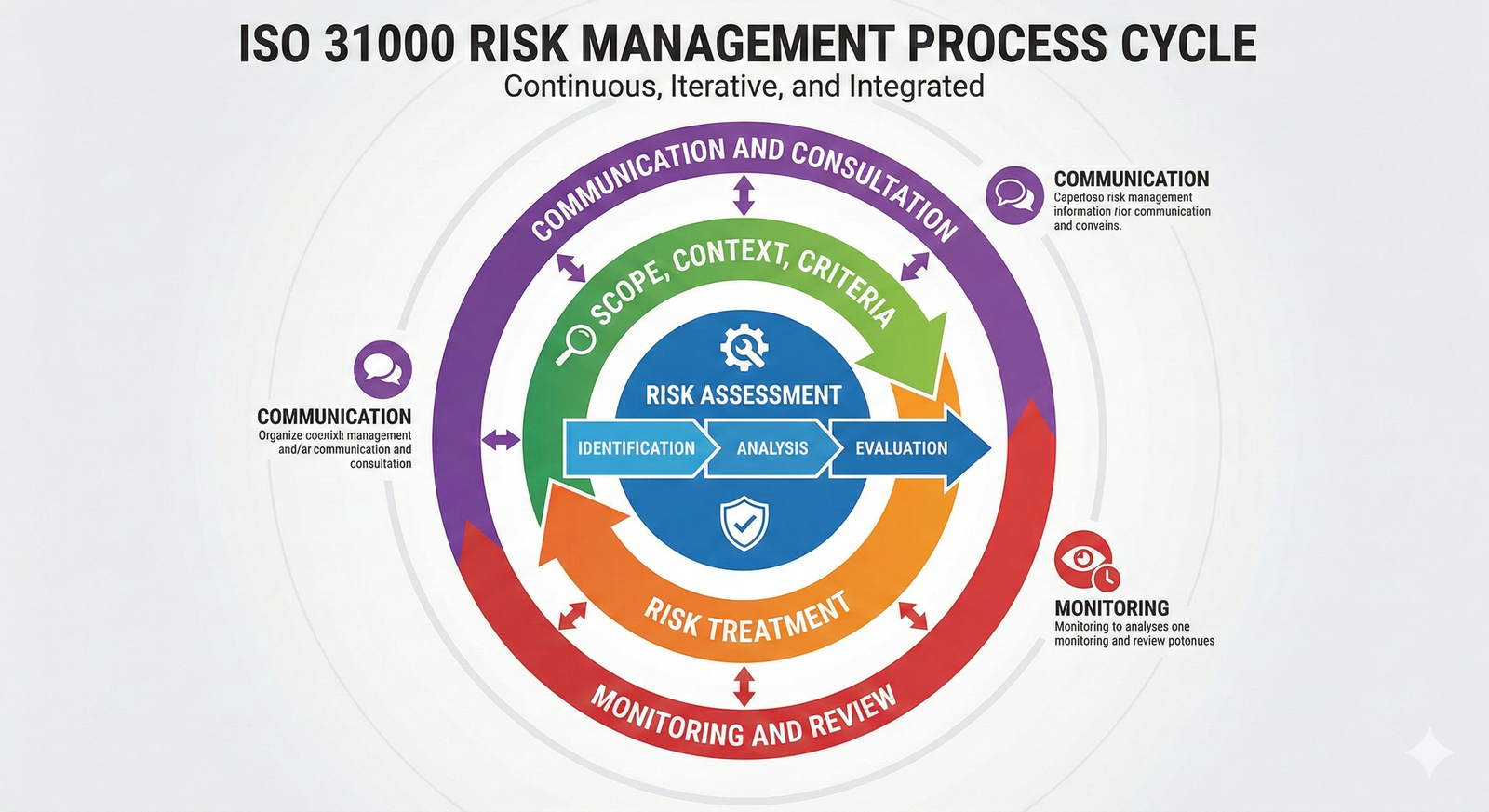
The ISO 31000 process is not a linear, one-time event. It's a continuous cycle of assessment, action, and review, ensuring that your understanding of the risk landscape is always current.
Conducting a Risk Assessment: From Identification to Evaluation
The core of the framework is the risk assessment itself. This is a three-step process designed to develop a deep understanding of your risks.
Step 1: Risk Identification
The first step is to find and describe the risks that could help or hinder your objectives. This involves identifying the sources of risk, the events that could occur, and their potential causes and consequences. A key term here is Hazard . For our coastal city's substation, the hazard is the storm surge. The event is the seawall being overtopped. The consequence is the substation flooding.
Common Infrastructure Hazards
Risk identification involves brainstorming potential hazards. For physical assets, these can range from:
- Physical: Corrosion, material fatigue, seismic activity, flooding, extreme temperatures.
- Operational: Human error, supply chain disruption, equipment failure.
- Financial: Budget cuts, unexpected inflation, changing interest rates.
- Digital: Cybersecurity attacks on control systems (SCADA), data loss, software failure.
Step 2: Risk Analysis
Once risks are identified, you must analyze them to understand their characteristics. The goal is to determine the level of risk, which is typically a function of two factors: Likelihood and Consequence .
This analysis can be qualitative, using descriptive scales (like Low, Medium, High), or quantitative, using numerical data. For many asset management applications, a qualitative analysis using a risk matrix is a powerful and efficient first step.
This next activity is your first hands-on skills practice in this module. You'll learn the practical steps of conducting a qualitative risk analysis, a fundamental skill for any asset manager. This will prepare you for the more complex case study that comes later.
Skills Practice: Conducting a Qualitative Risk Analysis
Launch the interactive skills practice to build and apply your new abilities.
Step 3: Risk Evaluation
With the analysis complete, you now evaluate the risks. This involves comparing the level of risk found during the analysis with the risk criteria the organization has established. This is where you decide if a risk is acceptable or if it requires action. This decision is guided by the organization's Risk Appetite and Tolerance . If a risk (like our substation flooding) exceeds the organization's tolerance, it must be treated.
From Assessment to Action: Risk Treatment and Documentation
Identifying and analyzing risk is pointless without a plan for action. This is the purpose of Risk Treatment . The goal is to modify the risk to an acceptable level. This is often done by implementing a Control . The risk that remains after all controls have been implemented is known as Residual Risk .
All of this information—the identified risks, their analysis, evaluation, and treatment plans—must be documented. The standard tool for this is the Risk Register . It is a living document, central to monitoring and reviewing risks over time.
It's time to put all these pieces together. The following case study will challenge you to apply the entire risk management process to a realistic infrastructure scenario. You'll use the concepts and skills we've covered to move from a problem statement to a documented risk mitigation plan. This is a capstone activity for the module.
Case Study: Developing a Risk Mitigation Plan for an Aging Bridge
Launch the interactive case study to analyze a real-world scenario.
Looking Ahead: The Evolving Landscape of Risk
The world of infrastructure is not static. As you become proficient in these foundational risk management techniques, you must also keep an eye on the horizon. New and evolving categories of risk are constantly emerging, demanding new approaches and considerations.
This final reading looks to the future. It explores how major global trends like climate change and digitalization are reshaping the risk landscape for asset managers. Understanding these trends is what separates a good asset manager from a great one.
Reading: The Future of Risk: Integrating Climate Change and Cybersecurity into PIAM
Launch the reading to explore a key course topic.
Assess Yourself
Time for a quick check-in. This ungraded quiz will help you confirm your understanding of the key concepts and vocabulary from this module. Use it to identify any areas you might want to review before moving on.
❓ Knowledge Check
Test your understanding of the key concepts from this section.
Wrapping Up
Excellent work completing this module! You've moved from understanding financial metrics to tackling the complex world of uncertainty and risk. You've achieved the core competency for this module: applying a risk management framework to physical and infrastructure assets. You've learned how to systematically identify, analyze, evaluate, and treat risks, and how to document this process in a professional risk register. This is a skill set that is absolutely fundamental to the practice of modern asset management.
Next Steps
You have successfully completed the learning activities for this module. Please return to the main course page to complete the module assessment and continue your journey through the course.