
Introduction
If you manage physical assets—be it a power grid, a fleet of vehicles, or a municipal water system—you are in the business of managing risk. It’s not a side task; it’s the core of what you do. Every decision, from scheduling a maintenance check on a critical pump to planning a multi-billion dollar bridge replacement, is an exercise in balancing performance, cost, and risk. But how do you do this consistently, defensibly, and in a way that everyone in your organization understands?
This is where a structured approach becomes invaluable. We're not talking about a rigid, one-size-fits-all procedure, but a way of thinking. This reading introduces you to the ISO 31000, a globally recognized framework for risk management. Think of it less as a prescriptive rulebook and more as a strategic guide. It provides the principles and a clear process to help you make better, more informed decisions that protect and create value for your organization.
Why a Framework, Not Just a Hunch?
As an asset manager, you've likely developed a sharp intuition for what can go wrong. You know which transformer is most likely to fail during a heatwave or which section of pipeline is in the most corrosive soil. This experience is indispensable. However, relying on intuition alone has its limits. It’s hard to scale, difficult to justify to a regulator or a CFO, and it can walk out the door when a senior team member retires.
ISO 31000 provides a way to formalize this expert knowledge into a structured, repeatable, and transparent process. It helps you answer critical questions: * Are we focusing on the right risks? * How do we compare a high-likelihood, low-consequence risk with a low-likelihood, catastrophic one? * Are our investments in risk mitigation delivering real value? * How does a risk to one asset affect the entire system?
By adopting its principles, you shift from a reactive "firefighting" mode to a proactive stance, anticipating challenges and capitalizing on opportunities.
Framework, Not a Certifiable Standard
A key distinction of ISO 31000 is that it provides guidelines, not requirements. You cannot get 'certified' in ISO 31000. This is intentional. It encourages organizations to adapt the principles and processes to their specific objectives, context, and culture, rather than forcing them into a rigid, 'check-the-box' compliance exercise.
The Guiding Lights: Core Risk Management Principles
The framework is built on a set of principles that define the characteristics of effective and efficient risk management. When you embed these into your organization's culture and processes, you create a powerful foundation for decision-making.
1. Integrated Risk management is not a standalone activity performed by a separate department. The principle of being Integrated means it must be woven into the fabric of everything you do, from strategic planning and capital budgeting to daily operations and maintenance. When your engineering team designs a new substation, they should be inherently considering risks like physical security, cybersecurity, and supply chain delays for critical components.
2. Structured and Comprehensive A Structured and comprehensive approach ensures that you don't miss significant risks. It involves having a clear plan and methodology that allows you to compare risks across different asset classes. For example, a structured process helps a port authority consistently evaluate the risk of crane failure, channel siltation, and labor disputes, allowing for a holistic view of operational vulnerabilities.
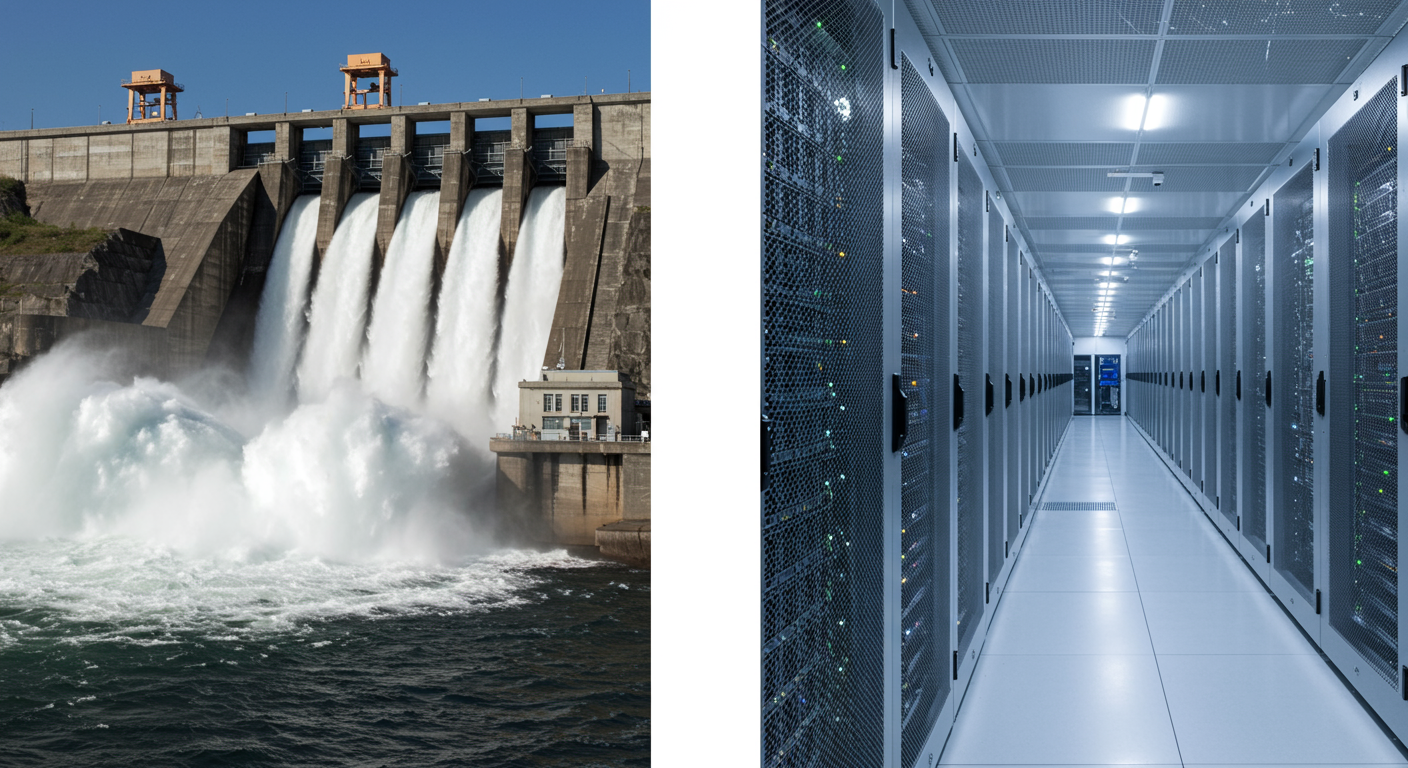
3. Customized The risks facing a national railway are vastly different from those facing a data center. The Customized principle is critical. Your risk management framework must align with your organization’s specific objectives, culture, and the external environment in which you operate. A generic, off-the-shelf solution will fail because it doesn't account for your unique asset portfolio, regulatory requirements, and strategic goals.
4. Inclusive Effective risk management is Inclusive. This means involving the right people at the right time. Your field technicians have hands-on knowledge of asset conditions and failure modes that a director in a boardroom might not. Conversely, your finance team understands the financial implications and insurance options. Involving diverse stakeholders—from operators and engineers to finance and legal—ensures that risks are identified and assessed from all relevant angles.
5. Dynamic Risk is not static. The world changes, and so do your vulnerabilities. A Dynamic approach means that risk management is an ongoing, iterative process. New technologies emerge (e.g., drone-based inspections), new threats appear (e.g., new strains of malware), and the physical environment evolves (e.g., changing weather patterns due to climate change). Your risk management process must be able to anticipate, detect, and respond to these changes.
The Engine Room: The ISO 31000 Risk Management Process
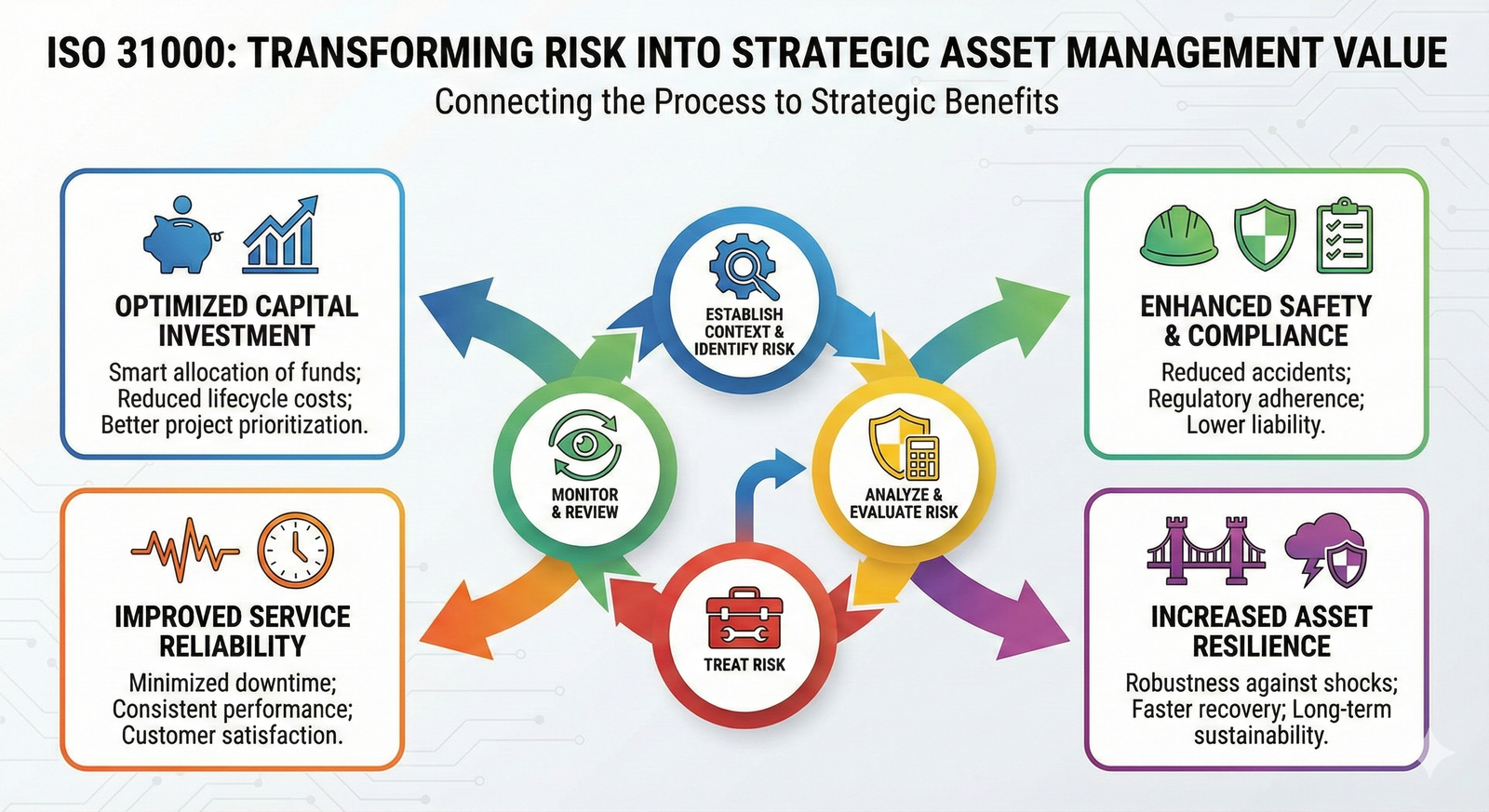
While the principles are the philosophy, the process is the engine that drives risk management. It’s a logical and systematic series of activities that can be visualized as a continuous cycle.
Let's walk through each component.
Continuous Activities: The Process Bookends
Two activities, Communication and Consultation and Monitoring and Review, are not just steps in a line; they are fundamental to the entire process and happen at every stage. You are always communicating with stakeholders and always monitoring the environment and the effectiveness of your actions. Likewise, Recording and Reporting ensures that decisions are documented, and results are communicated, creating a transparent and auditable trail.
1. Scope, Context, and Criteria Before you can manage risk, you must define the "playing field." This stage is about setting the boundaries. * Scope: What are we looking at? Are we assessing the risks for a single pumping station, the entire water distribution network, or a new capital project? * Context: What is our operating environment? This includes internal factors (e.g., budget constraints, strategic goals, available skills) and external factors (e.g., regulatory landscape, public expectations, economic climate). * **Criteria: What is our tolerance for risk? This is where you define what an "acceptable" or "unacceptable" risk looks like. This is often expressed in a risk matrix, which defines levels of likelihood and consequence.
2. Risk Assessment This is the core technical component where you find, analyze, and evaluate risks. It is a three-part process.
Hazard vs. Risk: A Critical Distinction
It's common to confuse these terms, but the difference is vital. A 'hazard' is a potential source of harm. For example, a corroded pipe is a hazard. The 'risk' is the effect of uncertainty on objectives, considering both the likelihood of the pipe bursting and the consequences (e.g., service interruption, environmental damage, repair costs). You manage risks, not hazards.
- Risk Identification: The process of finding, recognizing, and describing risks. This can be done through brainstorming, reviewing historical data, expert interviews, and using checklists. For a bridge, you might identify risks like vehicle impact, seismic activity, bearing failure, and advanced corrosion.
- Risk Analysis: The process to comprehend the nature of risk and to determine the level of risk. This is where you analyze the identified risks to estimate their likelihood and potential consequences. This can range from a simple qualitative "High/Medium/Low" assessment to a complex quantitative analysis using failure-rate data and financial modeling.
- Risk Evaluation: The process of comparing the results of risk analysis with the risk criteria to determine whether the risk and/or its magnitude is acceptable or tolerable. Here, you take the output of your analysis (e.g., "a 5% chance per year of a failure costing $500,000") and compare it against your pre-defined criteria to decide if action is needed.
3. Risk Treatment Once a risk has been evaluated as unacceptable, you must take action. This is Risk Treatment. You have several options: * Avoid: Decide not to start or continue with the activity that gives rise to the risk (e.g., deciding not to build in a known floodplain). * Mitigate (or Reduce): Take actions to reduce the likelihood or consequence of the risk (e.g., applying a protective coating to a pipeline to reduce corrosion rates, or installing a backup generator to reduce the impact of a power outage). * Transfer (or Share): Move some of the financial impact of the risk to a third party (e.g., purchasing insurance or using contractual warranties with suppliers). * Accept (or Retain): Make an informed decision to take no action, while continuing to monitor the risk. This is often done for low-level risks where the cost of treatment outweighs the potential impact.
The selection of the best treatment option involves balancing the costs of implementation against the benefits received—a classic asset management trade-off.
The Strategic Impact: Creating and Protecting Value
Following the ISO 31000 framework is not just an academic exercise; it has a direct and profound impact on an organization's ability to achieve its objectives. It's how you move from simply maintaining assets to actively managing them as a portfolio to deliver value.
-
Value Creation: By understanding your risks, you can make better investment decisions. A risk-based approach helps you prioritize your capital expenditures, ensuring you spend money where it has the greatest effect—replacing the highest-risk components first. It can also reveal opportunities. For example, an analysis of climate-related risks might spur an investment in renewable energy that not only mitigates risk but also creates a new revenue stream.
-
Value Protection: This is the more traditional view of risk management. By systematically identifying and treating risks, you protect your organization from catastrophic failures, financial losses, reputational damage, and harm to people and the environment. It ensures the resilience of your infrastructure and the continuity of the services you provide to society.
Closing
Adopting the ISO 31000 framework is a journey, not a destination. It represents a fundamental shift in organizational thinking—moving from viewing risk as a negative to be avoided, to seeing risk management as a core competency that drives strategic decision-making. For the Physical and Infrastructure Asset Manager, it provides a robust, defensible, and internationally recognized language and process for the work you do every day.
By understanding its core principles—integrated, structured, customized, inclusive, and dynamic—and by applying its systematic process of assessment and treatment, you can more effectively argue for budgets, prioritize work, and demonstrate the value your assets provide. Ultimately, mastering this framework empowers you to not only protect the immense value embodied in your physical infrastructure but also to enhance it for the future.
Learning Outcomes
In this reading, you have explored the ISO 31000 framework and its application in physical and infrastructure asset management. You can now:
- Explain the core principles that make ISO 31000 a flexible and powerful guide for risk management, rather than a rigid set of rules.
- Describe the key components of the risk management process, from setting the scope and context to assessing, treating, and monitoring risks.
- Analyze how a structured approach to risk management is not just about preventing failures, but is a strategic function that actively creates and protects organizational value.
You are also now familiar with essential terminology, including the core Risk Management Principles (Integrated, Structured, Customized, Inclusive, Dynamic) and the stages of the Risk Management Process (Communication, Scope, Context, Criteria, Risk Assessment, Risk Treatment, Monitoring, and Recording).
Assess Yourself
Check your understanding of the key concepts covered in this reading.
❓ Knowledge Check
Test your understanding of the key concepts from this section.
Next Steps
Excellent work completing this deep dive into the ISO 31000 framework. This is a foundational concept for strategic asset management. Please navigate back to the course page to continue with your next activity.