
Introduction
Imagine you are the asset manager for a regional water authority. A critical, 70-year-old cast iron water main running under the city's central business district has just shown a significant pressure drop during a routine sensor check. A failure could be catastrophic, causing massive service disruption, property damage, and a public relations nightmare. What do you do? Do you schedule an immediate, expensive, and disruptive replacement? Do you implement more intensive monitoring? Do you just hope for the best?
This is not a hypothetical for professionals in our field. Decisions like this are at the heart of Physical and Infrastructure Asset Management. The answer lies not in guesswork, but in a structured, disciplined process for understanding and managing uncertainty. This process is the risk management lifecycle, and its central nervous system is the risk register. This isn't just about preventing disasters; it's about making deliberate, defensible decisions that balance cost, performance, and risk to deliver sustained value from your assets.
The Continuous Cycle of Risk Management
A common mistake is to view risk management as a one-time task—something you do at the start of a project and then file away. This couldn't be further from the truth. Effective risk management is a continuous, cyclical process. The environment in which our assets operate is constantly changing: regulations evolve, new technologies emerge, usage patterns shift, and the assets themselves degrade. Your approach to risk must be just as dynamic.
The risk management lifecycle provides a structured way to navigate this uncertainty. While different frameworks might use slightly different terms, the core stages are fundamentally the same.
📊 View Diagram: The Risk Management Lifecycle
Let's walk through what happens at each stage of this essential process.
Stage 1: Risk Identification - Seeing the Unseen
You can't manage a risk you don't know about. The first step is a systematic process of finding, recognizing, and describing risks that could affect your asset management objectives. This is Risk Identification.
This isn't a passive activity. It requires proactive investigation. Sources for identifying risks are everywhere if you know where to look: * Asset Data: Maintenance records, condition assessments, sensor data, and failure histories. A history of repeated pump failures is a clear indicator of a risk. * Expert Judgment: Workshops with operators, maintenance crews, engineers, and other stakeholders. The technician who works on a piece of equipment every day often has insights that data alone can't provide. * External Environment: Changes in regulations (e.g., new environmental standards), economic shifts (e.g., supply chain volatility for spare parts), new technologies, and even climate change projections (e.g., increased flood risk for a substation).
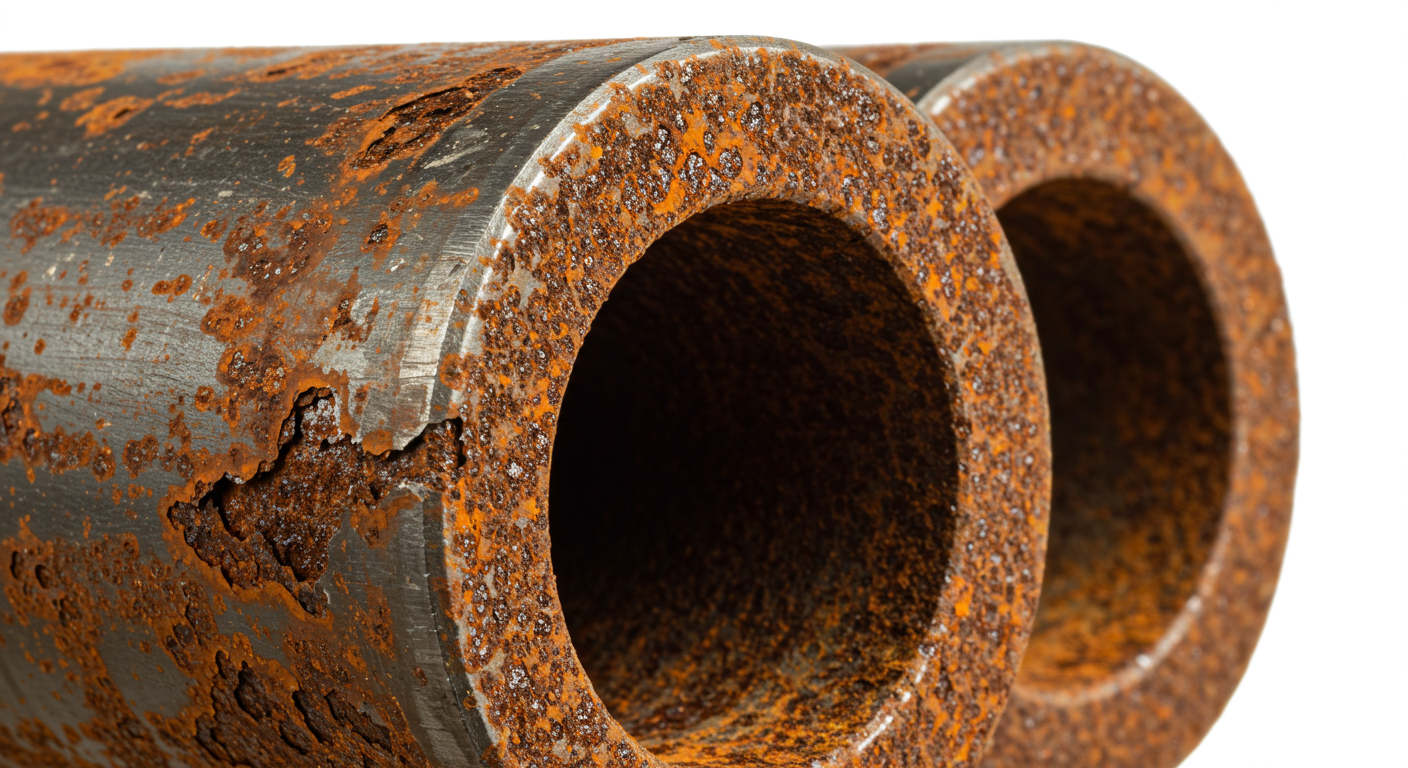
The goal here is to be comprehensive. You want to create a complete list of potential risks, from the physical failure of an asset to a cybersecurity breach of your control systems.
Stages 2 & 3: Analysis and Evaluation - How Bad Could It Be?
Once you have your list of identified risks, you need to understand them better. Which ones are minor annoyances, and which are potential catastrophes? This is the purpose of risk analysis and evaluation.
Risk Analysis is the process of developing an understanding of the risk. It involves considering the causes and sources of risk, their positive and negative consequences, and the likelihood that those consequences can occur.
Risk Evaluation is the process of comparing the results of risk analysis with risk criteria to determine whether the risk and/or its magnitude is acceptable or tolerable.
In practice, these two stages are often done together. The most common method is to assess each risk based on two key factors: 1. Likelihood: How likely is this event to happen? (e.g., Very Low, Low, Medium, High, Very High) 2. Consequence: If it does happen, what is the impact? (e.g., Insignificant, Minor, Moderate, Major, Catastrophic)
The impact isn't just financial. For infrastructure assets, consequences can relate to public safety, environmental damage, service disruption, or reputational harm. A good risk framework defines what each of these levels means in concrete terms. For example, a "Major" safety consequence might be defined as "single fatality or multiple serious injuries."
By plotting these two factors on a matrix, you can generate a risk score or rating, which allows you to prioritize. A high-likelihood, high-consequence risk (like the failure of that critical water main) demands immediate attention, while a low-likelihood, low-consequence risk can be managed with less urgency.
Mentor's Corner: Qualitative vs. Quantitative Analysis
Early in your career, you'll mostly use qualitative analysis (High, Medium, Low). It's fast and effective for prioritizing. As you deal with more complex assets and bigger budgets, you'll move toward quantitative analysis. This means putting real numbers to it—calculating the probability of failure in a given year and estimating the financial cost of that failure in dollars. This quantitative data is what you'll use to build a business case for a multi-million dollar asset replacement program. Both are valid; the key is to use the right tool for the job.
The Heart of the System: The Risk Register
All of this information—the identification, the analysis, the evaluation—needs a home. It cannot live in spreadsheets on individual laptops or just in people's heads. The single source of truth for risk in an organization is the Risk Register.
Think of it as a detailed logbook for everything that could go wrong. A well-structured risk register is the tool that transforms risk management from a theoretical exercise into a practical management discipline. While the exact columns can vary, a robust register typically includes:
- Risk ID: A unique identifier for each risk.
- Risk Description: A clear, concise statement of the risk (e.g., "Failure of water main #78B due to age-related corrosion, leading to major service outage").
- Risk Category: (e.g., Financial, Operational, Safety, Environmental, Reputational).
- Likelihood Rating: The assessed likelihood.
- Consequence Rating: The assessed consequence.
- Risk Score/Level: The resulting priority level (e.g., Critical, High, Medium, Low).
- Risk Owner: The single person accountable for managing the risk.
- Mitigation Actions: The specific actions being taken to treat the risk.
- Action Owner & Due Date: Who is responsible for the action and by when.
- Status: The current status of the risk and the mitigation actions.
Here is an example of what a few entries in a risk register for a public transit authority might look like.
Metro Transit Authority - Critical Asset Risk Register (Excerpt)
| Risk ID | Risk Description | Likelihood | Consequence | Risk Score | Mitigation Action | Risk Owner |
|---|---|---|---|---|---|---|
| PTA-ENG-001 | Signal system failure on a key line, leading to major service disruption and potential safety incidents. | 4 | 5 | 20 | System-wide upgrade project for signaling and control systems. | Chief Engineer |
| PTA-STN-001 | Prolonged escalator failure at a major interchange station, causing significant passenger congestion and accessibility issues. | 3 | 3 | 9 | Increase frequency of preventative maintenance and stock critical spare parts. | Director of Stations |
| PTA-STR-001 | Structural failure due to cracking in concrete supports on an elevated track section, posing a risk of derailment. | 2 | 5 | 10 | Implement continuous structural health monitoring with sensor technology and regular physical inspections. | Director of Structures |
| PTA-IT-001 | Cybersecurity breach of the passenger information system, resulting in reputational damage and passenger confusion. | 3 | 2 | 6 | Install next-generation firewalls and conduct mandatory annual cybersecurity training for all staff. | IT Director |
Stage 4: Risk Treatment - Taking Action
Once you've prioritized your risks, you have to decide what to do about them. This is Risk Mitigation. There are generally four ways to treat a risk, often called the "4 T's":
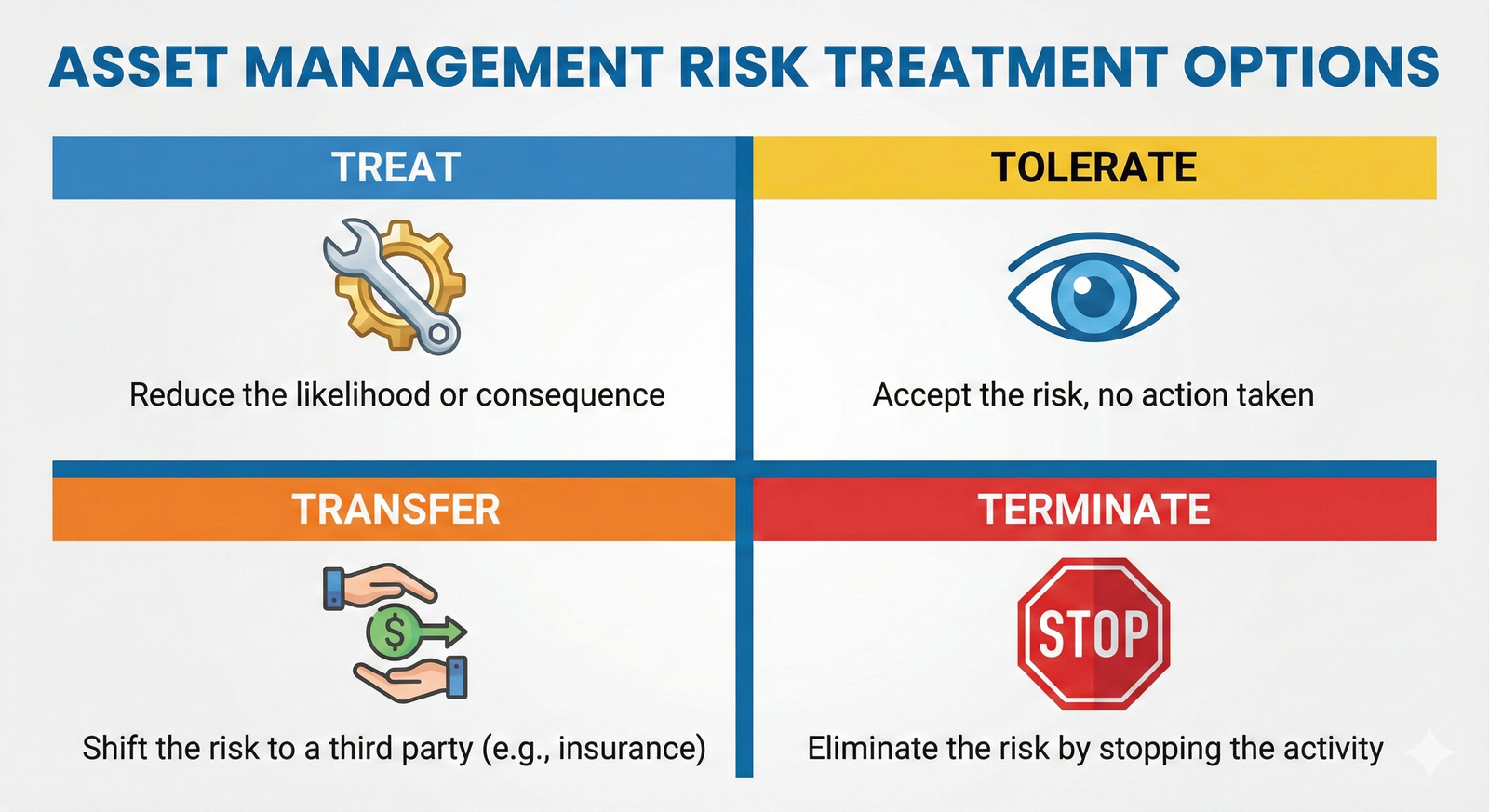
- Treat: This is the most common response. You take action to reduce either the likelihood or the consequence of the risk. For our aging water main, treating the risk could mean replacing a section of the pipe, installing a reinforcing liner, or implementing cathodic protection to slow corrosion.
- Tolerate (or Accept): For risks with a very low score, the cost of treatment might outweigh the benefit. In these cases, you may decide to formally accept the risk and do nothing. This is a conscious decision, not an oversight, and it must be documented in the risk register.
- Transfer: This involves shifting some or all of the financial consequence of the risk to a third party. The most common example is insurance. You can't insure against service disruption, but you can insure against the cost of repair and third-party liability.
- Terminate: In some cases, you can eliminate the risk entirely by ceasing the activity that causes it. For example, if a small, non-essential chemical storage tank poses a significant environmental risk, you might decide to decommission the tank and use a different process, terminating the risk.
For significant risks that are being treated or tolerated, you should also develop a Contingency Plan. If the water main does fail despite your mitigation efforts, what is the plan? Who gets called? How is water re-routed? How are customers notified?
After you've applied your treatment, the risk that is left over is called Residual Risk. It's impossible to eliminate all risk; the goal of asset management is to understand and manage the residual risk to a level that is acceptable to the organization.
Stage 5: Monitoring and Review - Keeping the Document Alive
This final stage is what makes the process a cycle. Risk Monitoring ensures that your risk register remains a living, relevant document.
This involves several activities: * Tracking Mitigation Actions: Are the actions defined in the register actually being completed on time? * Evaluating Effectiveness: Is the mitigation action having the desired effect? If we increased maintenance frequency on our escalators, have the number of breakdowns actually decreased? * Scanning for New Risks: The world changes. A new cybersecurity vulnerability might be discovered, or a key supplier might go out of business. The monitoring process needs to be able to detect and assess these new risks. * Periodic Reviews: The entire risk register should be formally reviewed on a regular basis (e.g., quarterly or annually) by senior management. This ensures continued visibility and accountability.
This is the stage that directly connects your mitigation strategies back to the ongoing process. You don't just launch a mitigation plan and hope it works. You monitor its performance, measure its impact, and adjust your approach based on real-world results. This feedback loop is the engine of continuous improvement in asset management.
Closing
We began with the problem of a single, aging water main. As you can now see, the professional response is not a single action, but the activation of a continuous cycle. It involves identifying the risk of failure, analyzing its likelihood and potential consequences, and documenting this in a risk register. From there, you make a conscious decision on how to treat the risk—whether to replace, reinforce, or simply monitor it more closely.
The risk register is the critical tool that makes this possible. It's not a static report but a dynamic dashboard for managing uncertainty across your entire asset portfolio. The final, crucial step of monitoring and review ensures this dashboard is always current. By tracking your mitigation efforts and scanning for new threats, you transform risk management from a reactive, crisis-driven activity into a proactive, strategic function. Mastering this lifecycle is fundamental to ensuring the safety, reliability, and value of the physical infrastructure that society depends on.
Learning Outcomes
In this reading, you have explored the core processes that enable effective asset management. You can now: * Describe the risk management process as a continuous, five-stage cycle involving identification, analysis, evaluation, treatment, and monitoring. * Explain that the risk register is the central, living document used to log, track, and manage all identified risks and their associated treatment plans. * Connect the dots between choosing a risk mitigation strategy and the essential follow-up process of monitoring its effectiveness and reviewing the risk profile over time.
You have also been introduced to the foundational vocabulary of the discipline, including Risk Identification, Risk Mitigation, Risk Monitoring, the Risk Register, Contingency Plans, and the concept of Residual Risk.
Assess Yourself
❓ Knowledge Check
Test your understanding of the key concepts from this section.
Next Steps
Well done on completing this reading. You have taken a significant step in understanding how to manage risk in a structured and professional way.
When you are ready, please navigate back to the course to continue your learning journey.
