
From 'What If' to 'What's Next': Mastering Risk in Asset Management
Welcome to Module 3. In our previous modules, we focused on the financial tools used to value assets and understand their costs over time. Now, we shift our focus to protecting that value from a constant and powerful force: uncertainty.
Imagine you are the asset manager for a major metropolitan transit authority. A 100-year-old rail bridge is a critical part of your network. What could go wrong? A structural failure, a fire, a collision, a flood, a security threat—the list of possibilities can feel overwhelming. Simply hoping for the best is not a strategy. Your job is to move from "what if" to "what's next" by systematically identifying, analyzing, and managing these potential events. This is the core of risk management in PIAM. It's how we ensure our assets remain safe, reliable, and valuable.
Seeing the Unseen: Risk Identification
The first step in managing risk is seeing it. You can't manage a risk you haven't identified. This process is called Risk Identification . It's a structured brainstorming effort where you and your team look at an asset or system and ask, "What could go wrong?"
We start by looking for any potential source of harm, which we call a Hazard . A hazard isn't the bad thing happening; it's the condition that could cause the bad thing to happen. For our rail bridge, a hazard might be outdated signal equipment, severe metal corrosion, or proximity to a floodplain.
Think of this stage like a detective gathering clues. You're not judging the severity of the clues yet, just collecting all of them. A good asset manager is curious and even a little paranoid, looking at an asset from every possible angle to spot potential hazards.
Sizing Up the Threat: Risk Assessment
Once you have a list of potential risks, you need to prioritize them. You can't address every single possibility with the same level of resources. This is where Risk Assessment comes in. We primarily do this in two ways: qualitatively and quantitatively.
Qualitative Risk Analysis
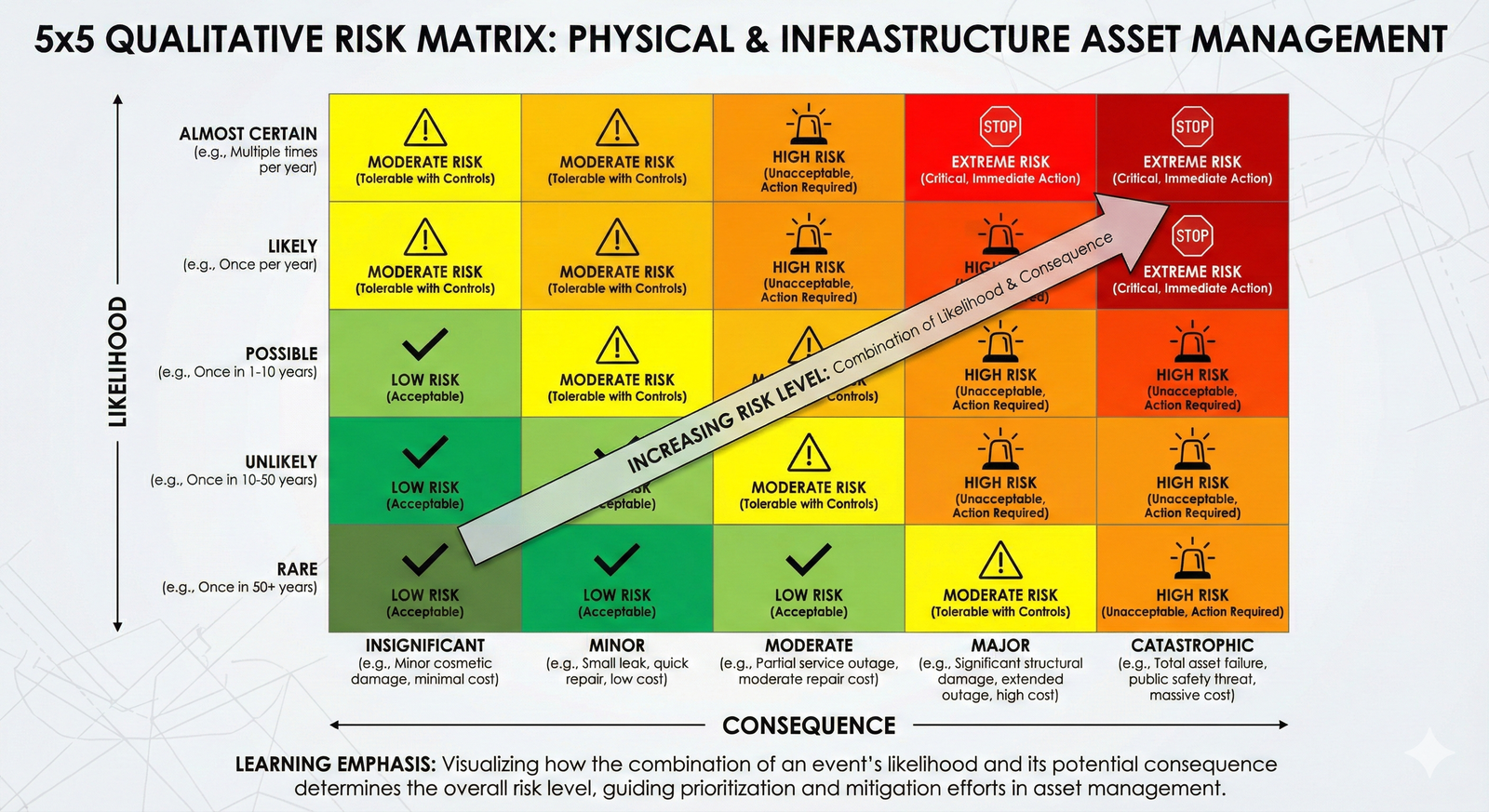
The most common starting point is Qualitative Risk Analysis . This approach uses expert judgment to evaluate two key factors for each risk:
- Likelihood: How likely is this event to happen?
- Consequence: If it does happen, how bad will the impact be?
We define Likelihood and Consequence using a predefined scale. By plotting these on a grid, we create a Risk Matrix , which gives us a quick visual guide to our biggest problems—the high-likelihood, high-consequence events in the "red zone."
Quantitative Risk Analysis
For high-priority risks, a qualitative assessment may not be enough. We need to attach real numbers to the problem. This is Quantitative Risk Analysis . For example, instead of saying a flood is "Likely" with "Major" consequences, we might calculate a 10% chance of a flood occurring in any given year that would cause an estimated $5 million in damages and service disruption. This numerical approach is critical for making investment decisions and comparing different risk mitigation options.
These two approaches, qualitative and quantitative, are not mutually exclusive. In fact, they work together. You'll often use a qualitative analysis to quickly scan for the biggest threats, and then apply a more rigorous quantitative analysis to the ones that land in the red and yellow zones of your risk matrix.
To explore these assessment methods in more detail, complete the following reading.
Reading: A Tale of Two Analyses: Qualitative vs. Quantitative Risk Assessment
Launch the reading to explore a key course topic.
A Structured Approach: Failure Modes and Effects Analysis (FMEA)
One of the most powerful techniques for conducting a detailed risk assessment is Failure Modes and Effects Analysis (FMEA) . Originally developed by the military and heavily used in manufacturing, FMEA is a bottom-up method where you break down an asset into its components and analyze the potential failure modes for each one.
Get ready to roll up your sleeves! This next activity is a hands-on simulation of a technique used by asset managers every day. It will guide you through the process of conducting a simplified FMEA, giving you a real feel for this important skill.
Skills Practice: Conducting a Failure Modes and Effects Analysis (FMEA)
Launch the interactive skills practice to build and apply your new abilities.
From Analysis to Action: Risk Mitigation
Identifying and analyzing risk is useless without a plan to deal with it. The next step is Risk Mitigation . For each significant risk, you must decide on a course of action. Will you: * Avoid the risk by changing the plan? (e.g., rerouting the railway line away from the floodplain) * Transfer the risk to another party? (e.g., buying insurance) * Control the risk by implementing measures to reduce its likelihood or consequence? (e.g., reinforcing the bridge structure, installing better fire suppression systems) * Accept the risk because the cost of mitigation outweighs the potential impact?
For risks you can't eliminate entirely, you develop a Contingency Plan . The risk that remains after all your mitigation efforts are in place is called Residual Risk .
Now it's time to put all the pieces together. This case study will challenge you to think like a senior asset manager facing a complex problem. You'll use the concepts of risk assessment to develop a concrete mitigation plan.
Case Study: Developing a Risk Mitigation Plan for a Coastal Data Center
Launch the interactive case study to analyze a real-world scenario.
Staying Vigilant: Risk Monitoring and the Risk Register
Risk management is not a one-time project; it's a continuous cycle. Assets degrade, new technologies emerge, and the environment changes. Risk Monitoring ensures that your understanding of the risk landscape stays current.
The central document for managing this entire process is the Risk Register . This is a master log of every identified risk, its assessment, the mitigation plan, who is responsible, and its current status. It's the single source of truth for risk in your asset portfolio.
This final reading will bring the full lifecycle together and show how the risk register is used in practice.
Reading: The Risk Management Lifecycle and the Role of the Risk Register
Launch the reading to explore a key course topic.
Assess Yourself
Time for a quick check-in. The following quiz is a great way to see how well you've grasped the key concepts from this module. Don't worry, it's not for a grade. Use it to identify any areas you might want to review before moving on.
❓ Knowledge Check
Test your understanding of the key concepts from this section.
Wrapping Up
Fantastic work completing this module! You've just navigated one of the most critical responsibilities of an asset manager. You've learned how to move from uncertainty to proactive management by applying a structured process to analyze and manage the risks that threaten your assets. This ability to anticipate, prioritize, and plan is what separates a good asset manager from a great one.
Next Steps
You have successfully completed the work for this module. Please return to the course homepage to review your graded assignments for this module and to begin your work on the next one.