
Introduction
Have you ever seen a beautifully crafted Asset Management Plan (AMP) sitting on a shelf, gathering dust? It’s a common sight in many organizations. The document is technically sound, detailed, and comprehensive, yet it has almost no real-world impact on day-to-day decisions. Why does this happen? More often than not, the plan fails because it exists in a vacuum, disconnected from the organization's core mission.
An AMP that isn't directly and clearly tied to what the organization is trying to achieve—whether that's increasing profitability, ensuring public safety, or meeting sustainability targets—is fundamentally flawed. It becomes a box-ticking exercise, a compliance document that fails to drive value. True asset management is about making your assets work for the business. It’s about translating the high-level vision from the boardroom into tangible, value-driven actions in the boiler room, on the factory floor, or across the transmission network. This article will provide you with practical strategies to forge that critical link, ensuring your AMP is not just a document, but a dynamic roadmap for success.
The "Why": Starting with the Strategic Vision
Before you can even think about maintenance schedules or capital replacement plans, you have to understand the bigger picture. What is the fundamental purpose of your organization? What does success look like in three, five, or ten years? The answers to these questions form your Organizational Objectives. These are not asset management goals; they are the business goals that asset management must support.
Think of a municipal water utility. Its organizational objectives might include: * Ensuring the delivery of safe and reliable drinking water to all residents. * Maintaining financial sustainability through efficient operations and fair rates. * Complying with all federal and state environmental regulations. * Improving community resilience to climate change events like droughts or floods.
Every decision made within the asset management program must ultimately support one or more of these objectives. If you propose a multi-million dollar project to upgrade a treatment plant, you must be able to articulate how it helps guarantee water safety, improves efficiency, or mitigates a regulatory risk. Without this connection, you're just spending money.
Start with 'Why'
Before you write a single line of your AMP, get a copy of your organization's strategic plan. If one doesn't exist or is outdated, your first step is to facilitate a conversation with senior leadership to define it. You cannot align with a target that doesn't exist. This isn't just an asset management task; it's a fundamental business practice.
The Art of Translation: Creating a Clear "Line of Sight"
Once you have a firm grasp of the organizational objectives, the next challenge is to translate them into meaningful actions at the asset level. This is where the concept of line of sight becomes essential. It’s the logical thread that connects the CEO's strategic vision to the technician's daily work order.
This translation is a cascading process. It doesn't happen in one leap. It flows downwards, getting more specific at each level.
📊 View Diagram: The Line of Sight Cascade
Let's break down this cascade using our water utility example.
-
Organizational Objective: "Maintain financial sustainability through efficient operations." This is the high-level goal from the board. It's broad and aspirational.
-
Asset Management Policy: This is a formal statement from management outlining the principles and commitment to asset management. It might state: "We will manage our assets to provide the required level of service at the lowest whole-life cost."
-
Asset Management Strategy (SAMP): This is a longer-term view of how the policy will be achieved. It might outline a strategy to "reduce reactive maintenance costs by shifting to a proactive, risk-based maintenance approach over the next 5 years."
-
Asset Management Objectives: Now we get specific. Derived from the strategy, an AM objective could be: "Reduce energy consumption from pumping operations by 10% in the next 24 months" or "Decrease the number of emergency main break repairs by 15% year-over-year." These are specific, measurable, achievable, relevant, and time-bound (SMART).
-
Asset Management Plan (AMP): This is where the rubber meets the road. The AMP details the specific activities to achieve the AM objectives. To reduce energy consumption, the AMP might include:
- Action: "Conduct energy audits on our top 5 most energy-intensive pump stations by Q2."
- Action: "Develop a capital project to replace two 30-year-old inefficient pumps with new variable frequency drive (VFD) pumps in the next fiscal year."
- Action: "Implement an optimized pump scheduling program to align with off-peak electricity rates by Q4."
Now, the technician dispatched to install a VFD pump has a clear "line of sight." They aren't just swapping out a piece of equipment; they are executing a specific task within the AMP, which achieves an AM objective, which enacts the AM strategy, which fulfills the AM policy, which helps the entire organization achieve its objective of financial sustainability. Every action has a purpose.
Measuring What Matters: The Power of KPIs
You can't manage what you don't measure. Once you've established your asset management objectives, you need a way to track your progress. This is the role of Key Performance Indicators (KPIs). A common mistake is to track dozens of metrics that are easy to collect but don't actually indicate progress toward a strategic goal. A good KPI is directly linked to an AM objective.
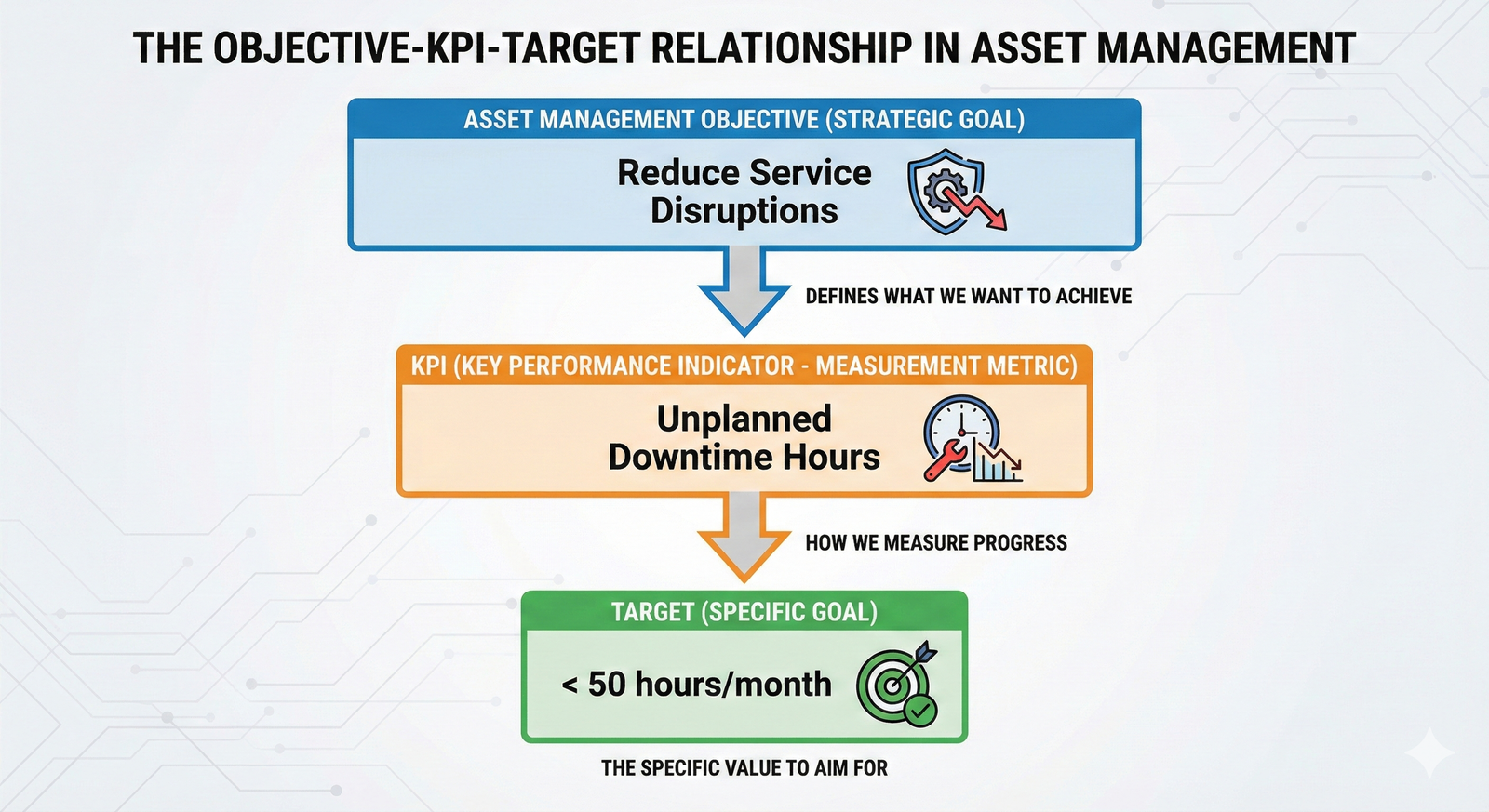
It's also useful to think about two types of KPIs:
- Lagging Indicators: These measure past performance. They tell you the outcome of what has already happened. Examples include "Number of asset failures last month" or "Total maintenance cost last quarter." They are important for reporting but don't help you prevent future problems.
- Leading Indicators: These are predictive and measure the performance of your inputs and processes. They give you an early warning if you are drifting off course. Examples include "Preventive Maintenance (PM) schedule compliance" or "Percentage of critical spares in stock." If your PM compliance is dropping, it's a leading indicator that you may see a rise in failures (a lagging indicator) in the future.
A mature asset management program relies on a balanced set of both leading and lagging indicators to get a complete picture of performance.
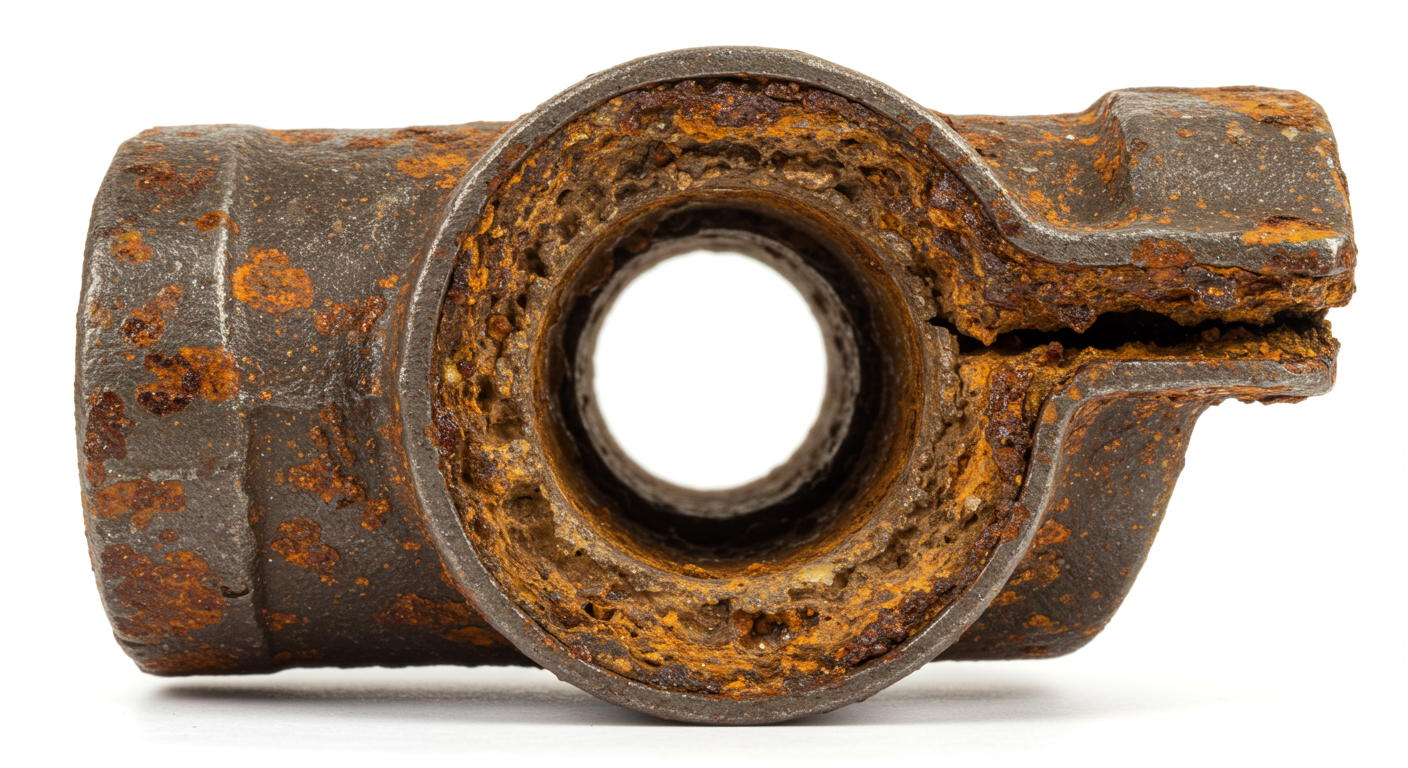
To make this tangible, imagine you are the Asset Manager for a regional transit authority. Your dashboard of KPIs might look something like this.
Q3 KPI Performance - Regional Transit Authority
| AM Objective | KPI | KPI Type | Target | Current Value | Status |
|---|---|---|---|---|---|
| Improve Service Reliability | Mean Distance Between Failures (MDBF) | Lagging | 10,000 miles | 9,150 miles | Below Target |
| Optimize Maintenance Practices | Preventive Maintenance (PM) Compliance | Leading | 95% | 97.2% | On Target |
| Enhance Passenger and Employee Safety | Reportable Incidents per 100k Miles | Lagging | < 0.50 | 0.62 | Below Target |
| Maintain Assets in a State of Good Repair | Facility Condition Index (FCI) | Lagging | < 2.0 | 1.85 | On Target |
| Improve Service Reliability | On-Time Performance | Lagging | 92.0% | 90.5% | Watch |
| Enhance Passenger and Employee Safety | Safety Training Completion Rate | Leading | 100% | 98% | Watch |
| Optimize Maintenance Practices | Corrective Maintenance Backlog (Days) | Lagging | < 15 Days | 22 Days | Below Target |
| Improve Service Reliability | Vehicle Availability Rate | Lagging | 93% | 94.5% | On Target |
| Maintain Assets in a State of Good Repair | State of Good Repair (SOGR) Backlog | Lagging | < $50M | $53M | Watch |
| Optimize Maintenance Practices | Ratio of PM to Corrective Maintenance | Leading | 70/30 | 65/35 | Watch |
This kind of dashboard allows you to see, at a glance, where you are succeeding and where you need to focus your attention. It transforms the AMP from a static plan into a living management tool.
Navigating the Real World: Common Challenges and Pitfalls
Forging and maintaining this alignment is a journey, not a destination. It's a process of continuous improvement, and there will be bumps in the road. Being aware of the common challenges is the first step to overcoming them.
Challenge 1: Organizational Silos In many organizations, the engineering, operations, and finance departments operate in their own worlds. They have different priorities, different vocabularies, and different metrics for success. The engineering team might want to replace an asset because it's old, but they fail to articulate the financial risk of failure in a way the CFO understands. The result? The budget request is denied, the asset fails, and everyone blames each other.
- Strategy: Create cross-functional teams. When developing your AMP, ensure you have representatives from finance, operations, IT, and other key departments in the room. This builds shared ownership and forces everyone to speak a common language—the language of risk, cost, and performance.
Challenge 2: The "Set and Forget" Mentality An AMP is a snapshot in time. But organizational objectives change, new risks emerge, and asset conditions degrade. An AMP that isn't regularly reviewed and updated becomes irrelevant.
- Strategy: Integrate the AMP review cycle with the organization's annual budgeting and strategic planning cycle. This makes the AMP a living document. The annual review should ask: Are our objectives still valid? Are our KPIs telling us the right story? Are we on track with our plans? What needs to change for next year?
Challenge 3: Poor Data Quality Your KPIs and your entire AMP are only as good as the data they are built on. If your asset registry is incomplete, your maintenance records are messy, or your condition data is non-existent, your decisions will be based on guesswork. This is the "garbage in, garbage out" principle.
- Strategy: Treat data as a critical asset. Invest in your CMMS/EAM systems. Define clear standards for data entry and train your staff on their importance. Start small—focus on getting reliable data for your most critical assets first, and then expand.
Beware of Vanity Metrics
A common pitfall is choosing KPIs that are easy to measure and make the department look good, but don't reflect actual progress on strategic objectives. Tracking 'number of work orders closed' is a classic example. You can close a thousand minor work orders and look productive, while ignoring a critical asset that is about to fail and shut down the entire plant. Always ask: 'Does improving this KPI directly contribute to achieving a core organizational objective?'
Challenge 4: Lack of Leadership Buy-in If senior leadership doesn't understand, support, and champion the asset management program, it is destined to fail. It will be seen as a "maintenance thing" or an "engineering thing" rather than a core business strategy. It will be the first thing to get its budget cut when times are tough.
- Strategy: Learn to speak the language of the C-Suite. Frame your asset management initiatives in terms of financial return, risk reduction, and competitive advantage. Use your KPIs and the "Line of Sight" to show them exactly how investing in proactive maintenance or replacing a critical asset protects revenue and supports their strategic goals.
The Future of Alignment: Dynamic and Data-Driven
Historically, the AMP was a static, paper-based document, reviewed annually. The future of alignment is far more dynamic. The "Line of Sight" is becoming shorter and clearer thanks to technology.

The rise of the Industrial Internet of Things (IIoT), digital twins, and predictive analytics is transforming asset management. Sensors on a pump can provide real-time data on vibration and temperature. This data feeds into a predictive model that can forecast a potential failure weeks in advance. This automatically triggers a work order, and the event is logged against a leading KPI for "proactive interventions."
The leadership team is no longer looking at a report that's a month old. They can see a live dashboard showing the health of their critical assets and how that performance is tracking against the organization's highest-level objectives. This closes the loop, turning the static, cascading "Line of Sight" into a dynamic, real-time feedback cycle. As you move forward in your career, your ability to leverage these technologies to create and manage this feedback cycle will be one of your most valuable skills.
Closing
We've covered the essential journey from the abstract goals of the boardroom to the concrete actions on the plant floor. The key is to remember that alignment is not a one-time project; it's a continuous, disciplined process. It begins with a deep understanding of your organization's strategic objectives. From there, you must meticulously translate those goals into specific, measurable asset management objectives, creating a clear "Line of Sight" that gives purpose to every task.
By implementing meaningful Key Performance Indicators, you can monitor your progress, demonstrate value, and make data-driven adjustments. This isn't just about tracking metrics; it's about telling a story of how your assets are performing and how your team's work contributes to the organization's success. While challenges like organizational silos and poor data are real, they can be overcome with strategic communication, cross-functional collaboration, and a commitment to continuous improvement. A well-aligned AMP is the most powerful tool you have to transform your asset portfolio from a cost center into a strategic advantage.
Learning Outcomes
In this reading, you have learned how to bridge the gap between strategy and execution in asset management. You can now: * Translate high-level Organizational Objectives into specific, actionable Asset Management Objectives by establishing a clear Line of Sight. * Use Key Performance Indicators (KPIs) to effectively monitor the performance of your Asset Management Plan and demonstrate its value. * Recognize common challenges, such as organizational silos and a "set and forget" mentality, that can derail alignment and apply strategies to overcome them.
Assess Yourself
Check your understanding of the key concepts from this reading.
❓ Knowledge Check
Test your understanding of the key concepts from this section.
Next Steps
You have successfully completed this reading on aligning your AMP with organizational objectives. This is a foundational skill for any asset management professional. Please navigate back to the course page to continue your learning journey.
