
From Strategy to Action: An Introduction to Asset Management Planning
Welcome to the first module of your journey into PIAM Planning, Leadership, and Performance.
Imagine you've just been hired as the Asset Manager for a growing municipality. The city council has set an ambitious strategic goal: to become the most resilient and sustainable city in the region within the next 15 years. You look out your window at the city's assets—bridges, water treatment facilities, public transit fleets, parks—and you're faced with a fundamental question: How do you translate that high-level vision into concrete, daily decisions about maintaining, replacing, and investing in this vast portfolio of physical assets?
This is the core challenge that asset management planning solves. It’s the discipline of creating a direct, traceable link between an organization's strategic vision and the on-the-ground management of its assets. Without this link, asset management can become a series of disconnected, reactive tasks. With it, every maintenance schedule, every capital investment, and every operational decision becomes a deliberate step toward achieving the organization's most important goals.
The Planning Hierarchy: From Policy to Plan
To build this connection effectively, we use a clear hierarchy of documents. It starts with the highest-level statement of intent and becomes progressively more detailed.
At the very top is the Asset Management Policy, which is the formal expression of the organization's commitment to asset management. It sets the "why."
Derived from the policy is the Strategic Asset Management Plan (SAMP). The SAMP translates the organization's overall objectives into specific, high-level asset management objectives. It outlines the "what"—what we need to achieve with our assets over the long term.
Finally, we have the Asset Management Plan (AMP). This is where the strategy gets real. The AMP is a tactical document that details the specific actions, resources, and timelines required to achieve the SAMP's objectives for a particular asset or system of assets. It defines the "how."
This hierarchy ensures that the work being done on the ground is always in service of the bigger picture.
📊 View Diagram: The Asset Management Planning Hierarchy
This is a great time to go deeper into the purpose and structure of these critical documents. The following reading will give you a detailed breakdown of the SAMP and the AMP, which are central to this entire course. Pay close attention to the differences in their scope, timeframe, and audience.
Reading: Distinguishing Between the Strategic Asset Management Plan (SAMP) and the Asset Management Plan (AMP)
Launch the reading to explore a key course topic.
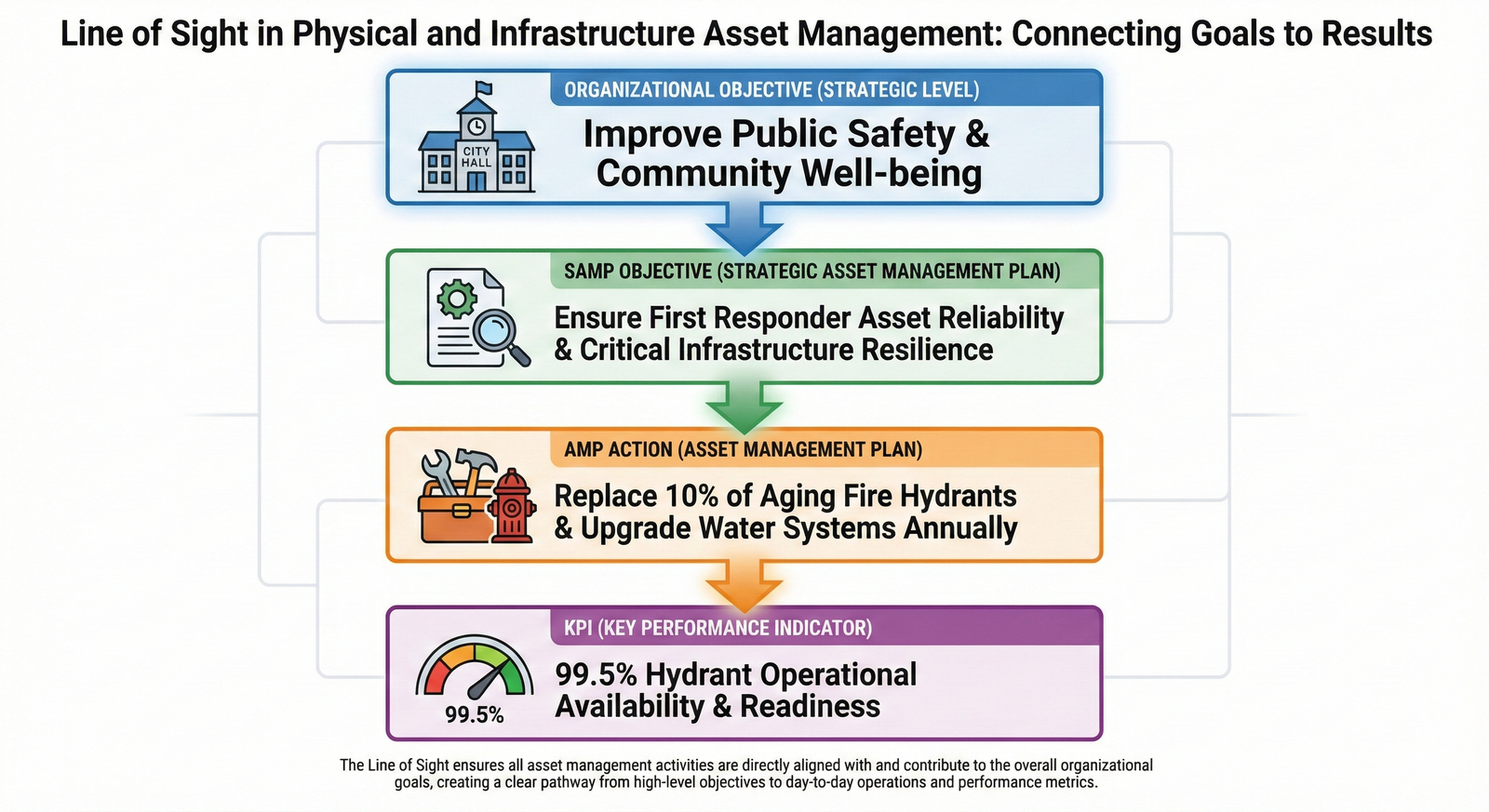
Creating a "Line of Sight"
The most effective asset management programs are those that can demonstrate a clear Line of Sight from the top floor to the shop floor. This means that any team member, whether in finance, operations, or maintenance, should be able to see how their work contributes to the overarching Organizational Objectives.
For example, if a transit authority's organizational objective is to "improve rider satisfaction by 15%," the line of sight might look like this:
- SAMP Objective: Improve asset reliability and comfort.
- AMP Action: Implement a new preventative maintenance schedule for the HVAC systems on all buses.
- KPI: Reduce in-service HVAC failures by 30% over the next 12 months.
This clear path ensures that resources are not wasted on activities that don't deliver strategic value.
The Human Element: Stakeholder Analysis
An AMP is not just a technical document; it's a social one. Its success depends on the people who influence it, execute it, and are affected by it. We call these individuals and groups Stakeholder.
Consider a plan to upgrade a major bridge. Stakeholders would include: * Internal: The finance department (funding), engineering (design), maintenance crews (long-term upkeep). * External: Commuters (traffic disruption), local businesses (economic impact), regulatory agencies (permits and compliance), and the community (noise and environmental concerns).
Ignoring any of these groups can lead to budget overruns, project delays, or public opposition. A professional asset manager must therefore be skilled in Stakeholder Analysis. This process helps you understand who to listen to, who to inform, and whose needs must be balanced to create a plan that is not only technically sound but also politically and socially viable.
Understanding stakeholders is a fundamental skill, not just in asset management but in any leadership role. The next activity is a hands-on instructional exercise designed to walk you through the process of conducting a stakeholder analysis. This is your first opportunity in this course to practice a core professional skill in a structured way.
Skills Practice: Conducting a Stakeholder Analysis for an Asset Management Plan
Launch the interactive skills practice to build and apply your new abilities.
Now that you have a handle on the 'what' (the plans) and the 'who' (the stakeholders), let's focus more on the 'how'. How do you ensure your AMP is truly aligned with the organization's goals? The next reading dives into the practical methods for achieving this, including the use of performance metrics.
Reading: Practical Strategies for Aligning the AMP with Organizational Objectives
Launch the reading to explore a key course topic.
It's time to bring all these pieces together. The following instructional case study will place you in a realistic scenario where you'll need to think through the initial steps of developing an Asset Management Plan. This is a safe space to apply what you've learned about planning, alignment, and stakeholders. Take your time and think like an asset manager!
Case Study: Initiating an Asset Management Plan for a Regional Airport
Launch the interactive case study to analyze a real-world scenario.
Assess Yourself
❓ Knowledge Check
Test your understanding of the key concepts from this section.
Wrapping Up
Fantastic work completing this first module! You've built a strong foundation for the rest of this course. You can now see how a simple list of assets becomes a strategic portfolio when managed correctly. You've learned how to create a "Line of Sight" that connects high-level organizational goals directly to the work done on the ground, using the hierarchy of the Asset Management Policy, the SAMP, and the AMP. Most importantly, you've started to develop the core competency of creating an Asset Management Plan by practicing the crucial first steps: aligning with objectives and analyzing the needs of your stakeholders. This is the bedrock of effective asset management leadership.
Next Steps
You have successfully completed the first module. Please navigate back to the main course page to continue your progress.
