
Introduction
Welcome. If you've ever been in a meeting where someone asks, "Do we have an asset management plan for this?" you might have noticed a moment of confusion. Is the person asking for the high-level, 20-year vision for all our assets, or are they asking for the detailed, 5-year maintenance and renewal schedule for our fleet of vehicles? This is a common point of ambiguity, and it gets to the heart of a critical distinction in our profession: the difference between the Strategic Asset Management Plan and the Asset Management Plan.
They sound similar, but they serve fundamentally different purposes. Think of it this way: one is the architect's grand vision for a city (the "why" and "what"), and the other is the detailed construction blueprint for a specific building within that city (the "how" and "when"). Understanding the unique role of each document is not just academic; it's essential for effective communication, proper planning, and successfully aligning your daily work with your organization's highest-level goals. In this reading, we will dissect these two foundational documents, clarifying their purpose, components, and how they work together to form the backbone of any mature asset management system.
The Foundation: The Asset Management Policy
Before we can build our two pillars, the SAMP and the AMP, we need a solid foundation. In asset management, that foundation is the Asset Management Policy. This is a high-level, C-suite-endorsed document. It's a formal statement of intent and principles. It doesn't contain detailed plans, but it provides the authority and guidance for creating them. It answers the question, "As an organization, why are we committed to doing asset management?" It links the organization's overall mission—providing safe drinking water, generating reliable power, ensuring public safety—directly to the need for a structured approach to managing the physical assets that deliver that mission.
The Strategic View: The "Why"
With the policy in place, we can now draft our strategic blueprint. This is the Strategic Asset Management Plan (SAMP). The SAMP is the direct descendant of the Asset Management Policy. Its primary job is to translate the broad organizational goals into specific, measurable goals for your assets.
If your organization's goal is to "be a leader in sustainable energy," the SAMP translates that into Asset Management Objectives like "reduce carbon emissions from our generation fleet by 30% over 15 years" or "achieve 99.9% grid reliability in our primary service area."
The SAMP is all about the long-term view, typically looking out 10, 20, or even 50 years. It considers the big picture: * What level of service do our customers and stakeholders expect, and how might that change? * What are the future financial constraints or opportunities? * What are the long-term risks (e.g., climate change, regulatory shifts, demographic changes)? * What overall approach will we take to managing our entire portfolio of assets to meet these challenges?
Who is the SAMP for?
The primary audience for the SAMP is internal and external senior leadership. Think executives, board members, regulators, and major investors. It's written to provide assurance that there is a robust, long-term strategy in place to manage the organization's valuable asset base and deliver on its promises. It's a document of governance and strategy, not a work order.
Key Components of a SAMP
While the exact structure can vary, a robust SAMP will almost always contain these core elements:
- Scope of Asset Management: Clearly defines which assets are covered by the plan. For a water utility, this would be everything from reservoirs and treatment plants to the vast network of underground pipes.
- Link to Organizational Objectives: This is the most critical part. It explicitly shows the "line of sight" from the highest-level corporate goals down to the asset management objectives.
- Asset Management Objectives: The specific, measurable, achievable, relevant, and time-bound (SMART) goals for the asset portfolio.
- Risk Management Framework: A high-level description of how the organization will identify, assess, and manage risks related to its assets (e.g., failure, financial, safety, environmental).
- Roles and Responsibilities: Defines who is accountable for what at a strategic level. It clarifies the roles of the asset management team, finance, operations, and executive leadership.
- Improvement Plan: A plan for improving the asset management system itself. It acknowledges that asset management is a journey of continuous improvement.
- Financial Strategy: Outlines the long-term financial planning approach, including how capital investment and operational budgets will be determined and allocated to meet the objectives.
📊 View Diagram: The Asset Management 'Line of Sight'
This diagram illustrates the crucial "line of sight." The SAMP is the central hub that connects the organization's strategic direction to the tactical plans needed to execute it. Without a SAMP, asset management activities can become disconnected from the business's core purpose.
The Tactical View: The "How"
If the SAMP is the "why," the Asset Management Plan (AMP) is the "how." This is where the rubber meets the road. An AMP is a detailed, tactical document focused on a specific group, system, or class of assets. A large organization won't have one single AMP; it will have many. A city's public works department might have separate AMPs for: * Roads and Pavement * Bridges and Structures * Water Distribution Network * Wastewater Collection System * Public Buildings * Vehicle Fleet
Each AMP takes the high-level Asset Management Objectives from the SAMP and details the specific actions, resources, and timelines required to achieve them for its particular asset group. The timeframe is typically shorter than a SAMP, often focusing on a 3-5 year planning horizon, though it will be informed by long-term lifecycle models.

Key Components of an AMP
An AMP is data-rich and action-oriented. It's the playbook for the engineers, maintenance planners, and operations managers who are responsible for the day-to-day and year-to-year stewardship of the assets. Its components include:
- Asset Inventory: A detailed register of the assets covered by the plan. What do we have? Where is it? What is its hierarchy (e.g., Pump Station > Pump > Motor)?
- Levels of Service: Defines the specific performance targets for this asset group, which are derived from the customer-facing targets in the SAMP. For a road network, this could be a Pavement Condition Index (PCI) target. For a pump station, it could be an uptime or reliability target.
- Condition and Performance Assessment: The current state of the assets. This is based on inspections, sensor data, and performance monitoring. What is the health of our assets right now?
- Lifecycle Delivery Activities: This is the core of the AMP. It details the optimal mix of capital (replace/renew) and operational (maintain/repair) activities over the planning period. It answers questions like:
- Which 50 miles of water main are we replacing in the next 5 years and why?
- What is the preventive maintenance schedule for our critical transformers?
- What is the budget needed for these activities?
- Risk Analysis: A detailed analysis of risks specific to this asset group. What happens if Pump A fails? What is the consequence, and what is our mitigation plan?
- Financial Forecast: The detailed, year-by-year budget required to execute the lifecycle activities outlined in the plan. This forecast is a primary input into the organization's overall budgeting process.
Who is the AMP for?
The primary audience for an AMP is internal. It's for asset managers, engineers, maintenance supervisors, capital project planners, and finance departments. It provides the detailed justification for budget requests and the specific work plans for the coming years. It's a document of execution and operations.
A Clear Comparison
The best way to solidify the distinction is to see them side-by-side.
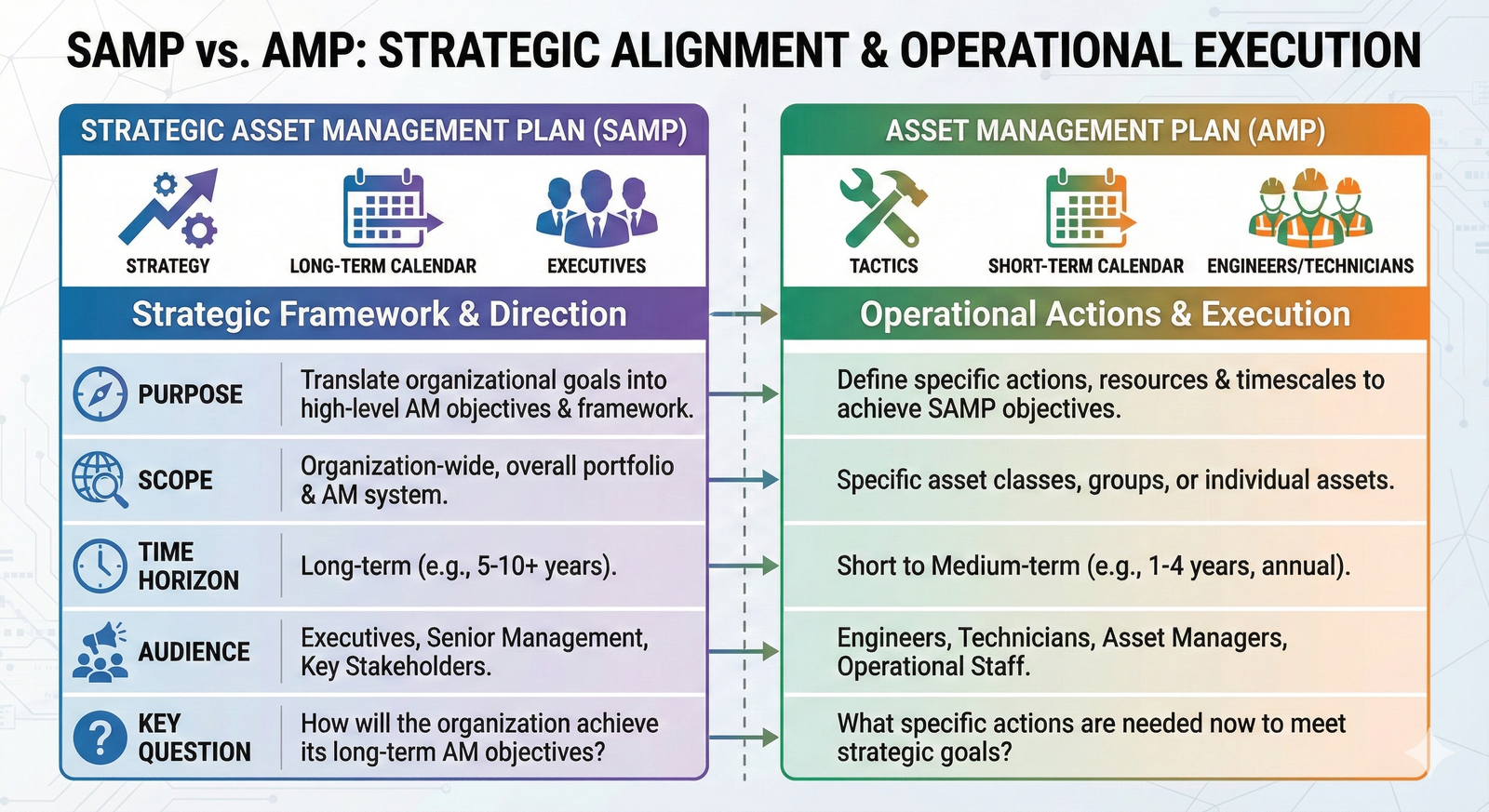
| Attribute | Strategic Asset Management Plan (SAMP) | Asset Management Plan (AMP) |
|---|---|---|
| Purpose | To state why and what; to align asset management with organizational goals. | To state how and when; to detail the specific actions for an asset group. |
| Scope | Entire asset portfolio of the organization. | A specific asset class, system, or group (e.g., bridges, pumps, pipes). |
| Time Horizon | Long-term (e.g., 10-50 years). | Medium-term (e.g., 3-5 years), but based on long-term lifecycle analysis. |
| Audience | Executive leadership, board members, regulators, investors. | Asset managers, engineers, operations, maintenance, finance planners. |
| Nature | Strategic, high-level, directional. | Tactical, detailed, data-driven, actionable. |
| Number | Typically one per organization. | Many; one for each logical asset grouping. |
| Key Question | "Are we doing the right things?" | "Are we doing things right?" |
How They Work Together
The SAMP and the AMPs exist in a continuous, dynamic loop. The SAMP sets the objectives. The various AMPs are developed to meet those objectives. The financial and resource requirements from all the AMPs are then rolled up and reconciled against the overall strategic financial plan in the SAMP.
This process often reveals gaps. The combined cost of executing all the "ideal" AMPs might exceed the available budget. This is where the strategic guidance of the SAMP becomes invaluable. It provides the framework for making tough, risk-based decisions. Which projects do we defer? Where can we accept a lower level of service temporarily? The SAMP ensures these trade-off decisions are made strategically, in alignment with the organization's most important goals, rather than in an ad-hoc or purely political manner.
The performance data and condition assessments from the AMPs also feed back up to the SAMP. If the AMPs consistently show that assets are deteriorating faster than predicted, the long-term strategic assumptions in the SAMP may need to be revised. This feedback loop is the engine of continuous improvement in asset management.
Closing
Mastering the distinction between the Strategic Asset Management Plan and the Asset Management Plan is a fundamental step in your development as an asset management professional. These two documents are the pillars that support a sound management structure, translating high-level organizational intent into concrete, on-the-ground action. The SAMP provides the strategic "why," setting the long-term vision and aligning asset activities with business goals for an audience of leaders and regulators. The AMPs provide the tactical "how," detailing the specific lifecycle activities, budgets, and risk mitigations for a particular group of assets for an audience of managers and engineers.
They are not interchangeable, nor is one more important than the other. They are two sides of the same coin, linked in a dynamic cycle of planning, execution, and feedback. A brilliant strategy in a SAMP is useless without effective AMPs to execute it, and well-written AMPs are rudderless without the direction of a SAMP. As you move forward in your career, your ability to not only understand but also to contribute to and connect these two critical documents will be a true measure of your effectiveness.
Learning Outcomes
In this reading, you have explored the foundational documents of asset management planning. You can now:
- Differentiate between the purpose, scope, and audience of a SAMP versus an AMP. You understand that the SAMP is a single, strategic document for leadership, while AMPs are multiple, tactical documents for managers and technical staff.
- Identify the key components typically found in a SAMP. You can recognize the elements that link organizational goals to asset management objectives, such as the line of sight, risk frameworks, and long-term financial strategy.
- Identify the key components typically found in an AMP. You are familiar with the data-rich, actionable components of a tactical plan, including asset inventories, condition assessments, and detailed lifecycle activities.
You have also been introduced to the core concepts of the Asset Management Policy, which provides the mandate for all planning, and the Asset Management Objectives, which are the specific goals the SAMP and AMPs are designed to achieve.
Assess Yourself
❓ Knowledge Check
Test your understanding of the key concepts from this section.
Next Steps
You have successfully completed this reading and have a solid understanding of the foundational planning documents in asset management. This knowledge is a critical building block for everything that follows. Please navigate back to the course page to continue your learning journey.
