
The Skill
Stakeholder analysis is the process of identifying individuals, groups, or organizations that could be affected by or have an influence on a project. In physical and infrastructure asset management, this means pinpointing everyone with a stake in an asset—from the public who uses a bridge to the finance department that funds its maintenance, and the regulatory agency that governs its safety.
A thorough analysis involves understanding each stakeholder's interests, expectations, and level of influence. This information is fundamental to developing a comprehensive and realistic Asset Management Plan (AMP) that balances competing needs and secures necessary support for its implementation.
Why Is This Skill Important?
An Asset Management Plan developed in a vacuum is destined to encounter problems. Without a systematic stakeholder analysis, you risk overlooking critical operational requirements, facing unexpected public opposition, or failing to secure the necessary budget approvals. A well-executed analysis is a powerful risk mitigation tool.
By understanding who your stakeholders are and what they care about, you can build consensus, manage expectations, and tailor your communication. This ensures your AMP is not only technically sound but also politically and socially viable. It bridges the gap between the engineering details of asset performance and the human factors that determine a project's ultimate success.
Your Task
You are an Asset Manager for the City of Crestwood. The City Manager has tasked you with developing a comprehensive Asset Management Plan for the city's aging water distribution network. Your first step is to conduct a stakeholder analysis to ensure all relevant parties are considered from the outset.
Your task is to review the project memo and create a stakeholder register that identifies key stakeholders, analyzes their position, and proposes a strategy for engaging them.
Your Process
- Review the provided project memo for the City of Crestwood.
- Identify all potential internal and external stakeholders.
- Analyze each stakeholder's interest and influence using a Power/Interest Grid.
- Document your findings in a stakeholder register, including a proposed engagement strategy for each.
Resources and Data
The following simulated document provides the necessary context for your task. Review it carefully to understand the project background and scope.
Key Document: Project Memo: Crestwood Water Network AMP
Detailed Steps
Follow these steps to build your stakeholder analysis. This structured approach ensures you cover all critical aspects of the process.
Step 1: Define Your Stakeholders
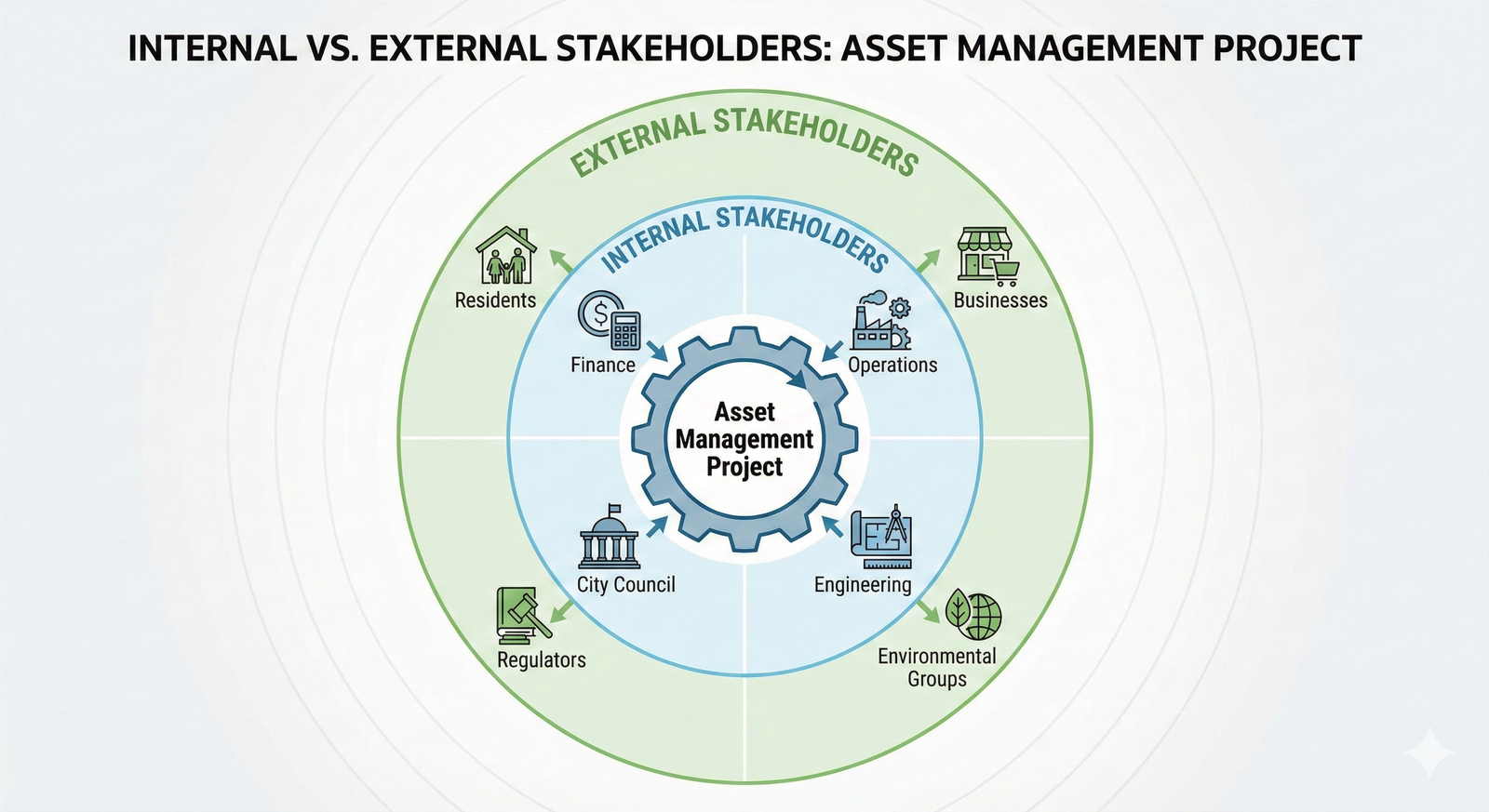
First, clarify what a stakeholder is in this context. A stakeholder is any person, group, or organization who can affect or is affected by the Crestwood Water Network AMP.
Stakeholder
Brainstorm a list of potential stakeholders based on the project memo. To organize your thoughts, categorize them as either Internal (within the City of Crestwood's organization) or External (outside the city's direct control).
Step 2: Analyze Stakeholders with the Power/Interest Grid
Once you have your list, you need to analyze each stakeholder's position. A standard tool for this is the Power/Interest Grid. This grid helps you visualize which stakeholders require the most attention.
📊 View Diagram: Stakeholder Power/Interest Grid
Defining Power and Interest
Power/Influence: A stakeholder's ability to impact the project. High-power stakeholders can stop the project, control its budget, or influence key decisions.
Interest: The degree to which a stakeholder is affected by the project's outcome. High-interest stakeholders are directly impacted by service disruptions or financial costs.
For each stakeholder you identified, plot them on the grid. Where do they fall? This placement will determine your strategy for engaging them.
Step 3: Develop an Engagement Strategy and Document Your Analysis
The final step is to consolidate your work into a stakeholder register. This document will serve as your guide for all future project communications. Based on a stakeholder's position in the grid, select an appropriate engagement strategy:
- Manage Closely (High Power, High Interest): These are your key players. You must fully engage with them, collaborate closely, and seek their input on major decisions.
- Keep Satisfied (High Power, Low Interest): These stakeholders have the power to influence the project but may not be interested in the daily details. Keep them happy and ensure their needs are met, but avoid overwhelming them with information.
- Keep Informed (Low Power, High Interest): These groups are impacted by the project but have little power to change it. Keep them informed through general communications like newsletters, public meetings, or website updates.
- Monitor (Low Power, Low Interest): These stakeholders require minimal effort. Monitor them for any changes in their interest or power level, but do not overload them with excessive communication.
Use the template below to structure your final output.
Crestwood Water Network AMP: Stakeholder Register Template
| Stakeholder | Type (Internal/External) | Primary Interest(s) | Power Level (High/Med/Low) | Interest Level (High/Med/Low) | Engagement Strategy |
|---|---|---|---|---|---|
An Expert Response
Note on the Expert Response
The following is a sample expert response based on the provided scenario. Your own analysis may differ in some details, and that's perfectly fine. The goal is to demonstrate a logical and thorough process. Other excellent responses are possible.
Crestwood Water Network AMP: Stakeholder Register
| Stakeholder | Type (Internal/External) | Primary Interest(s) | Power Level | Interest Level | Engagement Strategy |
|---|---|---|---|---|---|
| City Council | Internal | Political implications, budget approval, public perception, long-term city viability. | High | High | Manage Closely. Provide regular formal briefings, involve in all major budget/policy decisions. |
| Public Works / Operations | Internal | Operational feasibility, maintainability, minimizing service disruptions, staff safety. | High | High | Manage Closely. Treat as a core project partner, involve in all technical planning and scheduling. |
| Finance Department | Internal | Budgetary control, long-term financial sustainability, cost-effectiveness of solutions, impact on city's bond rating. | High | Medium | Keep Satisfied. Provide clear financial forecasts and cost-benefit analyses. Consult on funding strategies. |
| Residents / Citizens | External | Reliable water service, minimal rate increases, transparency, minimal disruption from construction. | Medium | High | Keep Informed. Use public meetings, city website, and local media for updates. Establish a clear contact point for concerns. |
| State Environmental Agency | External | Regulatory compliance, water quality standards, environmental impact of construction. | High | High | Manage Closely. Engage early and maintain open communication. Submit all required documentation promptly. |
| Engineering Department | Internal | Technical standards, design quality, long-term infrastructure performance, use of best practices. | Medium | High | Manage Closely. Involve as key technical advisors and reviewers throughout the project lifecycle. |
| Local Businesses | External | Uninterrupted water service (especially for restaurants, laundromats), impact of construction on access/sales. | Medium | Medium | Keep Informed. Targeted outreach to business associations. Provide advance notice of any planned disruptions. |
| Local Environmental Groups | External | Impact of construction on local ecosystems, water conservation measures, promotion of green infrastructure. | Low | High | Keep Informed. Invite to public information sessions. Be prepared to discuss environmental mitigation plans. |
Assess Yourself
Evaluate Your Work
Use the following criteria to critically evaluate your own stakeholder register against the expert example. This is not about being 'right' or 'wrong,' but about refining your analytical process.
- Stakeholder Identification: Did you identify a comprehensive range of both internal and external stakeholders relevant to a municipal water project?
- Interest Analysis: Did you accurately describe the specific interests, concerns, and motivations of each stakeholder group based on the scenario?
- Power/Influence Assessment: Did you logically assess each stakeholder's level of power and influence over the project's outcomes, providing justification for your rating?
- Grid Placement & Strategy: Is your proposed engagement strategy logical, specific, and appropriate for each stakeholder group based on their power and interest levels?
- Clarity and Organization: Is your stakeholder register clear, well-organized, and easy for another project team member to understand and use?
Learning Progress
In this activity, you have practiced the core skills of conducting a professional stakeholder analysis. You have applied a systematic process to identify relevant internal and external stakeholders for an asset management project, analyze their specific interests and influence, and develop a targeted engagement strategy to support the project's success.
Next Steps
Excellent work completing this skill-building activity. You have successfully applied a foundational project management technique to a realistic asset management scenario. Please navigate back to the main course page to continue your learning journey.
