
The Skill
A Strategic Asset Management Plan (SAMP) is a cornerstone document for any organization that relies on physical assets to achieve its objectives. It provides the direct link between the organization's overall strategy and the day-to-day decisions made about managing its assets, such as infrastructure, facilities, and equipment.
Developing a SAMP involves a systematic process of understanding organizational goals, assessing the current state of assets, and creating a long-term plan to ensure assets deliver value, manage risk, and meet performance expectations. This plan is not merely a maintenance schedule; it is a high-level, strategic document that guides investment, resource allocation, and improvement activities across the entire asset portfolio.
Why Is This Skill Important?
In physical and infrastructure asset management, moving from a reactive "fix-it-when-it-breaks" approach to a proactive, strategic one is essential for long-term sustainability and financial health. A well-crafted SAMP enables this shift. It ensures that every dollar spent on assets is aligned with the organization's mission, whether that is providing safe public transportation, reliable energy, or efficient manufacturing.
Mastering the development of a SAMP allows you to justify asset management budgets, prioritize investments based on risk and value, and communicate a clear, long-term vision to stakeholders. This skill is critical for leaders and managers responsible for ensuring that physical assets are not just maintained, but are actively contributing to the organization's success.
Your Task
Your task is to develop a foundational outline for a Strategic Asset Management Plan (SAMP) for the fictional "City of Northwood." Using the provided memo from the City Manager, you will first identify the essential sections of the SAMP. Then, you will formulate three distinct asset management objectives that directly support the city's strategic goals outlined in the memo.
Task Overview
- Review the 'City of Northwood Strategic Direction Memo'.
- Create an outline listing the essential sections of a SAMP.
- Write three specific asset management objectives that align with the city's goals.
Resources and Data
You have been provided with a key document to inform your plan. This memo from the City Manager of Northwood outlines the high-level strategic priorities that your SAMP must support.
Key Document: City of Northwood Strategic Direction Memo
Detailed Steps
Follow these steps to structure your SAMP outline and formulate your objectives.
Step 1: Define the Core Sections of the SAMP
A comprehensive SAMP provides a clear line of sight from organizational goals to asset management activities. While the exact format can vary, a robust plan typically includes a set of standard sections that build upon one another.
Strategic Asset Management Plan (SAMP)
Your first task is to outline these sections. A logical flow is essential for the document to be coherent and useful.
📊 View Diagram: Standard Structure of a SAMP
For your task, create a simple list of these section titles as the basic structure of your plan.
Step 2: Translate Organizational Goals into Asset Management Objectives
This is the most critical part of the process. Your asset management objectives must directly support the high-level strategic goals provided in the City Manager's memo. Each objective should be SMART: Specific, Measurable, Achievable, Relevant, and Time-bound.
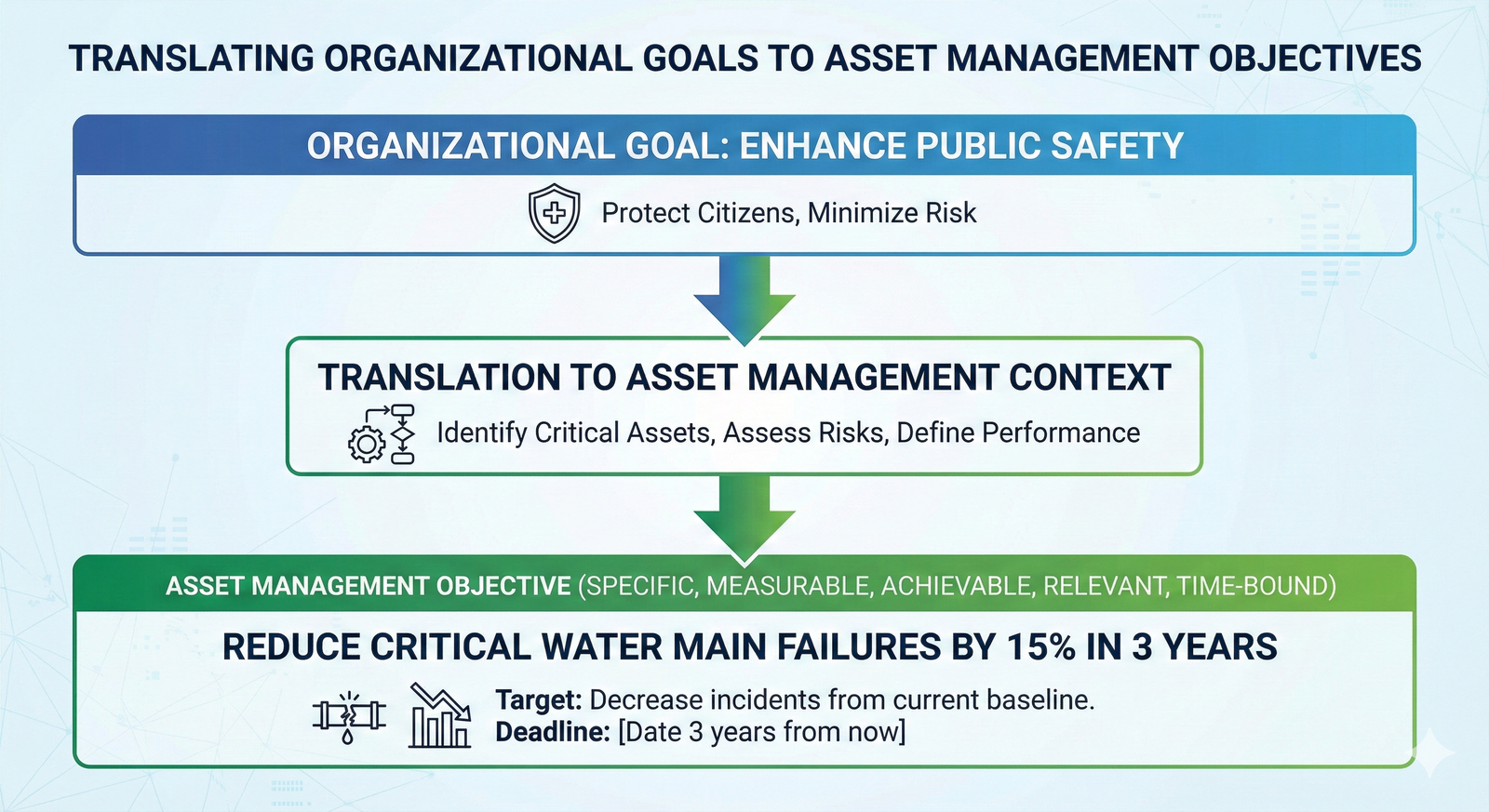
Review the three strategic goals from the "City of Northwood" memo: 1. Enhance Public Safety and Resilience 2. Promote Sustainable Economic Growth 3. Improve Fiscal Responsibility and Efficiency
Step 3: Formulate Your Objectives
Now, write three distinct asset management objectives. Each one should clearly connect to one of the city's strategic goals. Use a clear and concise format.
Writing SMART Objectives
Use this template to structure your objectives: To [Action Verb] [Specific Metric] by [Percentage or Number] within [Timeframe] in order to support [Organizational Goal].
Example based on a different goal:
- Organizational Goal: Improve Community Health.
- Poor Objective: Improve our parks.
- SMART Objective: To increase the average condition rating of playground equipment from 'Fair' to 'Good' across all 15 city parks within 24 months in order to support improved community health.
Apply this thinking to formulate three objectives for the City of Northwood based on the provided memo.
An Expert Response
Note on This Response
This is a sample expert response that meets the requirements of the task. Your response may be different but equally valid, provided it follows the correct principles and aligns with the scenario's strategic goals.
Strategic Asset Management Plan (SAMP) Outline: City of Northwood
1.0 Introduction and Scope * Purpose of the SAMP * Alignment with City of Northwood Strategic Direction FY 2025-2030
2.0 Asset Management Policy * Statement of principles and commitment to asset management
3.0 Asset Management Objectives * See formulated objectives below
4.0 Demand Analysis * Current and future demand on infrastructure (transportation, water, etc.)
5.0 Asset Management Strategy & Lifecycle Planning * Approach to managing asset lifecycles (creation, operation, maintenance, disposal) * Risk management framework
6.0 Financial Projections * Long-term funding requirements for operational and capital expenditures
7.0 Improvement Plan & Monitoring * Key performance indicators (KPIs) * Process for review and continuous improvement of the SAMP
Formulated Asset Management Objectives
-
Objective (Supports Goal: Enhance Public Safety and Resilience): To reduce the backlog of identified critical-risk deferred maintenance on the city's transportation and water main assets by 30% over the next 5 years.
-
Objective (Supports Goal: Promote Sustainable Economic Growth): To develop and implement a 5-year capital improvement plan that increases the capacity of the wastewater treatment system by 10% to support projected commercial and residential development.
-
Objective (Supports Goal: Improve Fiscal Responsibility and Efficiency): To implement a new asset information system and reduce reactive maintenance work orders by 20% within 3 years through the introduction of a preventative maintenance program for all major pump stations.
Assess Yourself
Evaluate Your Work
Use the following criteria to assess the quality and completeness of your SAMP outline and objectives. Compare your work against the expert response to identify areas for improvement.
- Structural Completeness: Your outline includes all the standard, logical sections of a SAMP, from Introduction to Improvement Planning.
- Strategic Alignment: Each of your three objectives clearly and directly supports one of the strategic goals outlined in the City Manager's memo.
- Objective Formulation (SMART): Your objectives are specific, measurable, achievable, relevant, and time-bound, avoiding vague statements.
- Clarity and Professionalism: The language used is precise and appropriate for a formal strategic planning document.
Learning Progress
In this activity, you have practiced the foundational skills for strategic asset management. You successfully identified the essential components of a Strategic Asset Management Plan, outlined the step-by-step process for its development, and formulated specific asset management objectives based on an organization's strategic goals.
Next Steps
You have successfully completed this skill-building activity. You can now navigate back to the course to continue your learning journey.
