
Introduction
If you've been in this field for any length of time, you've heard of ISO 55000. For many, it brings to mind thick binders, complex audits, and a mountain of paperwork. It's easy to see it as a compliance exercise—a box to be ticked. But I want you to set that perception aside.
Think of ISO 55000 not as a rulebook, but as a framework for excellence. It’s the collective wisdom of asset management professionals from around the globe, distilled into a set of principles for delivering value from your assets. It answers the fundamental question we all face: How do we make the right decisions at the right time to balance performance, cost, and risk over the entire life of our infrastructure? This isn't just about getting a certificate for the wall. It's about building a robust, strategic, and sustainable approach to managing the critical assets that our organizations and communities depend on. In this reading, we'll break down what that means in practice.
Demystifying the Standard: What is ISO 55000?
Let's start by clearing up a common point of confusion. You'll often hear the terms ISO 55000, 55001, and 55002 used together. They are a family of standards, each with a specific purpose.
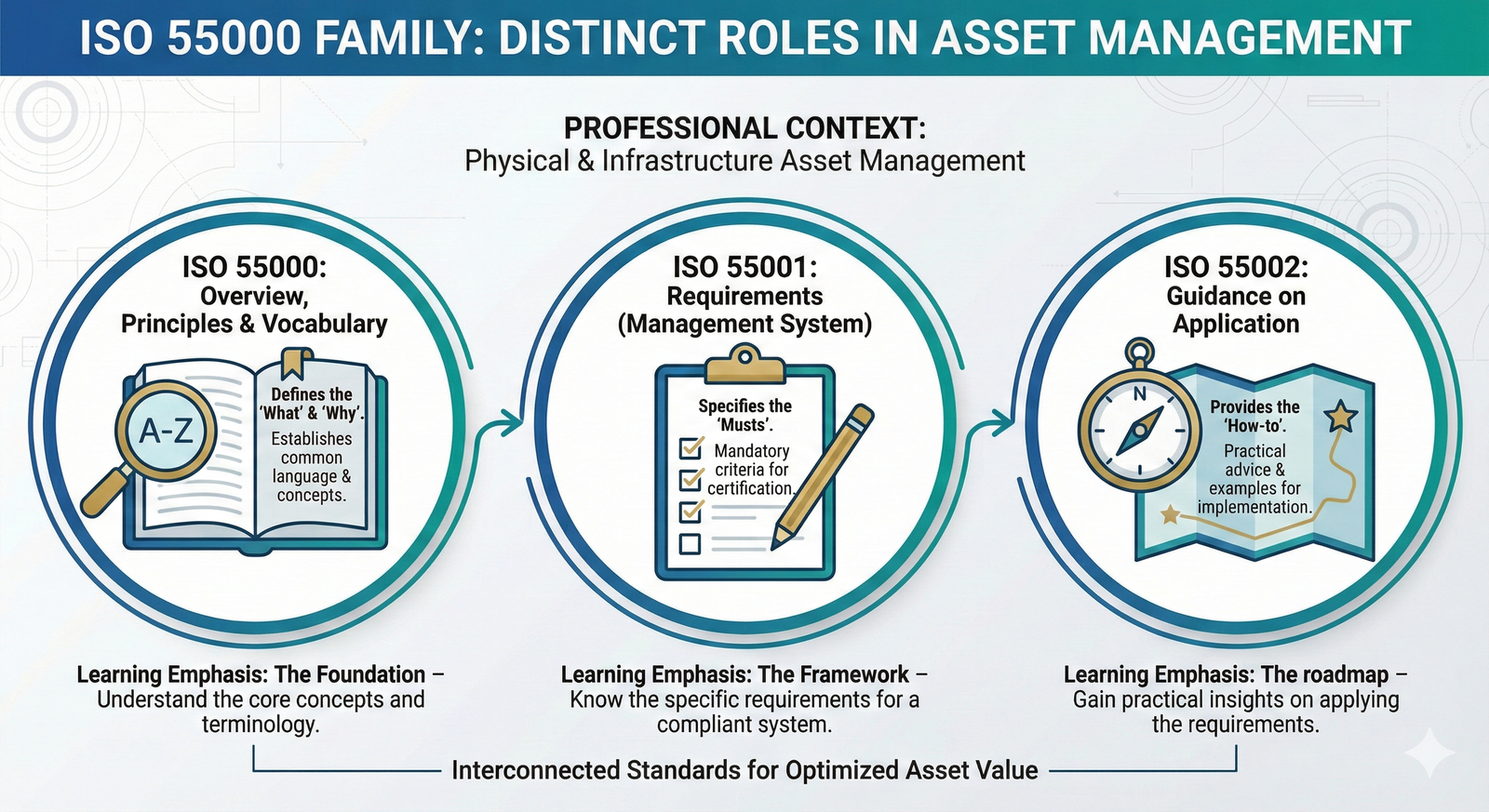
For our purposes, when we talk about implementing the standard, we are primarily focused on meeting the requirements of ISO 55001. But the entire family provides the "what," "why," and "how." At its heart, ISO 55000 is a strategic framework. It forces an organization to stop thinking about assets in silos—like the maintenance team being separate from the finance team—and start thinking about them holistically.
The Engine Room: Your Asset Management System (AMS)
The standard doesn't tell you exactly how to manage your assets. It doesn't prescribe which software to use or how often to inspect a bridge. Instead, it requires you to create and use an Asset Management System (AMS). This system is the collection of policies, plans, business processes, and information systems that work together to guide asset-related decisions in your organization.
Think of it like the quality management system (like ISO 9001) that a manufacturer uses. The system ensures that every step, from sourcing raw materials to final assembly, is planned, controlled, and documented to achieve a consistent, high-quality product. An AMS does the same for assets. It connects the high-level strategic goals of the organization directly to the day-to-day activities of operations and maintenance.
📊 View Diagram: Core Components of an Asset Management System (AMS)
As you can see from the diagram, the AMS is a dynamic, continuous improvement loop, not a static set of documents. It forces you to plan your work, execute that plan, check if you achieved your objectives, and then act to make improvements.
The Asset Lifecycle Delivery Model: From Cradle to Grave
This brings us to the core of practical asset management. How does the AMS translate into action? Through the asset lifecycle delivery model. This model provides the structure for all the activities and decisions related to an asset, from the moment you identify a need for it until its final disposal. The importance of this model is that it forces a long-term view, preventing decisions that seem good in the short term but create massive problems down the road.
Let's break down the typical stages:
-
Identify/Acquire: This is the beginning. It's not just about buying or building something. It starts with a strategic question: "What service do we need to provide, and what is the best way to provide it?" This stage involves needs analysis, options analysis (should we build new, refurbish old, or even lease?), business case development, design, and construction or procurement. An ISO 55000-aligned approach ensures that the total cost of ownership, not just the initial capital cost, is considered right from the start.
-
Operate: The asset is now in service, doing what it was designed to do. This phase is about using the asset efficiently and effectively to deliver the required service. For a power grid, this is managing electricity flow. For a road network, it's managing traffic. Key activities include monitoring performance, managing energy consumption, and ensuring the asset is used within its design parameters.
-
Maintain: This is where things get complex. Maintenance isn't just about fixing things when they break (corrective maintenance). A mature asset management approach focuses on proactive strategies:
- Preventive Maintenance: Time-based or usage-based servicing (e.g., inspecting a bridge every two years).
- Condition-Based Maintenance: Using data and inspections to intervene only when needed (e.g., replacing a pump bearing when vibration analysis shows it's starting to fail).
- Predictive Maintenance: Using advanced analytics and IoT sensors to predict failures before they happen.
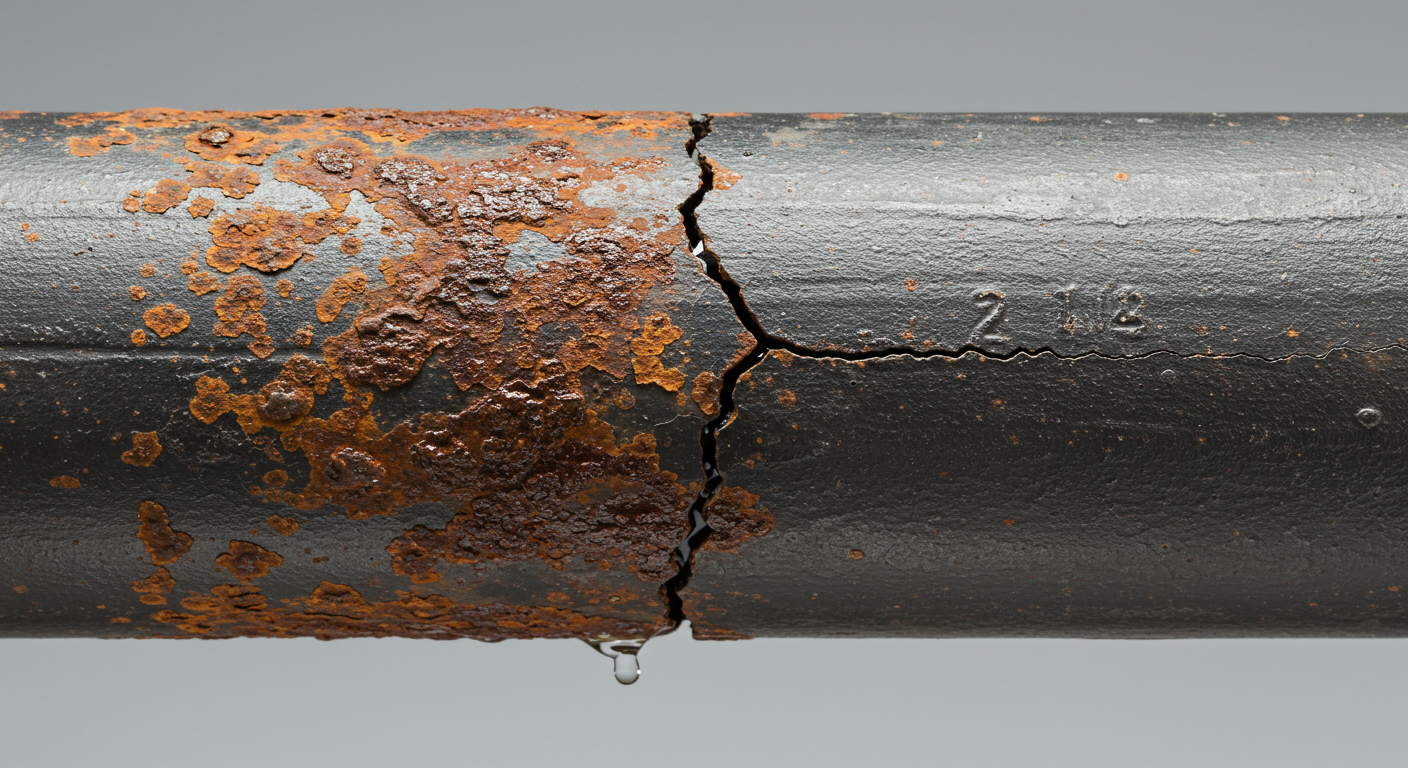
- Dispose/Renew: All assets eventually reach the end of their useful life. This phase involves making a strategic decision: Do we dispose of the asset? Decommission it? Refurbish it to extend its life? Or replace it entirely? This decision feeds right back into the "Acquire" phase, closing the lifecycle loop. This stage must consider environmental regulations, disposal costs, and the impact of removing the asset from service.
Whole-Life Value
The asset lifecycle model shifts focus from minimizing initial capital expenditure (CapEx) to optimizing whole-life value. A cheaper pump that requires frequent, costly maintenance and uses more energy may be far more expensive over its 20-year life than a more expensive, efficient, and reliable alternative. ISO 55000 forces you to do that math.
The Pillars of Strategic Decision-Making
Within the lifecycle model, your AMS guides you to make decisions by balancing three critical inputs: service levels, risk, and stakeholders.
1. Defining Value through Service Levels
Assets exist for a reason: to provide a service. A Service Level is a promise to your customers and stakeholders. It makes the organization's performance goals tangible. Instead of a vague goal like "provide good roads," a transportation agency might have a service level stating that "95% of major arterial roads will have a Pavement Condition Index (PCI) of 70 or higher."
This is powerful because it connects maintenance budgets directly to outcomes. If the PCI drops below 70, the AMS should trigger a plan to invest in resurfacing. It moves the conversation with finance from "We need more money for paving" to "To meet our agreed service level of a PCI of 70, we require a budget of $X, otherwise, the PCI will drop to 65, impacting travel times and driver satisfaction."
2. Managing Uncertainty with Risk
Every asset carries Risk. A water main could break, a bridge could be closed due to structural concerns, or a power transformer could fail during a heatwave. A mature asset management approach doesn't try to eliminate all risk—that would be infinitely expensive. Instead, it seeks to understand and manage risk to an acceptable level.
This involves: * Identifying Risks: What could go wrong with our assets? * Analyzing Risks: How likely is it to happen? And if it does, what are the consequences (safety, environmental, financial, reputational)? * Evaluating Risks: Is the level of risk acceptable, or do we need to take action? * Treating Risks: Implementing mitigation measures, such as increased inspections, capital replacement projects, or developing emergency response plans.
This risk-based approach allows you to prioritize your resources. You spend your limited budget on the assets where failure would have the most severe consequences, rather than spreading it thinly everywhere.
3. Answering the "Why": The Role of Stakeholders
Finally, none of this happens in a vacuum. A Stakeholder is anyone with an interest in your assets. For a municipal water utility, stakeholders include residential customers who want clean, affordable water; the fire department that needs reliable hydrant pressure; regulators who enforce water quality standards; and city council members who are accountable to taxpayers.
The AMS requires you to systematically identify these stakeholders and understand their needs and expectations. These needs are critical inputs that shape your service levels and your tolerance for risk. A hospital's tolerance for a power outage is vastly different from a residential home's, and their asset management strategies for their electrical systems will reflect that.
From Conflict to Alignment
Stakeholder needs often conflict. Customers want lower bills, while regulators may demand costly upgrades. A robust Asset Management System provides a transparent, evidence-based framework to justify decisions and communicate these trade-offs. It allows you to say, 'We can defer this $10M upgrade, but you must accept a 15% higher risk of a major service outage in the next five years.' This makes the decision-making process defensible.
By integrating the asset lifecycle model with a clear understanding of service levels, risk, and stakeholder needs, ISO 55000 provides a powerful, logical, and defensible way to manage your physical and infrastructure assets. It transforms asset management from a reactive, cost-centered function into a proactive, value-driven strategic capability.
Closing
We've covered a lot of ground, moving from the high-level principles of ISO 55000 to the practical realities of managing an asset through its life. The central idea to take away is one of integration. An effective asset management strategy, guided by the ISO 55000 framework, is not a separate activity. It is the connective tissue that binds your organization's strategic goals to the physical reality of your assets.
The asset lifecycle delivery model is the roadmap for this integration. By considering every stage—from acquisition to disposal—and making decisions based on a clear-eyed balance of service levels, risk, and stakeholder needs, you elevate your role. You are no longer just maintaining equipment; you are managing value, mitigating risk, and ensuring the long-term sustainability of the services your organization provides. This is the future of our profession, and understanding this framework is fundamental to building a successful career.
Learning Outcomes
In this reading, you have explored the core components of a modern asset management strategy. You can now explain the asset lifecycle delivery model and its critical role in providing a structured approach to managing physical assets from acquisition to disposal. You have also learned how an Asset Management System (AMS), built on the principles of ISO 55000, integrates strategic objectives with operational reality by balancing the competing demands of Service Levels, Risk, and Stakeholder expectations.
Assess Yourself
Test your understanding of the key concepts from this reading.
❓ Knowledge Check
Test your understanding of the key concepts from this section.
Next Steps
You have successfully completed this reading. Please navigate back to the course to continue your learning journey.
