
Introduction
Welcome. If you're managing physical or infrastructure assets, you know that the decisions made before a single shovel hits the ground are often the ones that determine a project's fate. We spend a lot of time talking about asset performance, maintenance, and lifecycle costing, but all of it hinges on how that asset was brought into existence in the first place. That's the world of procurement.
For too long, procurement was seen as a back-office function, a simple matter of finding the cheapest contractor. That mindset is a recipe for budget overruns, missed deadlines, and assets that fail to deliver long-term value. In this reading, we're going to reframe that thinking. We'll explore how modern procurement is a strategic function, a powerful tool that allows you to align project delivery with your organization's highest-level goals. You'll learn not just what the different models are, but why and when you would choose one over the other. This is about moving beyond the lowest bid to secure the best value for the entire life of your asset.
The Strategic Role of Procurement in Asset Management
Before we dive into specific models, let's establish a core principle: the way you buy or build an asset is as important as the asset itself. Your choice of Procurement Strategies dictates how risk is allocated, who is responsible for what, and how innovation is either encouraged or stifled. It sets the tone for the entire project, defining the relationships between the owner, designers, and constructors. A misaligned strategy can create an adversarial environment from day one, leading to disputes, claims, and an asset that costs more to operate and maintain over its life. A well-aligned strategy, on the other hand, can foster collaboration, accelerate schedules, and deliver an asset that truly meets the needs of its users for decades to come.
The Language of Solicitation: RFPs and Tenders
To execute any procurement strategy, you need a formal way to ask the market for proposals. This is typically done through two primary documents. While the terms are sometimes used interchangeably, they serve distinct purposes.
A Tender (or Invitation to Tender, ITT) is a request for a price. In this scenario, you, the owner, have already figured out exactly what you want and how you want it done. You've likely completed a full design and have a detailed set of specifications. The tender document asks contractors to simply put a price on executing that specific scope of work. The decision is heavily weighted, if not entirely based, on the lowest compliant bid.
A Request for Proposal (RFP) is fundamentally different. An RFP is used when you know the problem you need to solve, but you are open to different solutions for solving it. Instead of providing a complete design, you outline your functional requirements, performance specifications, and objectives. You are asking the market to come back to you with a proposal that includes their recommended technical solution, their team, their schedule, and their price. The evaluation is based on the overall value of the proposed solution, not just the cost.
Tender vs. RFP: A Quick Guide
Think of it this way: A Tender asks, 'What is your price to build this exact bridge to these exact specifications?' An RFP asks, 'What is your best solution for getting traffic across this river, and what will it cost?' The first is about execution; the second is about solutions.
Comparing Procurement Models: The Three Pillars
Now, let's get into the major frameworks that asset managers use to deliver projects. We'll look at the three most common models, exploring their structure, risks, and benefits.
1. The Traditional Path: Design-Bid-Build (DBB)
This is the model most people are familiar with, and it has been the default for public works for over a century. The name says it all: you first hire a designer to create a 100% complete design. Then, you put that design out to bid. Finally, you award the construction contract to the lowest responsive bidder, who then builds the project.
Design-Bid-Build (DBB)
The process is linear and sequential. The owner holds two separate contracts and acts as the intermediary between the design team and the construction team.
📊 View Diagram: Design-Bid-Build (DBB) Model
Benefits of DBB: * Cost Competition: Because the scope is fully defined, you can get aggressive, head-to-head price competition. This is often seen as its main advantage, especially in the public sector where demonstrating fiscal prudence is key. * Owner Control: The owner has significant control over the design phase. You work closely with the architect or engineer to ensure the final design meets your exact vision before it ever goes out to bid. * Clear Roles: Responsibilities are, in theory, very clearly defined. The designer is responsible for the design's adequacy, and the contractor is responsible for building to that design.
Risks and Drawbacks of DBB: * Adversarial Relationships: The model can create a built-in conflict. The contractor has an incentive to find any errors or omissions in the design to generate profitable change orders. The designer, in turn, may be defensive about their work. The owner is often caught in the middle. * Slow Schedule: The sequential nature (Design, then Bid, then Build) makes it the slowest delivery method. There is no overlap between phases. * Lack of Constructability Input: The builder, who has the practical knowledge of construction means and methods, is not involved during the design phase. This can lead to designs that are unnecessarily expensive or difficult to build, opportunities for innovation are missed. * Owner Risk: The owner bears the risk for any gaps or errors in the design documents. If the plans are flawed, the resulting cost overruns and delays are the owner's problem.
2. The Integrated Approach: Design-Build (DB)
The Design-Build model emerged as a direct response to the frustrations of DBB. Instead of the owner managing two separate contracts, this model consolidates design and construction under a single point of responsibility. The owner hires one entity—the Design-Builder—who is responsible for delivering the entire project from concept to completion.
Design-Build (DB)
The Design-Builder can be a single integrated firm or a joint venture between a design firm and a construction company. The key is that from the owner's perspective, there is only one party to deal with.
📊 View Diagram: Design-Build (DB) Model
Benefits of DB: * Single Point of Responsibility: This is the cornerstone of DB. If something goes wrong, there's no finger-pointing between the designer and the builder. The Design-Builder is accountable. * Faster Delivery: Design and construction can be overlapped (a practice known as "fast-tracking"). Site work can begin while the final details of the building are still being designed, significantly compressing the overall project schedule. * Innovation and Collaboration: The designer and builder are on the same team from day one. This fosters collaboration and allows for constructability to be baked into the design, often leading to more efficient and innovative solutions. * Cost Certainty: While the initial price might be based on a preliminary design, the Design-Builder typically provides a Guaranteed Maximum Price (GMP) early in the process, giving the owner cost certainty sooner than in DBB.
Risks and Drawbacks of DB: * Less Owner Control over Design: The owner must be comfortable stepping back from the day-to-day design decisions. The focus shifts from prescribing the design to defining the performance and functional outcomes. This requires a different skillset from the owner's project management team. * Potential for Reduced Quality?: A common concern is that the Design-Builder might cut corners on design or materials to maximize their profit. This risk is mitigated by having very clear performance specifications and a robust quality assurance process. * Difficulty in Bidding: It's harder to have an apples-to-apples comparison when you're evaluating proposals using an RFP. You are comparing different solutions, not just different prices for the same solution.
A Shift in the Owner's Role
Successfully managing a Design-Build project requires a mental shift for the owner. You move from being a 'director' who specifies every detail to a 'conductor' who defines the desired outcome and manages the performance of the integrated team. Your expertise is in defining the 'what' and 'why,' and you empower the DB team to determine the 'how'.
3. The Long-Term Alliance: Public-Private Partnership (P3)
The P3 model takes the integration concept of Design-Build and extends it across the entire asset lifecycle. It is a long-term contract between a public entity (like a city or transportation authority) and a private sector consortium. This private partner doesn't just design and build the asset; they also finance, operate, and maintain it for a long period, often 20 to 50 years.
Public-Private Partnership (P3)
In a typical P3 model, the public sector doesn't pay for the asset upfront. Instead, they make regular payments (often called "availability payments") to the private partner once the asset is operational. These payments are contingent on the asset meeting pre-defined performance standards. If the highway has too many potholes or the hospital wing is unavailable, the payment is reduced.
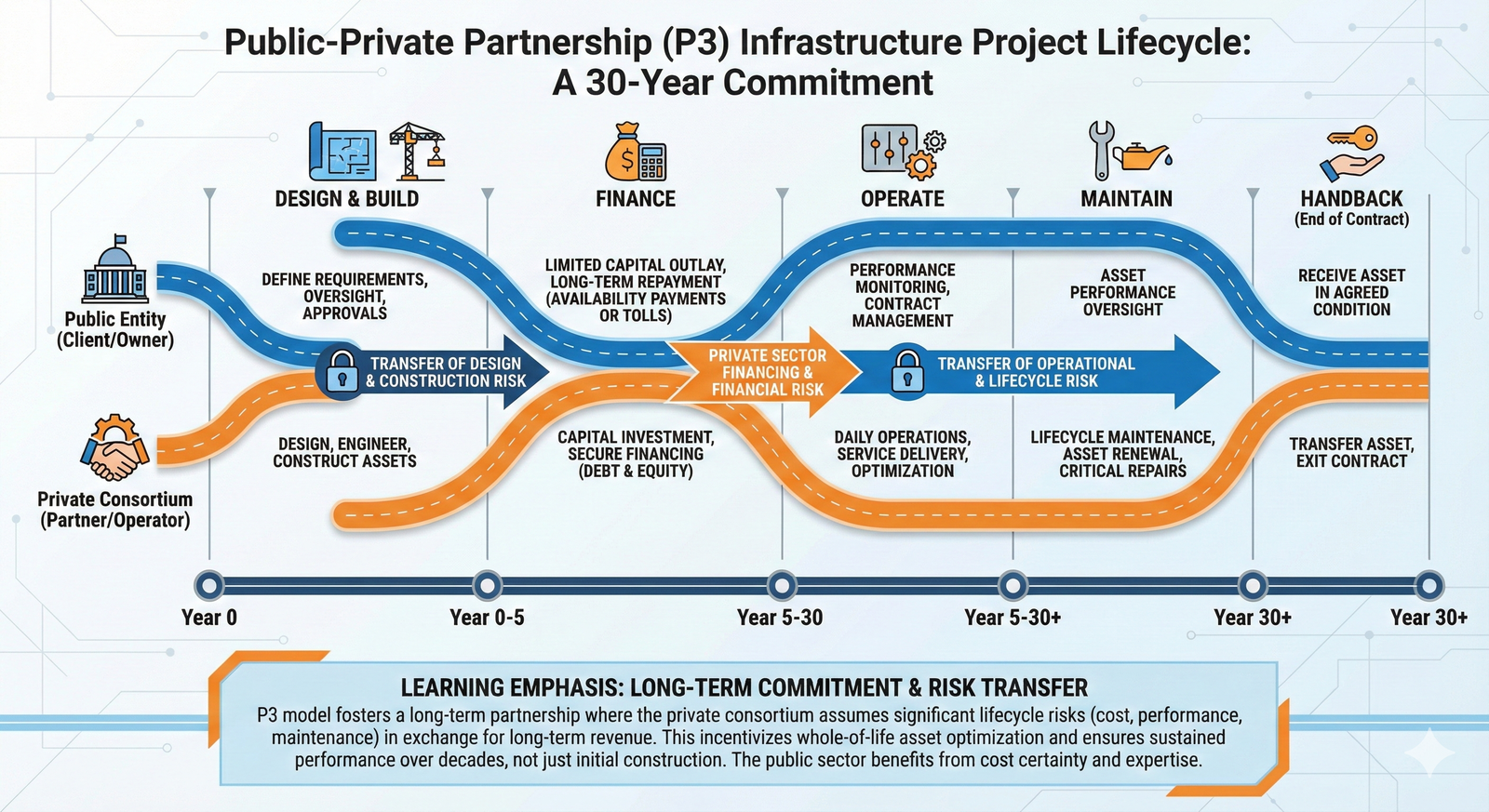
Benefits of P3: * Whole-Life Cost Optimization: This is the most powerful advantage. Because the private partner is responsible for maintenance for decades, they are highly incentivized to use high-quality materials and smart design to minimize long-term operating costs. They are not just thinking about the construction budget; they are thinking about the 30-year lifecycle budget. * Risk Transfer: Significant risks—including design, construction, financing, and long-term operational risks—are transferred from the public sector to the private partner, who is better equipped to manage them. * Access to Private Finance: P3s allow public entities to build critical infrastructure now without needing all the capital upfront. It leverages private sector capital and efficiency. * Performance Guarantees: The public sector is buying a service (e.g., a functioning highway, an available hospital bed), not just an asset. Payments are tied to performance, ensuring the asset is well-maintained and available for public use.
Risks and Drawbacks of P3: * Complexity and Cost of Procurement: P3 deals are incredibly complex to negotiate and structure. The legal and financial advisory fees can be substantial, making this model unsuitable for smaller projects. * Long-Term Commitment: The public sector is entering into a multi-decade contract. This can reduce future flexibility if needs or priorities change. * Higher Cost of Capital: Private financing is generally more expensive than public borrowing (e.g., municipal bonds). This higher cost must be offset by the efficiencies and risk transfer the private partner brings. * Public Perception: P3s can sometimes be politically controversial, with concerns raised about the privatization of public assets and the profits earned by the private partners.
Choosing the Right Strategy: A Comparative Analysis
There is no single "best" procurement model. The optimal choice depends entirely on the specific project and the owner's priorities. An asset manager must weigh the competing demands of cost, schedule, quality, and risk.
To help you think through this, let's analyze the models across a few key criteria. Imagine you are the asset manager for a large city, and you have three projects on the horizon: a standard fire station replacement, a new complex water treatment plant that needs to be online fast, and a major new light-rail transit line. Which model would you lean towards for each?
Procurement Model Selection Criteria
| Model | Best For | Speed | Owner's Upfront Cost | Risk Allocation | Innovation Potential |
|---|---|---|---|---|---|
| Design-Bid-Build (DBB) | Simple, well-defined projects where cost certainty is paramount and owner control is high. | Slow | High | Owner | Low |
| Design-Build (DB) | Complex projects where speed is critical and a single point of responsibility is desired. | Fast | High | Design-Builder | Moderate |
| Public-Private Partnership (P3) | Large-scale, long-life infrastructure assets requiring significant private financing and operational expertise. | Fast | Low | Private Partner | High |
For the fire station (a relatively simple, standard building), the control and price competition of Design-Bid-Build might be appealing. For the water treatment plant, where speed is critical and technical solutions are complex, Design-Build would allow you to leverage private sector expertise and fast-track the schedule. For the massive light-rail line, which requires huge upfront capital and has a 50+ year service life, a Public-Private Partnership would be the logical choice to optimize whole-life cost and transfer long-term operational risk.
The future of procurement is moving towards even more integrated and performance-based models. Concepts like Integrated Project Delivery (IPD), where the owner, designer, and builder are all part of a single contractual entity sharing risks and rewards, are gaining traction. Digitalization is also transforming the process, with Building Information Modeling (BIM) enabling better collaboration and data sharing across all procurement models. As an asset manager, staying current on these evolving strategies is essential for delivering lasting value to your organization and community.
Closing
We've covered the strategic landscape of modern infrastructure procurement, moving from the traditional, linear path of Design-Bid-Build to the integrated approaches of Design-Build and Public-Private Partnerships. You can now see that selecting a procurement model is not a simple administrative choice. It is a strategic decision that defines relationships, allocates risk, and ultimately shapes the financial and operational success of an asset over its entire life.
Understanding the distinct roles of a price-focused Tender versus a solution-focused RFP is the first step in engaging the market effectively. From there, analyzing the trade-offs between the control of DBB, the speed of DB, and the whole-life value of a P3 allows you to tailor your strategy to your project's specific needs. The right choice will not only get your asset built but will ensure it is built in a way that is efficient, innovative, and sustainable for the long term. This is the core responsibility of a forward-thinking asset manager.
Learning Outcomes
In this reading, you have developed the skills to approach asset procurement as a strategic leader. You can now:
- Compare different procurement models: You can articulate the structural differences, advantages, and disadvantages of Design-Bid-Build (DBB), Design-Build (DB), and Public-Private Partnerships (P3).
- Explain the role of RFPs and Tenders: You can distinguish between a Request for Proposal (RFP) and a Tender, and identify when to use each to achieve specific project goals.
- Analyze risks and benefits: You are now equipped to evaluate the risk allocation and value proposition of different procurement strategies, enabling you to recommend the most appropriate model for a given infrastructure project.
You have also gained familiarity with the foundational vocabulary of procurement, including Procurement Strategies, RFP, Tender, DBB, DB, and P3.
Assess Yourself
❓ Knowledge Check
Test your understanding of the key concepts from this section.
Next Steps
You have successfully completed this overview of modern procurement strategies. This foundational knowledge is critical for any asset management professional. Please navigate back to the course to continue your learning journey.

