
The Skill
A maintenance plan is a structured document that outlines the schedule and procedures for the routine upkeep of a physical asset. It details what tasks need to be done, when they should be performed, who is responsible, and what resources are required.
Developing a maintenance plan is a core competency in asset management. It involves analyzing an asset's needs, defining specific maintenance activities, and organizing them into a practical, actionable schedule. The goal is to shift from reactive repairs to proactive care, ensuring the asset performs its function reliably and efficiently throughout its lifecycle.
Why Is This Skill Important?
A well-executed maintenance plan is the foundation of effective asset management. It directly impacts operational availability by preventing unexpected failures and reducing downtime. By performing regular, scheduled maintenance, you extend the useful life of equipment, delaying costly capital replacements.
This proactive approach also enhances safety by identifying and mitigating potential hazards before they cause incidents. From a financial perspective, planned maintenance is significantly more cost-effective than emergency repairs. It allows for better budgeting, optimized resource allocation, and more efficient management of spare parts inventory. Mastering this skill enables you to contribute directly to your organization's reliability, safety, and profitability.
Your Task
Your task is to create a basic one-month preventive maintenance plan for a critical asset: the "P-101 Centrifugal Water Pump." You will use the provided asset information sheet and spare parts list to develop a comprehensive plan. Your final plan should be organized in a clear, tabular format that includes the maintenance task, its frequency, the required craft (personnel), and the necessary spare parts.
Your Process
- Review the P-101 Water Pump asset information sheet and the available spare parts list.
- Identify and list all necessary preventive maintenance tasks for a one-month period.
- Determine a logical frequency for each task (e.g., Daily, Weekly, Monthly).
- Allocate the appropriate personnel (craft) and estimate the time for each task.
- Link any required spare parts from the inventory list to each relevant task.
- Assemble your findings into a single, organized maintenance plan document.
Resources and Data
Use the following documents and data to complete your task. The Asset Information Sheet provides the technical context for the pump, and the Spare Parts Inventory gives you a list of available components.
Key Document: Asset Information: P-101 Water Pump
P-101 Spare Parts Inventory
| Part Number | Part Name | Quantity on Hand |
|---|---|---|
| P101-BRG-001 | Bearing Assembly | 4 |
| P101-MSL-003 | Mechanical Seal Kit | 2 |
| P101-GSK-005 | Pump Casing Gasket | 10 |
| P101-IMP-002 | Impeller | 3 |
| P101-CPL-001 | Motor Coupling | 5 |
| P101-SHS-004 | Shaft Sleeve | 8 |
| P101-WRK-007 | Wear Ring Kit | 6 |
| P101-OVR-010 | O-Ring Overhaul Kit | 9 |
Detailed Steps
Follow these steps to build your maintenance plan from the provided resources. A methodical approach ensures no details are missed.
Step 1: Analyze the Asset Information
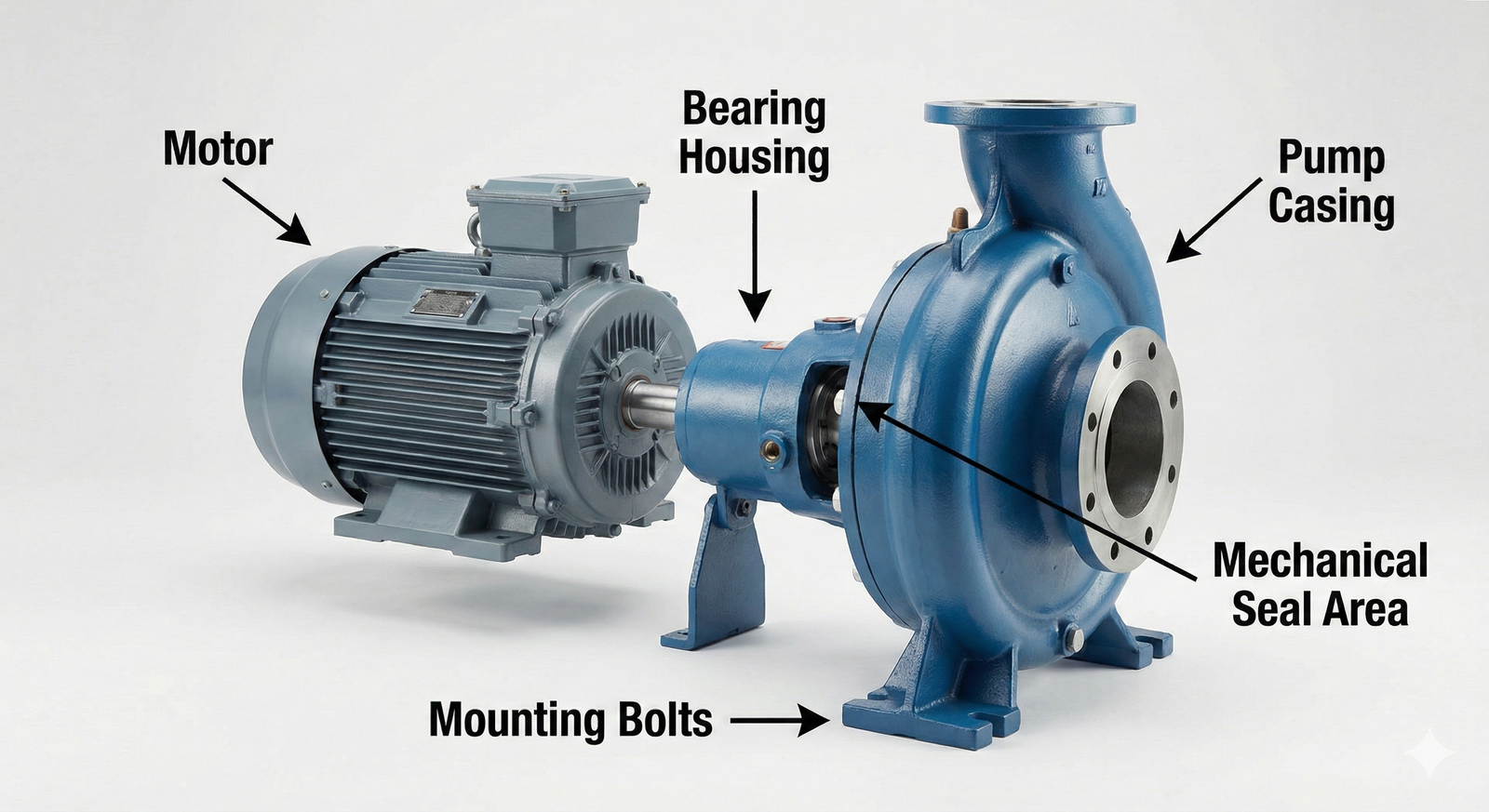
First, thoroughly review the Asset Information Sheet for the P-101 pump. Pay close attention to its function, operating schedule, and maintenance history. The notes on past failures (bearing vibration, seal leaks) are critical clues for what to prioritize in your preventive maintenance plan.
Preventive Maintenance (PM)
Step 2: Create a Comprehensive Task List
Based on your analysis, compile a list of all maintenance tasks. Combine the manufacturer's recommendations with actions that address the specific issues noted in the maintenance history.
Your list should include tasks like: * Visual inspection for leaks * Check for unusual noise/vibration * Check bearing lubrication * Verify mounting bolt tightness * Monthly vibration analysis
Step 3: Assign Frequencies and Resources
For each task, determine how often it should be performed within the one-month timeframe. Use the terms Daily, Weekly, or Monthly. Then, assign the appropriate craft (personnel) and estimate the time required. Be practical. A visual check takes minutes, while a vibration analysis takes longer.
- Task: Visual inspection for leaks
- Frequency: Daily
- Craft: Operator
-
Est. Time: 0.25 hours
-
Task: Monthly vibration analysis
- Frequency: Monthly
- Craft: Reliability Technician
- Est. Time: 1.5 hours
Setting Task Frequencies
Start with the manufacturer's recommendations as your baseline. Increase the frequency for tasks related to known failure modes. For example, since the P-101 had a seal leak, a weekly or even daily visual inspection is justified.
Step 4: Incorporate Spares Management
Review your task list and the Spare Parts Inventory. Identify which tasks might require a spare part to be available. For example, a task to "Replace mechanical seal if leaking" would require the "Mechanical Seal Kit" to be listed. While you may not use the part every time, planning for its availability is a key part of Spares Management
Step 5: Assemble the Final Plan
Organize all the information into a clear, easy-to-read table. This table is your final maintenance plan. Use markdown to create a table with the following columns: Task Description, Frequency, Craft, Estimated Time (Hours), and Required Spares. This structured format makes the plan actionable for the maintenance team.
📊 View Diagram: Maintenance Plan Creation Workflow
An Expert Response
About This Response
This is a sample of a high-quality response. Your plan might differ in some details, such as time estimates, and still be excellent. The key is to provide a logical, well-justified plan based on the provided data.
One-Month Preventive Maintenance Plan: P-101 Water Pump
| Task Description | Frequency | Craft | Estimated Time (Hours) | Required Spares (If Needed) |
|---|---|---|---|---|
| Visually inspect for leaks at pump casing and connections. | Daily | Operator | 0.25 | Mechanical Seal Kit |
| Listen for unusual noise or vibration. | Daily | Operator | 0.25 | N/A |
| Check bearing housing lubrication level. | Weekly | Mechanic | 0.5 | N/A |
| Clean debris from pump and motor exterior. | Weekly | Mechanic | 0.5 | N/A |
| Perform vibration analysis on motor and pump bearings. | Monthly | Reliability Technician | 1.5 | Bearing Assembly |
| Verify tightness of pump and motor mounting bolts. | Monthly | Mechanic | 1.0 | N/A |
Justification Notes:
- Daily Checks: These are quick inspections performed by on-site operators to catch incipient issues like leaks or major changes in vibration, which are critical for a 24/7 operating asset.
- Weekly Checks: Lubrication and cleaning are fundamental PM tasks. A weekly frequency is appropriate given the continuous operation.
- Monthly Checks: The vibration analysis directly addresses the historical bearing failure. The bolt tightness check is a best practice to prevent misalignment. Spares are listed as "If Needed" to ensure the technician has them on hand if the inspection reveals a problem that can be addressed immediately.
Assess Yourself
Evaluate Your Work
Use the following criteria to assess the quality and completeness of your maintenance plan. Compare your work against the expert response to identify areas for improvement.
- Completeness of Task List: Your plan should include tasks derived from both the manufacturer's recommendations and the asset's specific maintenance history.
- Logical Frequencies: The frequency assigned to each task should be justifiable based on the asset's criticality, operating schedule, and known failure modes.
- Appropriate Resource Allocation: Your plan should assign a suitable craft (e.g., Operator, Mechanic, Technician) and a realistic time estimate for each task.
- Effective Spares Integration: Your plan must correctly identify which maintenance tasks may require specific spare parts and list them accordingly.
- Clarity and Organization: The final plan should be presented in a clear, structured format that is easy for a maintenance team to understand and execute.
Learning Progress
In this activity, you have practiced a fundamental asset management skill. You have demonstrated the ability to create a basic maintenance plan for a critical asset by developing task lists, allocating appropriate resources, and incorporating spares management into your planning.
Next Steps
You have successfully completed this skill-building exercise. This foundational knowledge is essential for managing physical assets effectively. Please navigate back to the course to continue your learning journey.
