
Keeping the World Running: An Introduction to Asset Operations and Maintenance
Welcome to Module 3. So far in this course, we've focused on the early stages of the asset lifecycle—planning, acquisition, and creation. Now, we shift our attention to what is often the longest and most challenging phase: operating and maintaining those assets.
Think about the vast network of pumps, pipes, and filters that make up a municipal water system. When you turn on your tap, you expect clean water to flow. That simple expectation is the result of a complex, continuous effort in operations and maintenance. A single pump failure isn't just a mechanical problem; it's a potential public health issue, a financial drain, and a breach of public trust. This is where asset management proves its value day in and day out.
In this module, we'll move from the theoretical to the practical. You'll learn how to keep assets running effectively, efficiently, and safely throughout their intended life. We will explore the strategies for maintaining them, the methods for planning that work, and the metrics used to measure success.
The Maintenance Strategy Playbook
Not all maintenance is created equal. You wouldn't maintain a critical hospital generator the same way you'd maintain a park bench. The approach you take is a strategic decision with significant consequences for cost, risk, and performance. This is the core of developing a maintenance strategy.
The goal is to apply the right type of maintenance to the right asset at the right time. Do you wait for something to break? Do you service it on a fixed schedule? Or do you use advanced technology to predict a failure before it happens? Each path has its place.
This next reading is foundational for the entire module. It will introduce you to the main types of maintenance strategies. As you read, focus on understanding the key differences between them and think about a real-world asset you're familiar with—like a car or a home appliance—and consider which strategy would be most appropriate for it.
Reading: The Pillars of Modern Maintenance Strategy
Launch the reading to explore a key course topic.
From Strategy to Action: Planning and Scheduling
Having a great strategy is one thing; executing it is another. This is where maintenance planning and scheduling. It’s the discipline of turning your strategic goals into concrete actions—assigning the right people with the right parts and the right tools to the right job at the right time.
Without effective planning, even the best strategy devolves into chaos. Technicians arrive without the necessary spare parts, critical assets are taken offline during peak demand, and costs spiral out of control. Good planning is the bridge between your maintenance philosophy and the work that happens on the ground.
Now you're going to build that bridge yourself. The following skills activity will guide you through the process of creating a basic maintenance plan. This is a hands-on exercise, so roll up your sleeves. Pay close attention to how the components—the task list, the resources, and the schedule—all fit together.
Skills Practice: Creating a Basic Maintenance Plan
Launch the interactive skills practice to build and apply your new abilities.
Measuring What Matters: Asset Performance and KPIs
How do you know if your maintenance plan is working? You measure it. In asset management, we live by the principle that "what gets measured, gets managed." Evaluating asset performance is not about collecting data for its own sake; it's about generating insights that lead to better decisions.
We use Key Performance Indicators (KPIs) to translate complex operations into a clear, concise scorecard. Metrics like availability, reliability, and Mean Time Between Failures (MTBF) tell a story about the health of your assets and the effectiveness of your maintenance program.
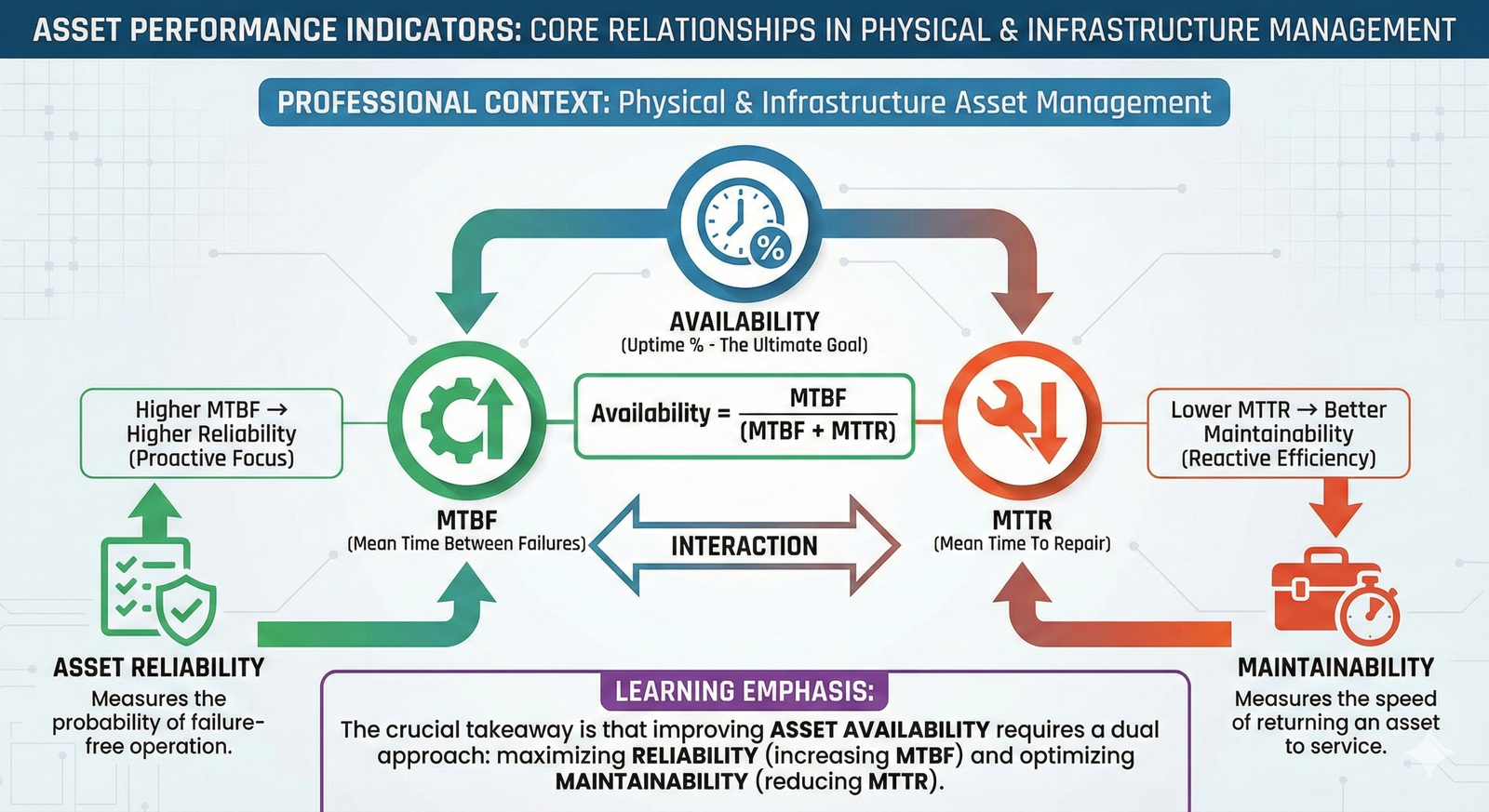
Understanding these metrics is just the beginning. The real skill lies in analyzing the data to spot trends, diagnose underlying problems, and uncover opportunities for improvement.
This next reading goes deeper into the analytical side of asset performance. You'll learn about powerful frameworks like Overall Equipment Effectiveness (OEE) and Root Cause Analysis (RCA). These are tools that professionals use every day to solve complex operational problems.
Reading: Beyond the Dashboard: Analyzing Asset Performance with OEE and RCA
Launch the reading to explore a key course topic.
The Pursuit of Perfection: Optimization and Continuous Improvement
The final piece of the puzzle is optimization. It’s not enough to just maintain assets; we must constantly seek ways to make them run better, last longer, and cost less over their lifecycle. This is the essence of asset optimization.
Optimization is a continuous cycle. You use performance data to identify a weakness—perhaps high energy consumption or frequent minor stoppages. You then adjust your strategy, implement the change, and measure the results. This cycle of measure-analyze-improve is the engine of continuous improvement in asset management.
It's time to put everything you've learned in this module together. The following case study presents a realistic scenario from a municipal water utility. You'll be given performance data and asked to act as the asset manager. Your task is to analyze the situation and propose an optimized strategy. This is your chance to think like a professional and apply your new knowledge to a real-world problem.
Case Study: Optimizing Pumping Station Operations
Launch the interactive case study to analyze a real-world scenario.
Assess Yourself
Let's take a moment to check your understanding of the key concepts from this module. This short quiz is for your practice only. Use it to see which topics you've mastered and which ones might need another look.
❓ Knowledge Check
Test your understanding of the key concepts from this section.
Wrapping Up
Excellent work completing this module on Asset Operations and Maintenance. You've covered a lot of ground, moving from high-level strategy to hands-on application. You should now be comfortable developing and implementing maintenance strategies by differentiating between the various approaches available. You've also gained the skills to evaluate asset performance using key metrics and apply optimization techniques to drive continuous improvement. These are critical competencies for any asset management professional.
Next Steps
You have successfully completed Module 3. Please return to the course homepage to continue your journey through the asset lifecycle.