
Measuring What Matters: From Cost Center to Value Driver
Welcome to Module 3. In our previous modules, we established the strategic foundations of asset management. Now, we turn to a critical question that every senior leader will ask: "How do we know if our asset management program is actually working?"
Answering this question is what separates a reactive maintenance department from a strategic, value-generating asset management function. It's the difference between sailing blind and navigating with a full suite of instruments. Without performance measurement, you're just spending money. With it, you're making informed investments.
In this module, we'll build your competency in evaluating asset management performance. You'll learn the language of performance, master the tools to measure it, and understand how to use that data to drive continuous improvement.
The Language of Performance: KPIs
To start, we need a common language. The foundation of that language is the Metric. While we can measure thousands of things, not all metrics are created equal. The most important ones are your Key Performance Indicators (KPIs). A good KPI is directly linked to a strategic goal.
A crucial distinction in performance measurement is between Leading vs. Lagging Indicators. Think of it like your health. A lagging indicator is the diagnosis of a heart condition; it tells you what has already happened. A leading indicator is your cholesterol level or blood pressure; it gives you a chance to act before the major event occurs. In asset management, we need both to understand our past and shape our future.
This distinction between leading and lagging indicators is a concept you'll see again and again in your career. As you go through the next reading, take a moment to think of one leading and one lagging indicator for an asset you're familiar with, like your car or a piece of equipment at work.
To go deeper on this topic, your first reading explores how to move from simple metrics to truly strategic KPIs.
Reading: Designing Meaningful KPIs for Physical Assets
Launch the reading to explore a key course topic.
Now that you have a solid conceptual understanding of KPIs, it's time to practice creating them. The following skills activity will guide you through the process of developing relevant KPIs for a given scenario. This is a core skill for any asset manager.
Skills Practice: Developing Key Performance Indicators (KPIs) for Asset Management
Launch the interactive skills practice to build and apply your new abilities.
Common Metrics and Frameworks
While KPIs are often unique to an organization's strategy, the asset management profession relies on several standardized metrics to measure asset-level performance. Three of the most common, especially in manufacturing and production environments, are:
- Overall Equipment Effectiveness (OEE)
- Mean Time Between Failures (MTBF)
- Mean Time To Repair (MTTR)
OEE, in particular, is a powerful indicator because it combines three different aspects of performance into a single number.
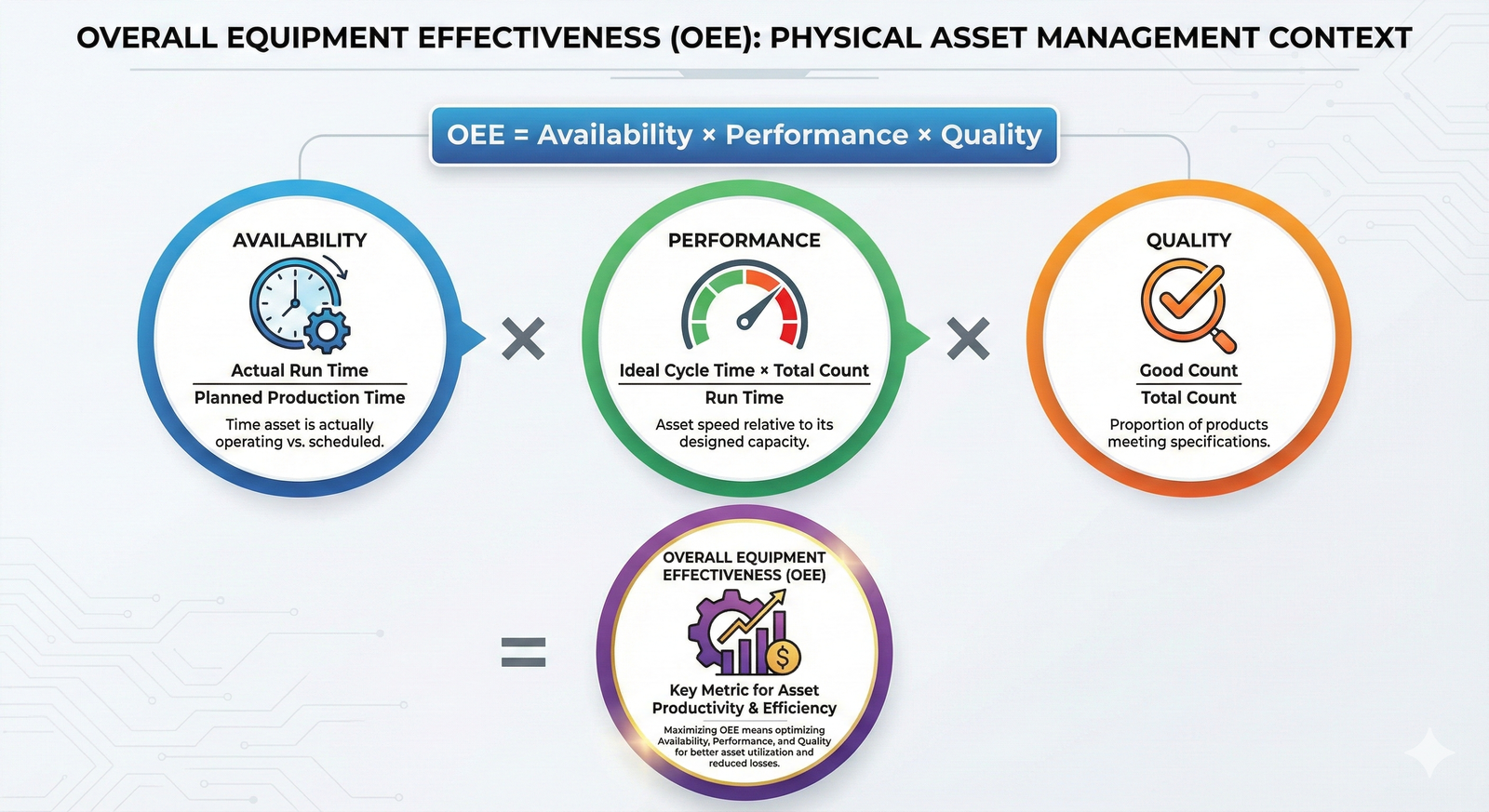
These individual metrics are powerful, but they gain even more meaning when placed within a larger strategic framework. One of the most influential is the Balanced Scorecard. This framework forces us to ask not just "How are our assets performing?" but also "How does that performance impact our customers, our finances, and our ability to innovate?"
Creating Context: Benchmarking and Gap Analysis
A KPI might tell you that your MTBF is 2,000 hours. Is that good or bad? On its own, the number is meaningless. To understand it, you need context. This is where Benchmarking comes in. By comparing your performance to others, you establish a Baseline and can set a realistic Target for improvement.
Benchmarking is a powerful tool, but it's also full of potential pitfalls, like comparing apples to oranges or using unreliable data. The next reading will give you a practitioner's view on how to do it right.
Reading: The Art and Science of Asset Performance Benchmarking
Launch the reading to explore a key course topic.
Once you have a benchmark, you can identify where your performance falls short. This process is known as Performance Gap Analysis. It's the formal process of asking: "Where are we, where do we want to be, and how do we close the gap?"
It's time to put these concepts together. The following case study will place you in the role of an asset manager for a municipal water utility. You'll be given performance data and asked to apply benchmarking and gap analysis techniques to evaluate the utility's performance and recommend improvements. This is a great opportunity to practice the core competency of this module.
Case Study: Performance Gap Analysis at a Municipal Water Utility
Launch the interactive case study to analyze a real-world scenario.
Closing the Loop: Reporting and Improvement
Collecting data and analyzing gaps is useless if it doesn't lead to action. The final steps in the performance management cycle are effective Performance Reporting and a commitment to Continuous Improvement.
This creates a virtuous cycle: you measure your performance, identify gaps, take action to close them, and then measure again to see if your actions worked. This is the engine of a mature, learning-focused asset management organization.
📊 View Diagram: The Continuous Improvement Cycle (PDCA)
By mastering the concepts in this module, you are equipping yourself to not only manage assets, but to demonstrate and improve their value to the entire organization.
Assess Yourself
Time for a quick knowledge check. This ungraded quiz will help you confirm your understanding of the key concepts and vocabulary from this module before you move on. Use it to identify any areas you might want to review.
❓ Knowledge Check
Test your understanding of the key concepts from this section.
Wrapping Up
Congratulations on completing this module on Asset Management Performance! You've done some excellent work building a critical competency for any asset management professional: the ability to evaluate asset management performance using appropriate metrics and frameworks. You've learned how to develop KPIs, apply benchmarking, and conduct a gap analysis—skills that allow you to translate data into strategic action. This is how you prove the value of your work and drive your organization forward.
Next Steps
You have now completed all the learning activities for Module 3.
Please return to the course homepage to review the module assessment requirements and continue your progress through the course.
